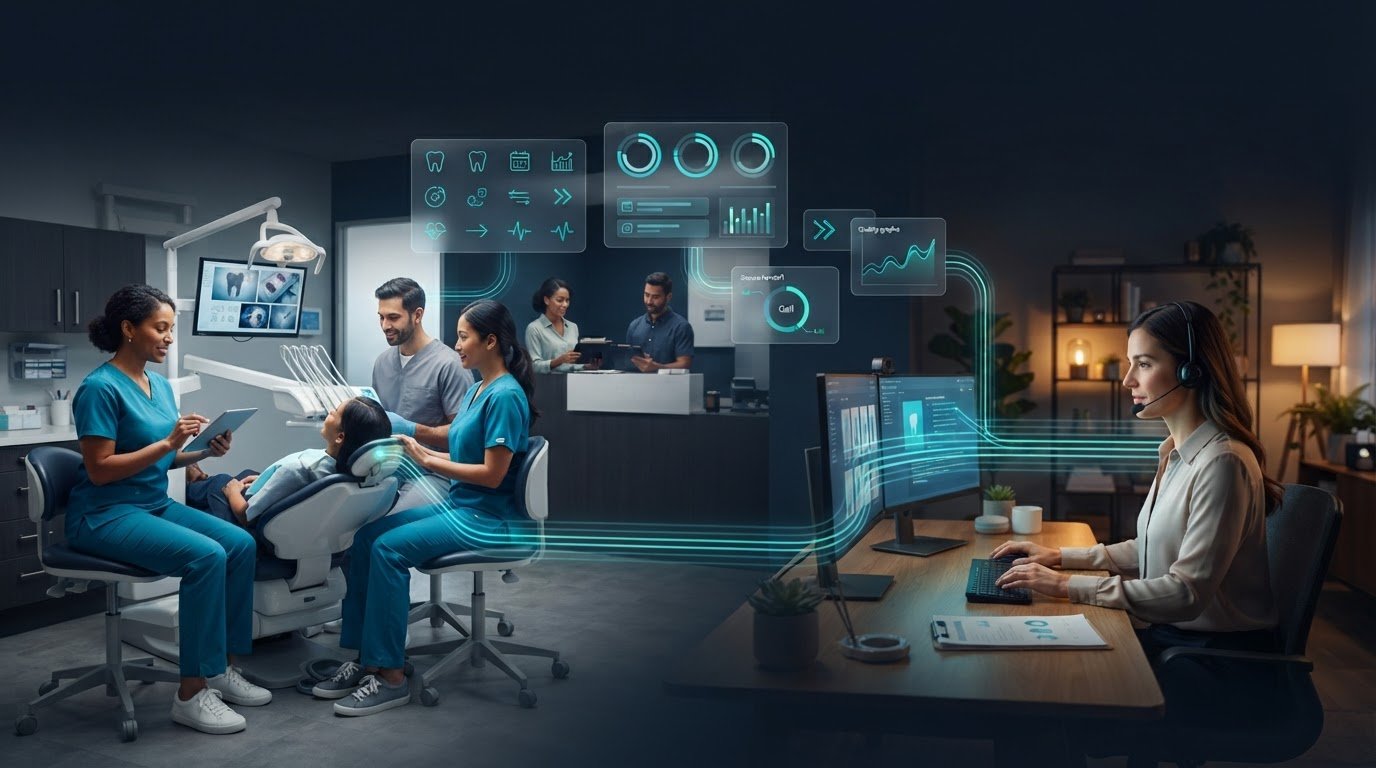
Thirty-five percent of your incoming calls are currently hitting a dead end. In 2026, the average first-year revenue for a new dental patient has reached $653, making it more critical than ever to prevent missed calls in your dental office. Every time your phone rings and goes unanswered, you aren't just missing a conversation. You're effectively handing your competitors a check for hundreds of dollars while your front desk team struggles under the weight of high turnover and chaotic lobby noise.
It's a structural flaw, not a staffing failure. You likely feel the daily pressure of trying to balance clinical care with the relentless demand of the phone lines. We understand that a disorganized front office leads to burnout and lost production. This guide reveals five human-centric strategies designed to plug your revenue leaks for good. You'll discover how to transition from a reactive environment to a high-performance operating system that captures every lead. We will cover everything from intelligent scheduling to specialized remote support, ensuring your office maintains a 100% answer rate during and after business hours.
Key Takeaways
- Quantify the financial impact. Every missed new patient call represents a $653 revenue leak in 2026.
- Master a hybrid staffing model that combines your in-office team with specialized remote support to prevent missed calls in your dental office.
- Move beyond the "voicemail graveyard" and impersonal AI bots by implementing human-centric systems that ensure every caller reaches a real expert.
- Identify and eliminate hidden abandonment patterns through a comprehensive call volume audit that brings order to front office chaos.
- Transform your practice operations by integrating trained dental agents who handle complex administrative tasks like insurance verification and scheduling.
The True Cost of Silence: Why Every Missed Call is a Lost Patient
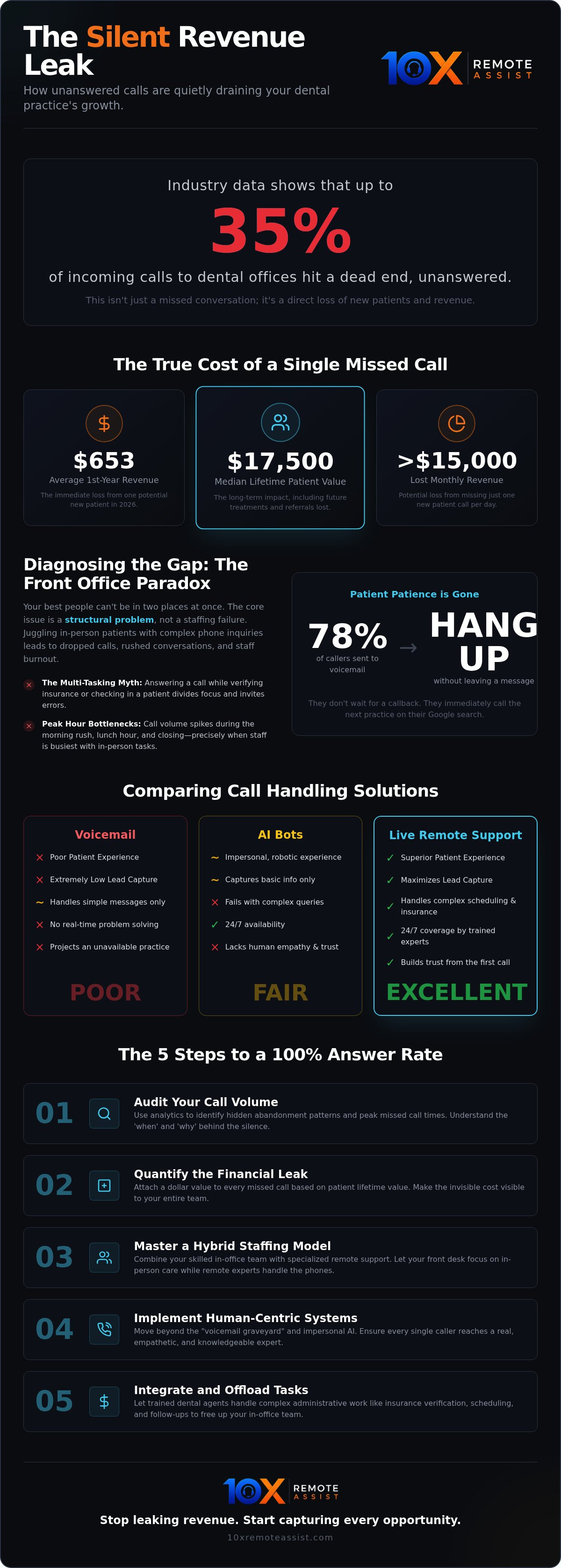
Silence is the most expensive sound in your practice. When the phone rings and nobody answers, the "Missed Call Revenue Leak" begins to drain your monthly production. This isn't just a minor administrative hiccup; it's a structural barrier to scaling your business. In 2026, the first-year revenue from a single new patient averages $653. If you miss just one new patient call per day, you are effectively burning over $15,000 in monthly potential revenue. Beyond the immediate financial loss, there is a deep psychological impact. Patients equate phone responsiveness with clinical quality. If you can't answer a call, they assume you can't manage their care. This leads to "Total Practice Silence," a state of operational paralysis that usually occurs during the noon lunch block or the 8:00 AM morning rush.
Calculating Your Practice's Revenue Leak
Every missed call represents a potential loss of $17,500, calculated as the median lifetime value of a dental patient in 2026. To understand the scale of this issue, you must look beyond basic call logs. Modern VoIP analytics provide a granular view of your abandonment rates, revealing exactly when patients hang up. The damage compounds quickly because a missed call doesn't just lose one patient; it halts the entire referral engine. Patients who receive poor initial service rarely recommend that practice to friends or family. By failing to prevent missed calls in your dental office, you are losing the initial $653 and the subsequent $25,000 in lifetime value that comes from a loyal, referring patient.
The 'First Impression' Window
The digital age has eliminated patient patience. Research shows that 78% of callers sent to voicemail will simply hang up without leaving a message. They don't wait for a callback; they move to the next name on their Google search results. This competitive reality means your front desk is in a constant race against the "back" button on a smartphone. Establishing an immediate human connection is the core of effective customer service principles within a clinical setting. It builds trust before the patient ever sits in the chair. When a real person answers the phone with confidence and empathy, the search ends. The patient feels seen, heard, and scheduled. Without this human-centric touch, you aren't just missing calls; you're losing the trust required to build a sustainable practice.
Diagnosing the Gap: Why Your Front Desk Can’t Catch Every Call
Most dental practices believe they have a staffing problem. In reality, they have a structural one. The "Front Office Paradox" is a physical reality where your receptionist cannot check in a patient while simultaneously providing a high-level new patient consultation over the phone. One interaction always suffers. Usually, it's the caller who gets sent to voicemail. This is the primary reason why practices fail to prevent missed calls in your dental office. Administrative tasks like insurance verification and claim follow-ups require deep, uninterrupted focus. When the phone rings during these complex workflows, the cognitive load spikes. This leads to errors, burnout, and ultimately, high staff turnover that resets your office's operational progress every six months.
The Multi-Tasking Myth in Dental Administration
Answering the phone is never just a single task. It involves navigating practice management software, verifying insurance benefits, and mastering patient communication safety strategies to ensure clinical and legal accuracy. The distraction cost is high. Every time a team member switches from a billing task to a phone call, they lose momentum. This cycle of distraction fuels front-desk burnout. When your team is overwhelmed, call-handling quality drops. They begin to rush through conversations just to get to the next task. This environment creates a "revolving door" of staff where knowledge gaps are never fully closed, leaving your practice vulnerable to lost leads and scheduling errors.
Structural Barriers to 100% Connectivity
Peak call volume rarely aligns with peak staffing levels. The "Morning Rush" and "Evening Close" create natural bottlenecks where phone lines are neglected in favor of patient check-ins and financial settlements. Lunch hour blackouts are even more damaging to your growth. Research shows that 45% of calls to dental practices occur outside standard 9-to-5 business hours or during the noon break. This is exactly when new patients are most likely to call because it's their only free time. Relying on traditional temp agencies to fill these gaps is a temporary bandage. These generalists lack the specialized dental knowledge required to handle treatment coordination or complex scheduling. You don't need more general bodies; you need a strategic dental partner that functions as an extension of your existing culture, ensuring order remains even during the most chaotic hours of the day.
Comparing Solutions: Voicemail, AI Bots, and Live Remote Support
Silence is expensive. Many practices try to automate their way out of the missed call crisis. They install complex phone trees or generic AI receptionists. These systems often create more friction than they solve. To truly prevent missed calls in your dental office, you must understand the difference between answering a call and managing a patient relationship. Voicemail is where leads go to die. As established, 78% of callers who reach a recording will hang up. In 2026, patients expect immediate gratification. A recording is a signal that your practice is too busy to care. It's a "Voicemail Graveyard" that buries your growth potential.
Why Your Patients Hate AI Voices
Speed doesn't equal trust. Patients calling about an emergency or a complex implant case don't want an algorithm. They want empathy. Automated voices feel impersonal and untrustworthy in a healthcare context. AI struggles with nuance. It can't navigate the intricacies of dual-insurance verification or the emotional hesitation of a phobic patient. These tools fail to meet patient contact management best practices because they prioritize technical efficiency over human connection. 10X Remote Assist rejects this impersonal approach. We prioritize the "Human Touch" by deploying real agents who understand dental terminology and your specific practice culture.
The Overhead Comparison: In-House vs. Remote Staffing
Hiring in-house is an expensive gamble. You aren't just paying an hourly wage. You're paying for payroll taxes, health benefits, and physical desk space. The hidden cost of turnover is the real production killer. It takes months to fully train a new hire on your Practice Management System. If they leave in six months, you lose thousands of dollars in recruitment and lost productivity. Remote staffing offers a variable cost model. It adapts to your practice's fluctuating call volume without the fixed overhead of a full-time employee. By 2026, the "Remote Front Office" has become the industry standard for high-performance practices that value scalability and precision over traditional, high-turnover staffing models.
5 Strategic Steps to Eliminate Unanswered Phones Today
Eliminating the dial tone is a matter of system design, not just effort. To prevent missed calls in your dental office, you must replace hope with a structured operating system. This transition begins with a rigorous audit of your current call volume. By identifying specific abandonment patterns, you can pinpoint exactly when your practice is bleeding revenue. Is it during the morning huddle? Or perhaps during the late-afternoon insurance verification crunch? Once you see the data, you can deploy targeted solutions instead of generic staffing fixes.
- Step 1: Audit and Analyze. Use your VoIP analytics to find the "dead zones" in your schedule where calls consistently go to voicemail.
- Step 2: Deploy Hybrid Staffing. Balance your in-office team with remote support during peak hours, lunch breaks, and administrative surges.
- Step 3: Centralize Complex Tasks. Move insurance verification and treatment follow-ups to a dedicated remote team to keep your in-office staff present for patients in the lobby.
- Step 4: Implement Quality Scoring. Use AI-driven tools to score every interaction, ensuring clinical standards and conversion techniques are met on every call.
- Step 5: Deep PMS Integration. Ensure your remote agents work directly inside your Practice Management System for real-time scheduling and data accuracy.
Step-by-Step Implementation of a Fail-Safe Phone System
A fail-safe system requires a "rollover" logic that never gives up. If your in-office team doesn't answer within two rings, the call should automatically route to a specialized dental agent. This ensures that no patient ever hears a busy signal or a voicemail recording. Training is the next pillar. Your remote partners must be fluent in your specific protocols, from how you handle emergency walk-ins to your preferred tone of voice. The perfect call flow for a new patient inquiry is a precise, empathetic navigation that moves from identifying the patient's pain point to securing a firm appointment time without hesitation. Schedule a consultation to see how this system can be tailored to your practice.
Leveraging Technology for Accountability
Transparency is the antidote to administrative chaos. Call recording is not just for security; it is a vital tool for improving patient communication. By reviewing recorded calls, you can identify coaching opportunities and refine your scripts. Data also reveals the best windows for patient reactivation and follow-up calls, turning your phone lines into a proactive growth engine. 10X Remote Assist utilizes a proprietary operating system that tracks real-time performance, providing you with total visibility into your practice’s connectivity and conversion rates. This level of intelligence ensures that every agent operates as a high-performance extension of your internal culture.
Seamless Integration: How 10X Remote Assist Becomes Your Front Office Extension
Integration is not an interruption; it's an evolution. Our onboarding process is designed to absorb your practice's unique DNA, from your preferred scheduling blocks to your specific insurance protocols. We don't just provide a service. We provide a high-performance operating system that functions as a natural extension of your team. This deep integration is the final step to prevent missed calls in your dental office while maintaining the human touch your patients expect. Every 10X agent undergoes specialized training focused exclusively on dental administrative tasks. They aren't general virtual assistants. They are dental experts who understand clinical terminology and the nuances of patient psychology.
Visibility creates security. Our proprietary operating system provides owners with total transparency through AI-driven quality scoring. Every call is recorded and analyzed to ensure professional standards are met. You no longer have to wonder if your leads are being handled correctly. You can see the data in real-time. This level of accountability ensures that your remote team operates with the same rigor as your in-office staff, allowing you to focus on clinical excellence without administrative worry.
Beyond Answering: A Full-Service Administrative Solution
Your practice needs more than a receptionist. It needs a strategic partner. Our agents handle complex insurance breakdowns and relentless claim status follow-ups that typically bog down your front desk. By centralizing these tasks, we free your in-office team to focus on the patients physically in your lobby. Proactive scheduling is another core capability. We don't just wait for the phone to ring. We actively manage your hygiene chair utilization, reaching out to unscheduled patients to keep your production levels high. We are strategic extensions of your culture, not just call center workers.
The Future of Dental Staffing
The 2026 dental staffing crisis has made traditional hiring models obsolete. High turnover and rising wages have created a fragile environment for practice owners. 10X Remote Assist offers a resilient alternative. We build a structural foundation that isn't dependent on a single front-desk person. If an in-office team member leaves, your phone lines and insurance workflows remain uninterrupted. This operational security is the key to sustainable growth. It's time to stop reacting to staffing gaps and start building a high-performance practice. Scale your practice with 10X Remote Assist today and ensure no patient ever hears a dial tone again.
Transforming Your Phone Lines into a High-Performance Growth Engine
Operational excellence in 2026 requires a departure from traditional, high-turnover staffing models. You've seen how silence on the phone lines directly translates to lost production and patient dissatisfaction. By auditing your call patterns and implementing a hybrid staffing structure, you can finally prevent missed calls in your dental office without overwhelming your local team. It's about building a resilient foundation where every patient interaction is handled with clinical precision and genuine empathy.
Success lies in the integration of specialized expertise. 10X Remote Assist provides 100% human-based specialized dental agents who function as a seamless extension of your practice culture. Our AI-driven call quality scoring offers total transparency; meanwhile, our systems integrate directly with Dentrix, Open Dental, and EagleSoft. You don't have to choose between a quiet lobby and a full schedule. You can have both. Book a free discovery call to stop your practice's revenue leak and take control of your administrative future. Your patients, your team, and your bottom line will thank you for the clarity.
Frequently Asked Questions
How do I know if my dental office is actually missing calls?
You can identify missed opportunities by reviewing your VoIP analytics and call abandonment reports. Most practice management systems don't track the calls that never reach your staff, so a dedicated tracking system is essential. In 2026, the average practice misses about 35% of incoming calls. If your team is checking in patients during peak hours, you're likely losing new patient leads to voicemail right now. Data transparency is the first step toward recovery.
Will my patients know they are talking to someone outside of the office?
No, your patients will experience a seamless transition that feels like a natural extension of your internal team. Our agents are trained in your specific practice DNA, protocols, and tone of voice. Because they have real-time access to your software, they can answer questions about appointment times or insurance with the same authority as your in-office receptionist. This human-centric approach ensures no patient feels like they've been routed to a third party.
How does a remote dental assistant access our scheduling software?
Our agents utilize secure, HIPAA-compliant integrations to work directly within your existing Practice Management System, such as Dentrix, Open Dental, or EagleSoft. This isn't a separate spreadsheet; it's a living connection to your actual schedule. This allows our team to book appointments, update patient records, and verify insurance benefits in real-time. This level of integration is the most effective way to prevent missed calls in your dental office while maintaining data integrity.
What happens if a patient has a clinical question the remote agent can't answer?
Remote agents are trained to handle administrative triage and will follow your specific protocols for clinical inquiries. If a patient asks a question that requires a doctor's or hygienist's expertise, the agent will perform a warm hand-off to your in-office clinical team or schedule a dedicated time for a callback. This ensures that clinical safety is prioritized while administrative tasks remain moving, preventing bottlenecks at the front desk and maintaining a professional flow.
Is a remote dental call center HIPAA compliant?
Yes, 10X Remote Assist maintains rigorous HIPAA compliance through mandatory multi-factor authentication, encryption at rest, and biannual vulnerability scans. We sign a Business Associate Agreement with every practice to ensure legal and operational security. In 2026, data protection is more than a checkbox; it is a core component of our high-performance operating system. Your patient data remains protected while our human agents manage your daily administrative workflows with total accountability.
How long does it take to integrate a remote team into my dental practice?
The integration process is methodical and typically takes between two to four weeks depending on the complexity of your current systems. During this onboarding phase, we learn your practice's unique DNA and configure the technical rollover lines. We prioritize a problem-solved certainty, ensuring that our agents are fully prepared to handle your specific scheduling nuances before the first call ever routes to our remote team. This ensures a seamless transition for your staff.
Can remote agents handle dental insurance verification and billing?
Yes, our agents specialize in high-volume administrative tasks including insurance verification, claim status follow-ups, and billing support. They provide detailed insurance breakdowns and ensure that all patient benefits are verified before the appointment begins. This specialized focus allows your in-office staff to concentrate on the patients in the chair. By centralizing these complex tasks, you effectively prevent missed calls in your dental office by removing the administrative burden from your front desk.
What is the cost difference between an in-house receptionist and a remote team?
Remote support provides a strategic financial advantage by replacing fixed overhead with a scalable, results-oriented model. While an in-house receptionist requires payroll taxes, health benefits, and physical desk space, a remote team eliminates these hidden costs. You also avoid the high price of turnover, which can cost a practice thousands in lost productivity and recruitment fees. It's a more efficient way to secure 100% call coverage without the traditional staffing headaches or overhead.
Frequently Asked Questions
You can identify missed opportunities by reviewing your VoIP analytics and call abandonment reports. Most practice management systems don't track the calls that never reach your staff, so a dedicated tracking system is essential. In 2026, the average practice misses about 35% of incoming calls. If your team is checking in patients during peak hours, you're likely losing new patient leads to voicemail right now. Data transparency is the first step toward recovery.
No, your patients will experience a seamless transition that feels like a natural extension of your internal team. Our agents are trained in your specific practice DNA, protocols, and tone of voice. Because they have real-time access to your software, they can answer questions about appointment times or insurance with the same authority as your in-office receptionist. This human-centric approach ensures no patient feels like they've been routed to a third party.
Our agents utilize secure, HIPAA-compliant integrations to work directly within your existing Practice Management System, such as Dentrix, Open Dental, or EagleSoft. This isn't a separate spreadsheet; it's a living connection to your actual schedule. This allows our team to book appointments, update patient records, and verify insurance benefits in real-time. This level of integration is the most effective way to prevent missed calls in your dental office while maintaining data integrity.
Remote agents are trained to handle administrative triage and will follow your specific protocols for clinical inquiries. If a patient asks a question that requires a doctor's or hygienist's expertise, the agent will perform a warm hand-off to your in-office clinical team or schedule a dedicated time for a callback. This ensures that clinical safety is prioritized while administrative tasks remain moving, preventing bottlenecks at the front desk and maintaining a professional flow.
Yes, 10X Remote Assist maintains rigorous HIPAA compliance through mandatory multi-factor authentication, encryption at rest, and biannual vulnerability scans. We sign a Business Associate Agreement with every practice to ensure legal and operational security. In 2026, data protection is more than a checkbox; it is a core component of our high-performance operating system. Your patient data remains protected while our human agents manage your daily administrative workflows with total accountability.
The integration process is methodical and typically takes between two to four weeks depending on the complexity of your current systems. During this onboarding phase, we learn your practice's unique DNA and configure the technical rollover lines. We prioritize a problem-solved certainty, ensuring that our agents are fully prepared to handle your specific scheduling nuances before the first call ever routes to our remote team. This ensures a seamless transition for your staff.
Yes, our agents specialize in high-volume administrative tasks including insurance verification, claim status follow-ups, and billing support. They provide detailed insurance breakdowns and ensure that all patient benefits are verified before the appointment begins. This specialized focus allows your in-office staff to concentrate on the patients in the chair. By centralizing these complex tasks, you effectively prevent missed calls in your dental office by removing the administrative burden from your front desk.
Remote support provides a strategic financial advantage by replacing fixed overhead with a scalable, results-oriented model. While an in-house receptionist requires payroll taxes, health benefits, and physical desk space, a remote team eliminates these hidden costs. You also avoid the high price of turnover, which can cost a practice thousands in lost productivity and recruitment fees. It's a more efficient way to secure 100% call coverage without the traditional staffing headaches or overhead.
Build the remote team that runs this for you
We recruit, train and manage a dedicated remote team member for your practice.