
What if front-office burnout is less about individual resilience and more about a workflow that asks one person to do too many things at once? A ringing phone, a patient waiting to check in, a schedule change, and an insurance follow-up can all compete for attention. It’s understandable that staff feel stretched. Effective dental front office burnout solutions start by examining the work, not blaming the people managing it.
This guide explains how to spot recurring sources of strain and prioritize practical changes without disrupting patient care. You’ll learn how clear task ownership, fewer avoidable interruptions, and reliable follow-up processes can make the day easier to manage. We’ll also consider where technology may help, where it may add friction, and when trained human support for calls, scheduling, insurance verification, or follow-up may be worth evaluating. The aim is to give staff more room to focus and patients a more consistent experience, without adding unnecessary complexity.
Key Takeaways
- Look for recurring work patterns that may signal front-office strain without treating a demanding day as a diagnosis.
- Consider how changing patient expectations and digital systems can reshape administrative workload.
- Compare dental front office burnout solutions by the tasks they relieve, the effort they require, and their potential effect on patient experience.
- Use a focused workflow audit to identify bottlenecks, gather staff input, and test one practical change.
- Evaluate whether remote human support could redistribute recurring administrative tasks, while accounting for onboarding, coordination, oversight, and data access.
Dental Front Office Burnout: What It Looks Like and Why It Matters
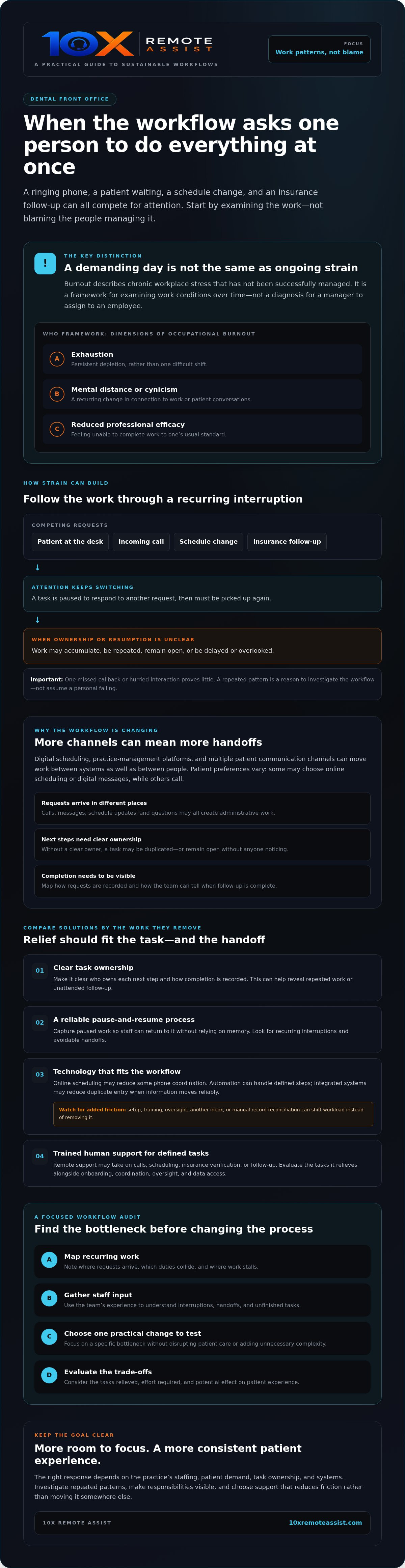
A packed schedule can make any day demanding. Burnout is a different concern: it points to ongoing strain, not just one difficult shift or a temporary rush. The World Health Organization describes occupational burnout as an effect of chronic workplace stress that hasn’t been successfully managed, with dimensions including exhaustion, increased mental distance or cynicism toward work, and reduced professional efficacy. Occupational burnout is not a diagnosis for a manager to assign to an employee. It can, however, provide a useful framework for examining work conditions and patterns over time.
How burnout can show up at a dental front desk
Look for recurring operational signals, not reasons to label a person. A team member may seem persistently depleted, disengage from patient conversations, or feel unable to complete work to their usual standard. One missed callback or hurried interaction proves little. A repeated pattern deserves attention.
For example, an employee starts confirming an appointment, pauses to answer a ringing phone, then returns to a patient at the desk while an insurance follow-up remains open. If this sequence repeats throughout the day, unfinished tasks can accumulate and interactions may become less consistent. That pattern points to a workload or interruption problem to investigate, not a personal failing to assume.
Why front-office work can become difficult to sustain
Front-office responsibilities often compete for the same attention. Staff may answer patient questions and incoming calls while coordinating schedules, updating records, and tracking administrative follow-up. Each interruption requires a shift in focus. Without a reliable way to capture and resume paused work, important details may be delayed or overlooked.
The effects can extend beyond the task queue. Patients may receive less consistent communication, colleagues may need to pick up incomplete work, and frustration can affect team morale. If pressure persists, staff may question whether the role is manageable long term. These are operational risks to monitor, not guaranteed outcomes or proof that an individual is experiencing burnout.
Context matters. Staffing levels, patient demand, task ownership, and systems differ from one practice to another, so the response should differ too. Useful dental front office burnout solutions begin by identifying which duties repeatedly collide, where work stalls, and what process change or support could make responsibilities more sustainable.
Why Dental Front-Office Workflows Are Changing
Front-office work is no longer confined to a phone and a paper schedule. In practices that use digital scheduling, practice-management platforms, and multiple patient communication channels, work may move between systems as well as between people. Patient preferences also vary: some may prefer online scheduling or digital messages, while others call. Each practice needs to assess its own mix of demand, tools, and staffing.
Workplace strain has been examined beyond the clinical team, too. The CareQuest Institute for Oral Health’s resource on burnout among dental professionals discusses contributing factors. It offers broader context, but individual practices should use their own workflow evidence rather than assume every role or office faces the same conditions.
More channels, more handoffs, and more task switching
Consider a patient who calls to change an appointment while another sends a message about a planned visit. A front-desk employee may update the schedule, document the call, pass along a question, and then return to a follow-up task. If no one clearly owns that follow-up, a colleague might repeat the work, or it may remain open without anyone noticing.
This is a workflow example, not a claim about every patient’s preferences. Mapping where requests arrive, who owns each next step, and how completion is recorded can reveal friction that a calendar alone may not show.
Technology trends that can either relieve or add pressure
Technology changes work only when it fits the handoffs around it. Online scheduling may reduce some phone-based coordination, but staff still need a process for exceptions, changes, and questions. Automation can handle defined steps, while integrated systems can reduce duplicate entry when information moves reliably between tools. Both require setup, training, and oversight. If a tool creates another inbox or requires staff to reconcile records manually, it may shift the workload rather than remove it.
Human support is another option. Trained agents can take on defined administrative tasks such as calls, scheduling, insurance verification, or follow-up. The practice still needs clear task boundaries, onboarding, coordination, and review. 10X Remote Assist describes its agents as human support designed to work with existing practice-management, CRM, and scheduling systems. Practices comparing this approach with other options can explore this guide to dental call center services for service-model context.
Start with the work that repeatedly stalls, then assess whether process changes, better-connected tools, or additional human capacity address the cause. For an overview of dental remote support, review the tasks, system fit, and oversight involved before deciding whether it belongs in your workflow.
Comparing Dental Front Office Burnout Solutions by the Work They Remove
The useful question isn’t just which solution sounds efficient. Ask which recurring task it removes, simplifies, or redistributes, and what new coordination it creates. The right fit depends on the practice’s actual bottlenecks. No single option guarantees lower strain.
Use this comparison to guide a team discussion. “Patient impact” describes a consideration to monitor, not a guaranteed result.
| Approach | Tasks it may relieve | Implementation effort | Oversight needed | Patient impact to consider |
|---|---|---|---|---|
| Workflow redesign | Unclear follow-ups, duplicate entry, avoidable interruptions | Map tasks, clarify ownership, test new handoffs | Review whether responsibilities are clear and work is completed | More consistent follow-through may be possible; unclear changes can confuse staff |
| Staffing changes | Work exceeding the team’s available capacity | Recruiting, onboarding, and defining responsibilities | Coordinate assignments and monitor workload distribution | Added capacity may support service, while onboarding can temporarily require attention |
| Technology | Defined steps such as appointment requests, reminders, or information transfer | Configure systems, train users, and plan for exceptions | Check accuracy, unresolved items, and any parallel queues | Convenience may improve for some tasks, but workflows need a human path for exceptions |
| Remote human support | Assigned calls, scheduling, insurance verification, or follow-up | Onboard support and align access and workflows with existing systems | Set communication practices and review call handling and task completion | Clear handoffs can support continuity; poorly defined ownership can create confusion |
Start with workflow changes and clearer ownership
Before adding capacity or software, identify work that repeatedly gets interrupted. Protected time for administrative tasks can help staff complete focused work, provided coverage for patient-facing needs is planned. Assign an owner for each follow-up, specify where its status is recorded, and standardize what information passes between colleagues. Test the change with the team first. If work simply shifts to another already stretched employee, the workload hasn’t been reduced.
Assess technology and remote human support by fit
Technology should simplify a real step, not create another inbox that staff must reconcile. Check how it handles exceptions, how it connects with existing systems, and who monitors unresolved items. Remote human support can redistribute defined administrative tasks, but still requires onboarding, staff communication, and quality review. A clinical guide to recognition and recovery can offer a complementary perspective on burnout. Operational changes should still be evaluated in the context of the practice’s workflow.
For practices assessing whether outside help fits their task mix, dental remote support is one option to evaluate alongside internal process changes. Compare what work moves, how handoffs will function, and what oversight the team can sustain. That’s a more practical starting point for dental front office burnout solutions than adding tools or duties without removing friction.
How to Choose and Test Burnout Solutions in a Dental Practice
Make changes based on how work actually moves through the practice, not assumptions about what staff should be able to handle. A focused audit can show whether the main friction comes from interruptions, unclear ownership, repeated data entry, or a mismatch between workload and available capacity. Use the findings to test one change before expanding it.
Start with a workload and handoff audit
Review a representative stretch of work, including busy periods and routine days. Record recurring tasks, who owns each one, when it needs attention, and where interruptions or handoffs occur. Keep the review operational: protect patient and employee information, and use only the detail needed to understand the process.
- Map the tasks. List common front-office duties, from calls and scheduling to administrative follow-up. Note when work arrives and how completion is recorded.
- Locate bottlenecks. Identify tasks that wait for information, are restarted after interruptions, or are handled more than once.
- Ask the team. Invite staff to describe where they lose focus or encounter unclear handoffs. Compare those observations with workflow records and unresolved tasks. Feedback is essential, but it isn’t the only measure of workload.
- Select one change. Choose a limited workflow, such as assigning clear ownership for appointment follow-ups or adjusting how scheduling requests are handled.
- Review and refine. Set a review date before the pilot begins. Compare the same practical indicators, then adjust the process before deciding whether to expand it.
Pilot changes and measure what improves
Define success in advance. For a scheduling change, that might mean fewer unresolved requests at the end of the day, clearer ownership of changes, or fewer repeated handoffs. Review call-handling patterns, administrative follow-through, and staff feedback together. Also check whether patient communication remains clear and whether the new process creates extra work elsewhere.
Protect the integrity of the review. Avoid collecting unnecessary identifying details, limit access to operational records, and follow the practice’s established information-handling procedures. If a technology or support change is part of the pilot, include training, system fit, exception handling, and quality review in the assessment.
For a scheduling-focused test, this guide to patient scheduling strategies can help frame the workflow questions. If recurring calls or scheduling tasks remain a bottleneck, explore dental remote support as one option for redistributing defined administrative work. Treat the pilot as a learning cycle, not a promise of results. That’s how practices can choose dental front office burnout solutions that fit the work and the team.
When Dental Front Office Support Can Become Part of the Solution
Outside support may be worth evaluating when recurring calls or administrative tasks consistently interrupt work that requires the in-house team’s attention. The goal is to redistribute clearly defined responsibilities, not simply move an unmanageable queue elsewhere. Support should fit the practice’s established workflows and complement its team. It should not replace clinical judgment or decisions that belong with qualified clinical staff.
Questions to ask before adding outside support
Start with the work itself. Specify which tasks need coverage, which systems are involved, who receives handoffs, and when a request must be escalated to someone inside the practice. Then assess the provider’s onboarding, staff communication, and quality-review processes. Confirm system compatibility and discuss data access, privacy, security, and contractual requirements with qualified advisors before sharing information or setting up access.
A human-supported model for administrative capacity
10X Remote Assist provides live, trained agents who support dental administrative workflows. Depending on the practice’s needs and agreed task boundaries, support can include phone answering, scheduling, insurance verification, and follow-up. Its agents are people, not AI voices. Calls are recorded and evaluated using AI-driven quality scoring, which can contribute to call review and performance monitoring.
That model still requires coordination. The practice and provider need clear ownership rules, consistent communication, and an agreed process for exceptions. Ask how the service is designed to work with existing practice-management, CRM, and scheduling systems, and confirm the details of system access and oversight for your setting. Review how questions are escalated and how the team will know whether transferred tasks are being completed as intended. External support can add capacity, but it doesn’t guarantee reduced workload or eliminate the need for internal management.
For a closer look at how providers structure this kind of support, explore dental call center service models. Use the guide to compare task scope, integration, onboarding, and oversight against the bottlenecks identified in your own workflow. If your practice is considering whether human administrative support fits its needs, contact the 10X Remote Assist team to discuss the model and the tasks you’re evaluating.
The best dental front office burnout solutions begin with a realistic view of the work. Map what repeatedly pulls staff away from focused tasks, clarify what should remain in-house, and assess support options at a pace your team can manage.
Build a More Sustainable Front Office, One Change at a Time
Front-office strain is a signal to examine how work is organized, not a reason to ask staff to simply push harder. Start by identifying recurring bottlenecks, clarifying task ownership, and testing one workflow change before expanding it. Review service consistency, administrative follow-through, and staff experience together to see whether the adjustment is helping.
The most effective dental front office burnout solutions fit the practice’s actual workload. Clearer processes may be enough to ease friction. When recurring calls or administrative tasks continue to compete with focused work, additional human support may be worth evaluating as part of the workflow, not as a guaranteed fix.
10X Remote Assist provides live agents trained for dental front-office tasks. Human agents handle calls, while recorded calls are evaluated using AI-driven quality scoring. Consider how that model, its task scope, and its fit with your systems align with your practice’s needs.
Explore human-led dental administrative support as one option for your workflow. Small, thoughtful changes can help your team build a calmer, more sustainable way to serve patients.
Frequently Asked Questions
What are effective solutions for dental front office burnout?
Effective dental front office burnout solutions address the work patterns creating pressure, rather than treating strain as an individual resilience problem. Start by identifying recurring interruptions, unclear task ownership, and follow-ups that stall. Then choose a focused change, such as standardizing a handoff or adjusting how calls are managed. Review staff feedback alongside unresolved tasks and patient-service consistency. A solution should fit the practice’s workflow, and results should be assessed before expanding it.
What causes burnout at a dental front desk?
Burnout can be associated with sustained work demands, limited control, unclear responsibilities, and insufficient support or recovery. At a dental front desk, patient conversations may overlap with incoming calls, scheduling changes, and administrative follow-up. This combination can make it difficult to finish focused work. Conditions differ across practices, so avoid assuming one cause or blaming an employee. Look at how tasks, interruptions, and handoffs are managed, then ask staff where pressure builds.
How can a dental office reduce front desk stress without hiring more staff?
A practice can start by simplifying the work already in place. Identify duplicate steps, assign a clear owner to recurring tasks, and set aside focused time for administrative work when coverage allows. Review existing scheduling and communication systems for features that fit the process, rather than adding another queue. If a task is moved, check who now owns it. Track staff feedback and patient-service quality to make sure pressure isn’t simply shifting elsewhere.
Can technology reduce dental front office burnout?
Technology may reduce repetitive work when it fits the practice’s workflow and staff know how to use it. Scheduling tools or connected practice-management systems, for example, may help organize requests and reduce duplicate entry. But setup, training, exception handling, and oversight still take time. Before expanding a tool, test it on a defined process and assess unresolved tasks, staff experience, and patient interactions. A new system isn’t automatically a simpler system.
Should a dental practice outsource front office tasks?
Outsourcing may be worth evaluating when specific recurring administrative tasks regularly limit the in-house team’s capacity. Define the work, handoffs, escalation paths, and oversight before choosing a provider. Also assess onboarding, system compatibility, data access, and contractual considerations with qualified advisors. Compare this option with workflow redesign and internal staffing changes. External support can redistribute defined tasks, but it won’t automatically resolve workload problems or remove the need for coordination.
How do you know if a dental front office burnout solution is working?
Set a baseline before making a workflow change, then review the same indicators afterward. Useful measures may include unresolved tasks, repeated handoffs, call patterns, administrative follow-through, and staff feedback. Check patient-service quality too, so a faster process doesn’t come at the expense of clear communication. Agree on a review date and adjust the approach if it creates new work. No single measure can establish that burnout has been resolved.
Does remote dental front office support replace an in-house team?
Remote dental front office support can complement an in-house team by taking on defined administrative tasks rather than replacing the team. 10X Remote Assist provides live, trained human agents for tasks such as phone answering, patient scheduling, insurance verification, and follow-up. Calls are recorded and evaluated using AI-driven quality scoring; AI doesn’t answer the calls. Practices should clarify task ownership, system integration, escalation, and oversight before deciding whether this model fits.
Frequently Asked Questions
Effective dental front office burnout solutions address the work patterns creating pressure, rather than treating strain as an individual resilience problem. Start by identifying recurring interruptions, unclear task ownership, and follow-ups that stall. Then choose a focused change, such as standardizing a handoff or adjusting how calls are managed. Review staff feedback alongside unresolved tasks and patient-service consistency. A solution should fit the practice’s workflow, and results should be assessed before expanding it.
Burnout can be associated with sustained work demands, limited control, unclear responsibilities, and insufficient support or recovery. At a dental front desk, patient conversations may overlap with incoming calls, scheduling changes, and administrative follow-up. This combination can make it difficult to finish focused work. Conditions differ across practices, so avoid assuming one cause or blaming an employee. Look at how tasks, interruptions, and handoffs are managed, then ask staff where pressure builds.
A practice can start by simplifying the work already in place. Identify duplicate steps, assign a clear owner to recurring tasks, and set aside focused time for administrative work when coverage allows. Review existing scheduling and communication systems for features that fit the process, rather than adding another queue. If a task is moved, check who now owns it. Track staff feedback and patient-service quality to make sure pressure isn’t simply shifting elsewhere.
Technology may reduce repetitive work when it fits the practice’s workflow and staff know how to use it. Scheduling tools or connected practice-management systems, for example, may help organize requests and reduce duplicate entry. But setup, training, exception handling, and oversight still take time. Before expanding a tool, test it on a defined process and assess unresolved tasks, staff experience, and patient interactions. A new system isn’t automatically a simpler system.
Outsourcing may be worth evaluating when specific recurring administrative tasks regularly limit the in-house team’s capacity. Define the work, handoffs, escalation paths, and oversight before choosing a provider. Also assess onboarding, system compatibility, data access, and contractual considerations with qualified advisors. Compare this option with workflow redesign and internal staffing changes. External support can redistribute defined tasks, but it won’t automatically resolve workload problems or remove the need for coordination.
Set a baseline before making a workflow change, then review the same indicators afterward. Useful measures may include unresolved tasks, repeated handoffs, call patterns, administrative follow-through, and staff feedback. Check patient-service quality too, so a faster process doesn’t come at the expense of clear communication. Agree on a review date and adjust the approach if it creates new work. No single measure can establish that burnout has been resolved.
Remote dental front office support can complement an in-house team by taking on defined administrative tasks rather than replacing the team. 10X Remote Assist provides live, trained human agents for tasks such as phone answering, patient scheduling, insurance verification, and follow-up. Calls are recorded and evaluated using AI-driven quality scoring; AI doesn’t answer the calls. Practices should clarify task ownership, system integration, escalation, and oversight before deciding whether this model fits.
Build the remote team that runs this for you
We recruit, train and manage a dedicated remote team member for your practice.