
Dual coverage sounds like a guarantee of complete reimbursement. In reality, it often just doubles the administrative headache. Understanding how dental insurance coordination of benefits works dictates whether your practice collects owed revenue promptly or absorbs costly write-offs. You already know the operational friction. Front-office teams lose valuable hours clarifying ambiguous primary versus secondary carrier rules, only to watch secondary submissions stall out weeks later. Worse yet, hidden non-duplication and carve-out clauses routinely leave loyal patients blindsided by unexpected out-of-pocket balances.
Coordination rules establish the payment hierarchy, but rigorous front-office verification dictates your ultimate reimbursement success. This comprehensive guide delivers a practical blueprint to master dual coverage protocols, eliminate secondary claim delays, and determine payer order accurately every time. Ahead, we break down standard determination guidelines like the birthday rule, unravel ERISA self-funded pitfalls, and outline the systematic verification workflows your practice needs to secure clean approvals without administrative burnout.
Key Takeaways
- Determine payer priority accurately using standard determination rules, eliminating intake guesswork and setting a clean foundation for dual-coverage claims.
- Navigate complex dental insurance coordination of benefits frameworks to maximize legitimate patient reimbursements without triggering carrier compliance issues.
- Identify non-duplication clauses and carve-out provisions during pre-appointment breakdowns to protect patients from unexpected out-of-pocket balances.
- Execute sequential secondary claim submissions with attached primary explanations of benefits to bypass typical clearinghouse rejections.
- Optimize front-office verification workflows to reduce administrative overhead, accelerate aging accounts receivable, and relieve staff burnout.
What Is Dental Insurance Coordination of Benefits and How Does It Work?
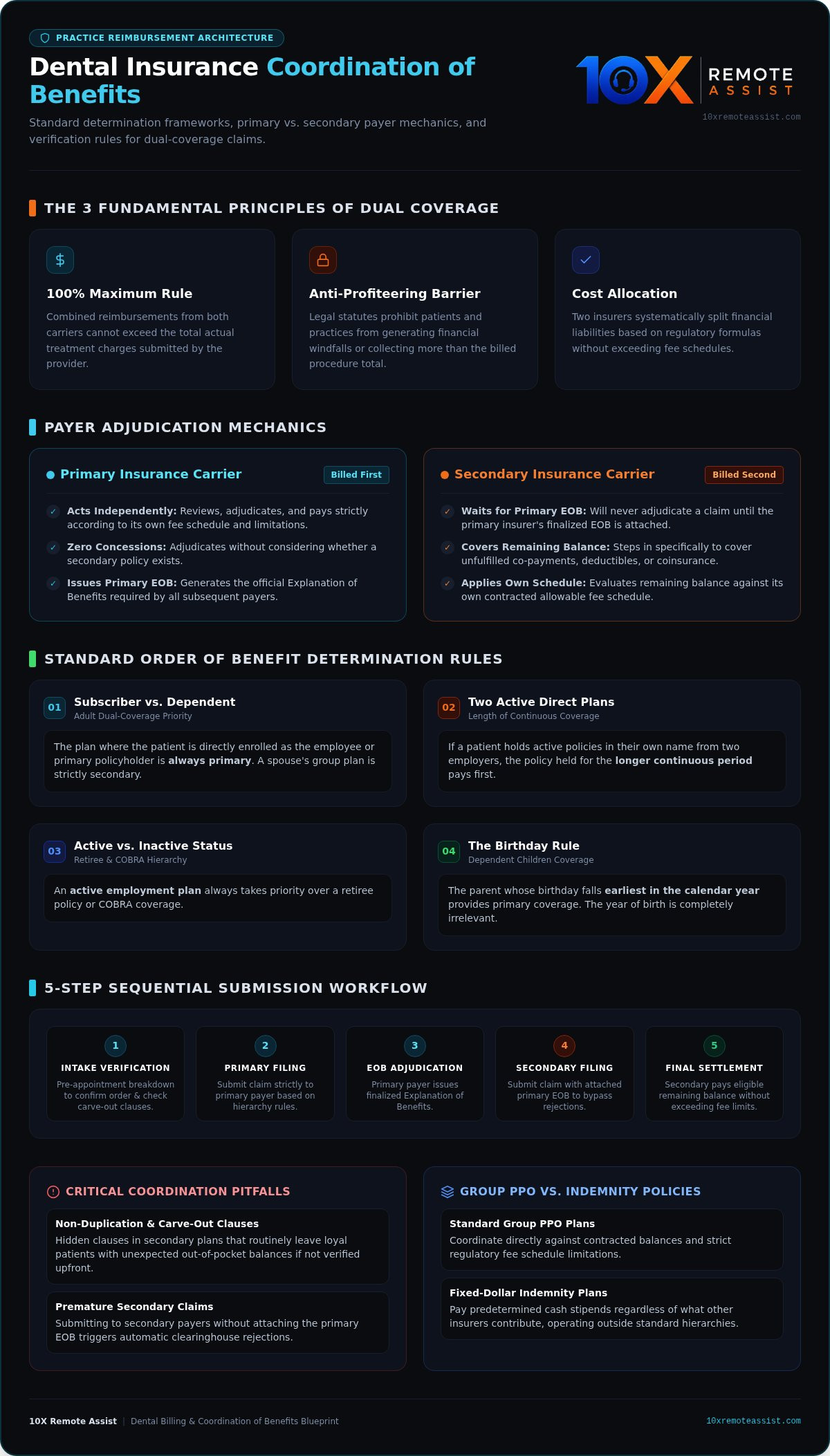
Dual coverage should simplify patient care. Instead, it frequently creates administrative confusion. At its foundation, dental insurance coordination of benefits (COB) is the standardized framework used to establish payer hierarchy when an individual is covered by two separate dental plans. The primary objective is straightforward: prevent duplicate claim payments while ensuring patients receive the maximum allowable coverage under their contracted plans.
A fundamental rule anchors the entire process. Combined reimbursements from both carriers cannot exceed the total actual treatment charges submitted by the provider. Insurance policies are structured to cover restorative and preventive oral care, not to generate financial windfalls. When a patient holds dual coverage, both plans coordinate systematically within standard protocols of medical billing and financial responsibility to ensure fair distribution of costs without exceeding actual fee schedules.
The Core Purpose of Dual Insurance Coordination
Dual coverage typically occurs when spouses share reciprocal employer policies or an employee works two jobs with distinct benefits. Coordination rules legally establish cost-sharing boundaries so that no claim pays more than 100 percent of the allowable fee. Understanding these relationships separates smooth operational collections from chronic revenue leakage:
- Cost allocation: Two insurers split patient financial liabilities based on pre-established regulatory formulas.
- Anti-profiteering barriers: Legal statutes bar patients and providers from receiving cumulative reimbursements higher than the billed procedure total.
- Coverage optimization: Secondary plans step in specifically to cover unfulfilled co-payments, deductibles, or coinsurance left behind by the first payer.
Primary vs. Secondary Insurance Responsibilities
The primary plan acts independently. It reviews, adjudicates, and pays out according to its specific fee schedule and contract limitations, completely unaware of what the other plan might cover. It makes zero concessions for secondary policies.
The secondary payer operates under entirely different mechanics. It waits. A secondary insurer will never adjudicate a claim until the primary payer issues a finalized Explanation of Benefits (EOB). Once received, the secondary carrier reviews the remaining patient balance, evaluates its own allowable fee schedule, and pays any eligible remaining portion.
This dynamic differs fundamentally between standard group dental insurance coordination and supplemental indemnity policies. Group PPO plans coordinate directly against contracted balances. Standalone indemnity or fixed-dollar plans pay predetermined cash stipends regardless of what other insurers contribute, operating outside standard coordination hierarchies.
Determining Payer Priority: Standard Order of Benefit Determination Rules
Payer order isn't optional. Neither the patient nor the dental practice can pick which carrier bills first based on richer coverage or lower deductibles. Regulatory frameworks establish an unalterable hierarchy across all group policies. By aligning your billing protocols with official ADA Guidance on Coordination of Benefits, your administrative team can systematically pinpoint payer priority before treatment begins, eliminating clearinghouse denials before they happen.
Subscriber Rules for Dual-Covered Adults
Subscriber status forms the bedrock of dental insurance coordination of benefits for adult patients. The plan where the patient is directly enrolled as the employee or primary policyholder is always primary for their own care. A spouse's group plan operates strictly as secondary coverage. If a patient holds two active plans in their own name from two employers, the policy held for the longer continuous period pays first. An active employment plan always takes priority over a retiree policy or COBRA coverage.
The Birthday Rule for Dependent Children
Dependent child coverage relies on the calendar, not parental age or policy seniority. The parent whose birthday falls earliest in the calendar year provides the primary coverage. Year of birth is completely irrelevant. For example, a parent born on March 15 holds primary status over a spouse born on September 2, even if the September policyholder is older. If both parents happen to share the exact same month and day, seniority takes over: the policy with the earlier continuous effective date pays primary.
Custody Agreements and Divorce Decrees
Legal documentation instantly supersedes standard calendar formulas. When a court decree explicitly assigns financial responsibility for dental care to a specific parent, that designated parent's policy becomes primary. Without an explicit legal mandate, default priority follows a strict order:
- First: Plan of the parent with primary physical custody.
- Second: Plan of the custodial parent's current spouse (stepparent).
- Third: Plan of the non-custodial biological parent.
- Fourth: Plan of the non-custodial parent's current spouse.
Confirming these details during patient intake protects your collections pipeline. Integrating dedicated remote support for comprehensive insurance verification ensures complex family hierarchies and secondary payer rules are identified and entered into your practice management software well before the patient sits in the chair.
Coordination Pitfalls: Non-Duplication Clauses and Benefit Carve-Outs
Dual coverage does not guarantee double payments. Many dental offices assume a secondary policy automatically covers whatever the primary plan leaves behind. In practice, restrictive policy clauses can reduce expected secondary payments to zero. Mastering dental insurance coordination of benefits requires identifying these contractual roadblocks during initial verification, long before treatment starts.
How Non-Duplication Clauses Work in Practice
Non-duplication clauses, commonly embedded in employer group contracts, protect secondary carriers from liability when the primary plan matches or exceeds their coverage percentage. Suppose a patient requires a crown, covered at 50 percent under both primary and secondary group plans. The primary plan pays its 50 percent share. When the secondary carrier adjudicates the claim, it calculates what it would have paid as the primary insurer (50 percent), subtracts the primary carrier's payment, and issues an Explanation of Benefits showing zero dollars owed. The remaining 50 percent balance shifts directly to the patient.
Understanding Benefit Carve-Out Provisions
Carve-out provisions operate under a similarly restrictive mathematical formula. Under standard coordination, the secondary carrier covers up to its allowable limit or the patient's remaining balance, whichever is less. Under a carve-out rule, the secondary carrier calculates its normal allowable benefit and subtracts the primary payment directly from that amount. If the primary carrier paid more than the secondary plan's contracted allowable fee, the secondary benefit is completely carved out. Practices that overlook this clause face sudden write-offs and awkward collection conversations.
Contractual Limitations Across Secondary Policies
Secondary policies never waive standard plan exclusions simply because primary coverage exists. Secondary carriers evaluate every submission against their own internal limitations:
- Waiting periods: Secondary plans enforce standard six- to twelve-month waiting periods on basic or major restorations, even if the primary plan pays immediately.
- Missing tooth clauses: Secondary insurers deny replacement benefits if a tooth was extracted before the patient's effective date on that specific secondary policy.
- Frequency rules: Dual coverage does not double preventive care limits. Routine cleanings, exams, and radiographs remain strictly capped by each plan's time limitations.
Failing to uncover these contractual nuances leaves your revenue cycle exposed. Identifying non-duplication rules and carve-out formulas before treatment ensures accurate patient estimates and prevents secondary billing surprises.
How to File Secondary Dental Claims Without Denials
Precision matters. Submitting secondary dental claims without a systematic workflow stalls your revenue cycle and leaves receivables aging past ninety days. Processing dental insurance coordination of benefits claims demands strict sequential execution, rigorous intake documentation, and proactive patient communication.
The Sequential Claims Submission Protocol
Secondary payers will not touch an unadjudicated claim. Filing out of order results in immediate rejections. Follow a structured three-step submission sequence:
- Transmit the primary claim: Send the primary claim electronically with all necessary diagnostic assets, including clear periapical radiographs, periodontal charting, and detailed clinical narratives.
- Reconcile the primary EOB: Review the primary Explanation of Benefits immediately upon receipt. Post carrier payments and contract adjustments accurately into your practice management software.
- Attach and transmit secondary: Forward the secondary claim through your clearinghouse with the full primary EOB attached electronically. Never bill secondary without the complete primary settlement details.
Pre-Appointment Verification Standards
Most secondary claim denials trace back to incomplete intake details rather than billing errors. Front-office teams must capture policy numbers, group numbers, subscriber social security numbers, and payer IDs for both carriers before the appointment. Performing a detailed dental insurance eligibility verification process ensures your team uncovers non-duplication provisions, individual deductibles, and procedural exclusions prior to care.
Transparent Patient Financial Communication
Never let dual coverage create false expectations. Provide patients with clear treatment estimates outlining anticipated primary and secondary contributions. Clarify that secondary figures remain estimates, not legal payment promises. Have patients sign an agreement confirming their personal responsibility for any unpaid balances if secondary coverage disallows payment under contractual clauses.
Keeping up with intricate carrier rules while managing incoming phone calls exhausts front-desk staff. If your team struggles to balance patient check-ins with secondary claim tracking, explore dedicated dental billing and claims support. Partner with the specialists at 10X Remote Assist to secure clean submissions, eliminate secondary rejections, and protect your practice cash flow.
Optimizing Practice Workflows: Solving the Coordination Administrative Burden
Dual-coverage administration drains practice bandwidth. Front-desk teams constantly juggle patient check-ins, inbound phone calls, and complex payer guidelines. When staff get pulled between personal patient care and forty-minute carrier hold times, billing errors multiply. Managing dental insurance coordination of benefits manually across dozens of disparate carriers is an operational bottleneck that stalls practice growth.
The Hidden Operational Costs of Dual-Coverage Administration
Carrier friction compounds quickly. When secondary claims stall over verification disputes or missing primary documentation, payments freeze. Uncollected revenue rapidly migrates into aging accounts receivable buckets. The operational toll surfaces across three core areas:
- Lost productivity: Front-office personnel lose hours navigating carrier automated menus rather than scheduling open chair time and following up on unscheduled treatment.
- Stagnant cash flow: Unresolved secondary claims age past sixty and ninety days, forcing practices to absorb avoidable write-offs.
- Administrative turnover: Tedious insurance hold times, claim tracking, and contentious balance billing conversations accelerate employee burnout and staff turnover.
Deploying Dedicated Remote Front-Office Specialists
High-performing practices no longer force on-site teams to fight carrier hold queues. Instead, they separate in-office hospitality from technical verification mechanics. By shifting heavy insurance research to dedicated off-site support, practices ensure dual-coverage claims flow smoothly without overwhelming front-desk personnel.
Forward-thinking teams modernize their operations by integrating live, trained remote administrators directly into their practice management software. Practices partner with 10X Remote Assist to handle end-to-end insurance verification and billing support with absolute clinical precision. These specialized human professionals track down primary payer rules, identify carve-out formulas, and confirm non-duplication provisions before patients step through the door. Backed by proprietary AI-driven quality scoring that evaluates verification accuracy, this workflow delivers dependable administrative reliability.
Your on-site staff stays focused on patient relationships and case acceptance. Your dual-coverage claims get processed accurately, systematically, and on time.
Transform Your Dual Coverage Workflow into Predictable Revenue
Predictable cash flow begins with administrative control. Navigating dental insurance coordination of benefits doesn't have to trigger endless clearinghouse rejections, surprise patient balances, or front-desk burnout. When your practice establishes payer priority systematically, uncovers non-duplication clauses during pre-appointment intake, and submits clean claims with primary EOBs attached, secondary reimbursement becomes dependable.
You don't need to burden your in-house team with relentless carrier phone queues. Streamline your insurance verification with 10X Remote Assist. Our live, trained human front-office specialists integrate directly into your practice management software, executing comprehensive insurance verification workflows that eliminate claim rejections. Monitored through a proprietary operating system featuring AI-driven quality scoring on administrative tasks, our remote specialists give you complete operational security. Take the friction out of dual coverage, protect your collections, and keep your focus where it belongs: on exceptional patient care.
Frequently Asked Questions
What is dental insurance coordination of benefits?
Dental insurance coordination of benefits is the standardized framework that determines payer order when a patient holds two dental policies. It prevents duplicate claim payments and establishes clear guidelines on how much each carrier contributes toward treatment costs. Combined reimbursements between both plans can never exceed 100 percent of actual billed fees, ensuring dental practices get paid accurately while patients maximize legitimate plan benefits.
How does the birthday rule work for secondary dental insurance?
The birthday rule assigns primary payer status for dependent children to the parent whose birthday occurs earlier in the calendar year. Birth year and parental age are completely irrelevant. If one parent was born on February 10 and the other on July 24, the February parent's plan pays primary. If both parents share the same birth date, the policy active for the longest continuous duration serves as primary.
Can I choose which dental insurance policy pays as my primary?
No, neither the patient nor the dental office can choose which plan acts as primary. National coordination guidelines establish an unalterable hierarchy across all commercial carriers. If you are enrolled as the employee on an active group plan, that policy is legally required to adjudicate first for your care. Your spouse's plan will always act as secondary coverage, regardless of which policy offers richer benefits.
What is a non-duplication clause in secondary dental insurance?
A non-duplication clause is a contractual provision that eliminates secondary payments if the primary carrier paid the same percentage the secondary plan covers. For example, if both policies cover major restorations at 50 percent and your primary plan pays its share, a secondary insurer with non-duplication pays nothing. It treats the primary payment as satisfying its own liability, shifting the remaining balance to the patient.
Does having two dental insurance plans guarantee 100 percent coverage?
No, holding two policies never guarantees complete reimbursement for dental care. Standard dental insurance coordination of benefits simply allows both plans to share eligible expenses up to each policy's contractual limits. Restrictive clauses like non-duplication rules, separate plan deductibles, fee schedule discrepancies, and missing tooth exclusions often leave patient balances. Dual coverage reduces out-of-pocket expenses, but zero-dollar balances are never guaranteed.
Can a dental office submit claims to both insurance plans at the same time?
No, a dental practice cannot submit dual-coverage claims simultaneously without causing instant denials. Secondary payers demand a finalized primary Explanation of Benefits before they evaluate remaining balances. Transmitting both claims simultaneously causes an immediate clearinghouse rejection from the secondary insurer. Billing staff must wait for primary payments and contractual adjustments to post before transmitting the secondary claim with the primary documentation attached.
Why did my secondary dental insurance pay zero dollars on an approved claim?
Secondary carriers typically issue zero-dollar payments due to non-duplication clauses, benefit carve-outs, or independent policy exclusions. If the primary plan's payout equaled or exceeded what the secondary insurer allows under its contracted fee schedule, the secondary carrier owes nothing. Zero-dollar payouts also occur when patients fail to satisfy secondary waiting periods or exceed annual procedural frequency limitations.
Frequently Asked Questions
Dental insurance coordination of benefits is the standardized framework that determines payer order when a patient holds two dental policies. It prevents duplicate claim payments and establishes clear guidelines on how much each carrier contributes toward treatment costs. Combined reimbursements between both plans can never exceed 100 percent of actual billed fees, ensuring dental practices get paid accurately while patients maximize legitimate plan benefits.
The birthday rule assigns primary payer status for dependent children to the parent whose birthday occurs earlier in the calendar year. Birth year and parental age are completely irrelevant. If one parent was born on February 10 and the other on July 24, the February parent's plan pays primary. If both parents share the same birth date, the policy active for the longest continuous duration serves as primary.
No, neither the patient nor the dental office can choose which plan acts as primary. National coordination guidelines establish an unalterable hierarchy across all commercial carriers. If you are enrolled as the employee on an active group plan, that policy is legally required to adjudicate first for your care. Your spouse's plan will always act as secondary coverage, regardless of which policy offers richer benefits.
A non-duplication clause is a contractual provision that eliminates secondary payments if the primary carrier paid the same percentage the secondary plan covers. For example, if both policies cover major restorations at 50 percent and your primary plan pays its share, a secondary insurer with non-duplication pays nothing. It treats the primary payment as satisfying its own liability, shifting the remaining balance to the patient.
No, holding two policies never guarantees complete reimbursement for dental care. Standard dental insurance coordination of benefits simply allows both plans to share eligible expenses up to each policy's contractual limits. Restrictive clauses like non-duplication rules, separate plan deductibles, fee schedule discrepancies, and missing tooth exclusions often leave patient balances. Dual coverage reduces out-of-pocket expenses, but zero-dollar balances are never guaranteed.
No, a dental practice cannot submit dual-coverage claims simultaneously without causing instant denials. Secondary payers demand a finalized primary Explanation of Benefits before they evaluate remaining balances. Transmitting both claims simultaneously causes an immediate clearinghouse rejection from the secondary insurer. Billing staff must wait for primary payments and contractual adjustments to post before transmitting the secondary claim with the primary documentation attached.
Secondary carriers typically issue zero-dollar payments due to non-duplication clauses, benefit carve-outs, or independent policy exclusions. If the primary plan's payout equaled or exceeded what the secondary insurer allows under its contracted fee schedule, the secondary carrier owes nothing. Zero-dollar payouts also occur when patients fail to satisfy secondary waiting periods or exceed annual procedural frequency limitations.
Build the remote team that runs this for you
We recruit, train and manage a dedicated remote team member for your practice.