
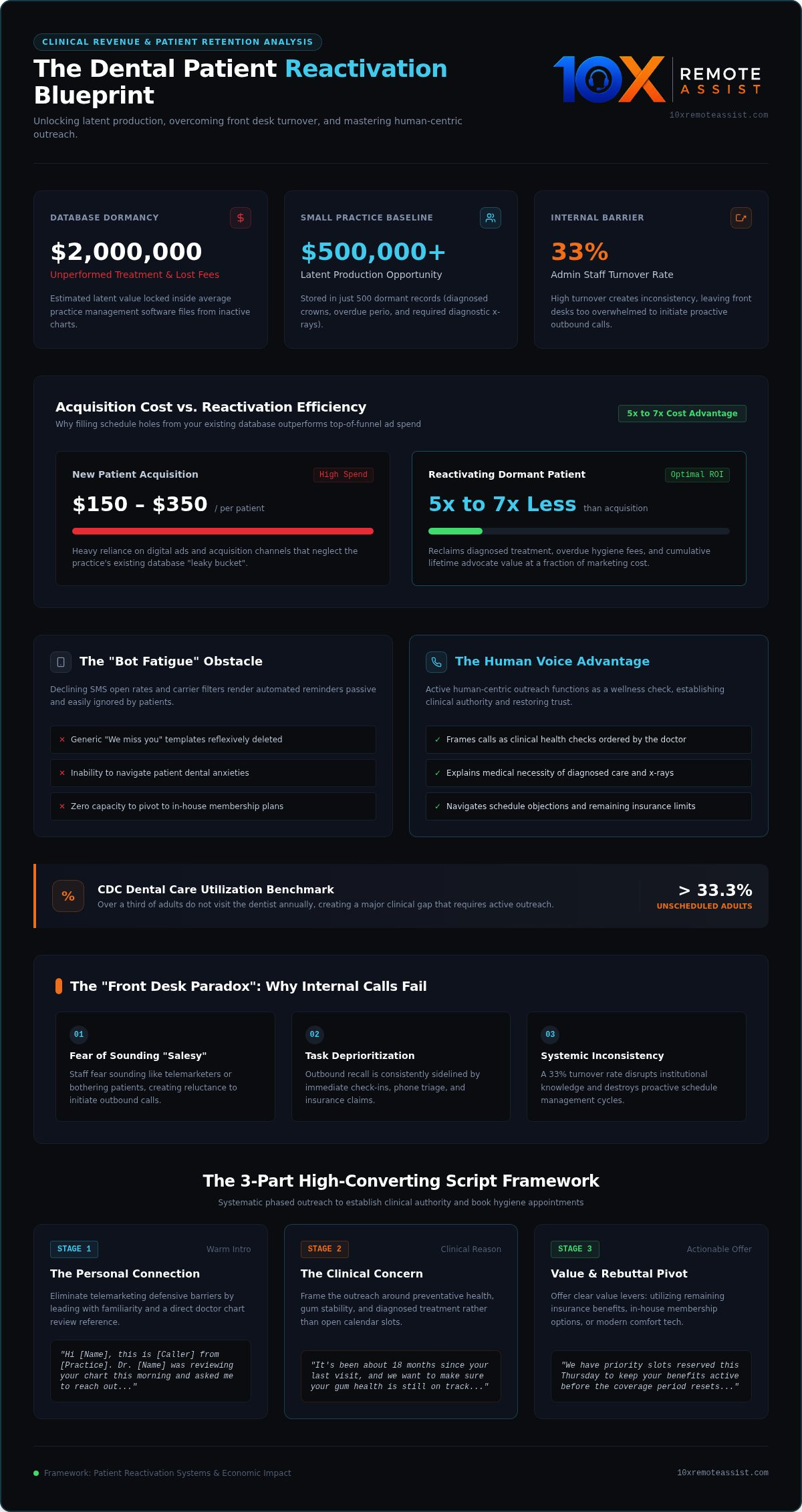
Your practice management software is likely a graveyard of $2 million in unperformed treatment and lost hygiene fees. While most offices settle for automated texts that patients reflexively delete, elite practices recognize that the human voice is the ultimate competitive advantage in 2026. Success requires more than just a phone number; it demands a precise dental patient reactivation script that blends clinical authority with empathetic outreach. This is how you transform a dormant database into an active engine for growth.
You've experienced the anxiety of seeing open blocks in the hygiene schedule while your front desk team struggles to manage the daily chaos. It's hard to stay proactive when administrative turnover has climbed to 33 percent and your staff fears sounding too aggressive on the phone. This guide delivers the templates and systematic frameworks needed to fill those gaps and recover thousands in unscheduled care. We will show you how to bypass the "automated ignore" phase and build a professional, repeatable process that brings your patients back through the door.
Key Takeaways
- Understand why automated texts are failing in 2026 and how shifting back to human-centric outreach can recover thousands in lost production.
- Learn the specific phrasing required for a high-converting dental patient reactivation script that establishes clinical authority without triggering patient defensiveness.
- Access scenario-specific templates tailored for both overdue hygiene patients and long-dormant records to ensure your outreach feels personalized and relevant.
- Master the "Future-Focus Flip" and other proven rebuttal techniques to navigate common objections regarding time, cost, and insurance coverage.
- Discover why delegating reactivation to a specialized remote team solves the "Front Desk Paradox" and ensures consistent, uninterrupted schedule growth.
The Revenue Leak: Why Your Dental Patient Reactivation Strategy is Failing
Acquiring a new dental patient in 2026 costs between $150 and $350. By contrast, reactivating a dormant patient costs five to seven times less. Many practices focus heavily on digital marketing and top-of-funnel leads while ignoring the "leaky bucket" in their own database. This oversight contradicts fundamental customer retention principles that dictate long-term profitability and sustainable growth. When a patient stops scheduling, your practice loses more than a cleaning fee; it loses the cumulative lifetime value of a loyal advocate.
The primary hurdle in 2026 is "Bot Fatigue." Patients are drowning in generic, automated "We miss you" texts and emails. These messages are often filtered by carriers or reflexively deleted. Automation is a passive tool; it cannot handle objections or build trust. To win back lost revenue, your office needs a human-centric approach. A professional following a structured dental patient reactivation script can address personal concerns that a software template simply cannot reach.
The High Cost of Inactive Patients
Inactive patients represent hidden accounts receivable. A typical solo practice with 500 dormant records is often sitting on over $500,000 in latent production opportunity. These records contain diagnosed crowns, overdue periodontal therapies, and essential diagnostic x-rays. When the hygiene schedule has gaps, doctor production inevitably plateaus. This stagnation affects your daily cash flow and lowers the overall valuation of the practice during a transition or sale.
Why Automated Reminders Aren’t Enough Anymore
The decline in SMS open rates for medical notifications is a direct result of over-saturation. Relying solely on software is a passive strategy that yields diminishing returns. Your office must transition from "reminding" to "re-engaging" as a core philosophy. Re-engagement requires an active presence. A human voice can navigate a patient's anxiety, explain the clinical necessity of a visit, or pivot to an in-house membership plan when insurance has changed. These are nuanced conversations that require specialized training and a precise dental patient reactivation script.
There is also a significant psychological barrier at the front desk. Most administrative staff avoid making reactivation calls because they feel like "cold calling." They fear sounding "salesy" or bothering patients during a busy day. Without a dedicated system and a proven framework, these vital outbound calls are consistently deprioritized in favor of immediate tasks like patient check-ins and insurance verifications. This creates a cycle of inconsistency that leaves your schedule under-filled and your revenue leaking.
Anatomy of a High-Converting Dental Reactivation Script
High-conversion outreach begins with a fundamental shift in perspective. Instead of calling to "fill a hole" in the schedule, the caller must act as a health advocate. A well-crafted dental patient reactivation script avoids the stilted tone of a telemarketer by establishing immediate familiarity. Start with the patient's name and a warm reference to the practice. This reduces the defensive wall patients build when receiving unsolicited calls. According to CDC dental care utilization statistics, over a third of adults don't visit the dentist annually. This highlights a massive gap in care that requires active intervention. Your outreach isn't just a business transaction; it's a wellness check.
The "Reason for Call" should center on the patient's oral health. Mention specific benefits like utilizing remaining insurance benefits or experiencing new comfort technology in the office. This creates value before you ever ask for a commitment. Professional dental virtual assistants are trained to master these nuances, ensuring every call feels like a natural extension of your internal team.
The 3-Part Script Framework
A systematic approach ensures consistency across every call. Use this three-step framework to guide the conversation toward a successful booking.
- Step 1: The Personal Connection. Start with a warm intro that mentions the doctor by name. "Hi [Name], this is [Caller] from [Practice]. Dr. [Name] was reviewing your chart this morning and asked me to reach out."
- Step 2: The Clinical Concern. Focus on the "why" behind the call. "It's been about 18 months since your last visit, and we want to make sure your gum health is still on track, especially since we've upgraded our diagnostic tools."
- Step 3: The Direct Ask. Use the "Specific Slot" technique to lower friction. Instead of asking when they're free, offer two choices: "We have an opening this Thursday at 10:00 AM or next Tuesday at 2:00 PM. Which works better for you?"
Tone and Delivery: The Human Advantage
Tone dictates how the script is received. Use vocal mirroring to match the patient’s energy and pace. If the patient sounds rushed, be concise and direct. If they're more relaxed, allow the conversation to breathe. Strategic pauses are your most powerful tool. After asking for the appointment, stop talking. Let the patient fill the silence, which often leads to them checking their calendar or offering a counter-time. Clinical Empathy is the ability to prioritize the patient’s oral health over the schedule.
3 Scenario-Specific Dental Reactivation Templates for 2026
One-size-fits-all scripts are a relic of the past. In 2026, patients expect personalization. A generic message is a missed opportunity to build rapport and often results in the "ignore" response typical of modern bot fatigue. Effective outreach requires segmenting your dormant database by the length of their absence and the type of care they need. Following American Dental Association patient management guidelines ensures that your communication remains ethical and professional while maximizing retention. Whether you're targeting a patient who missed a six-month cleaning or one with an outstanding crown diagnosis, your dental patient reactivation script must adapt to the specific situation.
The "We Miss Your Smile" Script (Hygiene Focus)
This template is designed for patients who are 6 to 9 months overdue. The goal is to reinforce the oral-systemic health link and emphasize preventative care. Focus on the benefits of maintaining their current health rather than catching up on lost time. Mentioning comfort amenities like noise-canceling headphones or weighted blankets helps reduce dental anxiety and makes the visit feel like a premium experience.
- The Hook: "Hi [Name], this is [Caller] from [Practice]. Dr. [Name] wanted me to check in because we haven't seen you since [Date] and we want to make sure your preventive care stays on track."
- The Value: "We've recently added some new comfort amenities to the office to make your hygiene visits even more relaxing."
- The Urgency: "I actually have two openings this Tuesday at 9:00 AM and 1:30 PM. Would one of those work to get you back on the schedule?"
The "Treatment Recovery" Script (Production Focus)
Unfinished treatment plans represent the highest value recovery for any practice. This script focuses on the specific clinical need and the "insurance clock." Using the doctor's name adds authority and reminds the patient that their health is the priority. This approach is essential for any high-performing dental patient scheduling service.
- The Hook: "[Name], Dr. [Name] was reviewing your chart this morning and asked me to follow up regarding the crown we discussed last year."
- The Clinical Rationale: "The doctor is concerned about the tooth's stability if we wait much longer, and I noticed you still have insurance benefits remaining for this year."
- The Direct Ask: "We have a block reserved for restorative work next Wednesday morning. Should I hold that for you before those benefits expire?"
For the "Long-Lost" patient (12 to 24 months inactive), the tone should remain low pressure. Acknowledge that life gets busy and offer a "clean slate" exam. This reduces the guilt patients often feel after a long absence. By tailoring your dental patient reactivation script to these specific scenarios, you move away from generic marketing and toward high-level patient care. Customizing these templates based on your specific practice goals ensures that your outreach remains a strategic extension of your internal culture.
Mastering the Rebuttal: How to Flip Common Patient Objections
Even the most polished dental patient reactivation script will encounter resistance. Objections aren't rejections; they're requests for more information or simpler logistics. Your team must be prepared to handle these moments with professional confidence rather than retreating. When a patient says they're "too busy," don't push for an immediate opening. Use the "Future-Focus Flip." Acknowledge their schedule and offer a slot three weeks out. This removes the immediate pressure while keeping the health goal on the calendar. Success lies in the ability to pivot the conversation from a scheduling hurdle to a health priority.
If a patient says, "I'll call you back," they rarely do. Inertia is a powerful force in patient behavior. Offer a "tentative appointment" instead. Tell them you'll put them in the system to hold a specific spot and send a confirmation text. This gives them a concrete placeholder they can adjust later if needed. It transforms a vague "maybe" into a scheduled commitment without sounding aggressive.
Handling the Financial Objection
Cost remains the most frequent barrier to care in 2026. When a patient mentions price or a lack of insurance, don't end the call. This is the moment to pivot to mastering dental insurance verification to provide immediate clarity. Providing real-time data on remaining benefits or specific copays removes the "unknown" factor that triggers financial anxiety. Always offer financing options like CareCredit as a standard part of the rebuttal. Frame the conversation around clinical risk versus financial cost. A small preventative visit today is significantly more affordable than an emergency restorative procedure next year.
The "No Pain" Misconception
Pain is a poor indicator of dental health. Many patients believe that if they don't feel discomfort, their teeth are fine. This is where your script must incorporate patient education. Explain that periodontal disease and decay are "silent" issues that often show no symptoms until they reach a crisis point. Use a "Safety First" approach. You aren't just looking for problems; you're ensuring their long-term stability and avoiding future emergencies. Educating the patient on the progression of decay helps them see the visit as a necessary protective measure rather than an optional errand.
Managing these nuanced conversations requires a level of focus that a busy front desk rarely possesses. If your team is struggling to stay consistent with these rebuttals, consider how specialized dental call center services can act as a high-performance extension of your office to recover that lost revenue.
Implementation: Why a Remote Call Center Wins Where the Front Desk Struggles
The "Front Desk Paradox" is a structural reality for nearly every growing practice. Your administrative team is expected to manage physical patient check-ins, verify insurance, and collect payments while simultaneously making high-volume outbound calls. In 2026, front-desk personnel endure an average of 60 phone interruptions per day. This environment makes it impossible to execute a dental patient reactivation script with the focus and consistency required to see results. Outbound calling is consistently deprioritized in favor of the patient standing directly at the counter. This creates a cycle where the hygiene schedule remains under-filled despite a database full of opportunity.
Consistency is the primary driver of reactivation ROI. A dedicated remote team operates in a quiet, focused environment, making 50 or more calls per day without the distraction of a ringing multi-line phone. Quality control is no longer a guessing game. Every call is recorded and analyzed with AI-driven performance scoring to ensure script adherence and professional delivery. This level of accountability transforms a haphazard task into a high-performance operating system. These dental call center services sync directly with your Practice Management Software (PMS), allowing for seamless scheduling in real-time without adding to your local team's workload.
Live Humans vs. AI Voices: The 2026 Trust Gap
Patients are increasingly sensitive to impersonal automation. While AI text reminders have their place, AI-generated voices often trigger immediate hang-ups. The "10X" approach rejects these synthetic solutions in favor of real, highly trained human agents. These professionals are specifically educated in dental terminology and insurance nuances, allowing them to build the rapport necessary to overcome deep-seated patient anxiety. Viewing remote assistance as a strategic extension of your internal culture, rather than an outsourced burden, ensures that your practice maintains its premium, human-centric reputation.
Scaling Your Reactivation Efforts
To scale effectively, you must move from intuition to data. Establish clear Key Performance Indicators (KPIs) that track total calls made versus appointments booked. This transparency allows you to quantify the exact revenue recovered from your dormant database. Starting with a pilot program is a logical way to prove ROI before fully integrating remote support into your daily workflow. This methodical approach brings order to the chaos of a shifting schedule and ensures total operational security. Schedule a demo with 10X Remote Assist to see how our agents can fill your schedule and recover your lost production.
Secure Your Practice’s Future with Human-Centric Growth
Winning back lost revenue in 2026 requires a departure from the impersonal text blasts that patients now ignore. By implementing a sophisticated dental patient reactivation script, your practice moves from simply reminding patients to truly re-engaging them through clinical empathy. You've seen how scenario-specific templates and proactive rebuttal strategies flip common objections into scheduled production. The final step is ensuring these conversations happen consistently, without being interrupted by the daily chaos of the front office.
Elite practices recognize that human talent is their greatest competitive advantage. This is where 10X Remote Assist transforms your operations. Our 100% human agents receive specialized dental training to act as a seamless extension of your team. With real-time AI quality scoring and deep PMS integration, we ensure every call is handled with professional rigor. It's time to move past the "leaky bucket" and start building a more resilient, high-performance schedule.
Stop losing patients and start filling your schedule with 10X Remote Assist. We are ready to help you reclaim your lost revenue and restore your operational security.
Frequently Asked Questions
What is the best time of day to make dental reactivation calls?
Mid-morning between 10:00 AM and 11:30 AM or mid-afternoon from 1:30 PM to 3:30 PM typically yields the highest answer rates. You want to avoid early morning rushes and the dinner hour when patients are least likely to engage in a professional conversation. Consistency in these windows is vital. High-performance teams often find that mid-week calls on Tuesday and Wednesday produce better results than Monday mornings or Friday afternoons.
How often should we call an inactive patient before giving up?
You should aim for a sequence of three to five touches over a 45-day period before moving a record to a dormant status. This cadence prevents the practice from becoming a nuisance while ensuring you stay top-of-mind. Your dental patient reactivation script should evolve with each attempt to keep the message fresh and health-focused. Persistent follow-up is necessary because patients often require multiple reminders before they prioritize their dental care.
Should we offer a discount or incentive for reactivating patients?
Incentives can be effective if they're framed as "wellness credits" or complimentary comfort upgrades rather than generic discounts. Offering a specific benefit for returning helps overcome initial inertia without devaluing your clinical expertise. Focus the conversation on the long-term value of their oral health first. Use the incentive only as a low-friction tool to help the patient say "yes" to a specific time slot during the call.
How do I handle a patient who says they have moved to a different dentist?
Acknowledge their decision with professional grace and offer to facilitate a records transfer to their new provider immediately. This "high-road" approach protects your practice's reputation and leaves the door open should they ever decide to return. Briefly ask if there was a specific reason for the change to gather helpful internal feedback. Maintaining professionalism during a departure often leads to positive word-of-mouth referrals in the community.
Can remote assistants access my dental practice management software?
Yes, 10X Remote Assist agents integrate directly with your existing practice management software through secure, encrypted connections. This allows our trained human agents to view your live schedule, update patient records, and book appointments in real-time. There's no need for manual data entry or messy double-booking. The integration ensures that your remote support functions as a seamless, high-performance extension of your physical front desk team.
What is the difference between a reactivation call and a recare reminder?
Recare reminders target active patients who are simply due for their next routine visit, while reactivation calls focus on patients who are significantly overdue. A recare reminder is a maintenance task; a reactivation call is a recovery effort. The dental patient reactivation script requires more sophisticated objection handling. You must address the underlying reasons for the patient's absence, such as anxiety or cost, to successfully bring them back.
How do we track the success of our reactivation scripts?
Track success by measuring the "Reactivation Rate," which is the percentage of dormant patients who schedule and complete an appointment. You should also monitor the total production value recovered from previously unscheduled treatment plans. Our system uses AI-driven quality scoring to evaluate every call for script adherence and professional delivery. This data-driven approach allows you to quantify your exact return on investment and refine your outreach strategy over time.
Frequently Asked Questions
Mid-morning between 10:00 AM and 11:30 AM or mid-afternoon from 1:30 PM to 3:30 PM typically yields the highest answer rates. You want to avoid early morning rushes and the dinner hour when patients are least likely to engage in a professional conversation. Consistency in these windows is vital. High-performance teams often find that mid-week calls on Tuesday and Wednesday produce better results than Monday mornings or Friday afternoons.
You should aim for a sequence of three to five touches over a 45-day period before moving a record to a dormant status. This cadence prevents the practice from becoming a nuisance while ensuring you stay top-of-mind. Your dental patient reactivation script should evolve with each attempt to keep the message fresh and health-focused. Persistent follow-up is necessary because patients often require multiple reminders before they prioritize their dental care.
Incentives can be effective if they're framed as "wellness credits" or complimentary comfort upgrades rather than generic discounts. Offering a specific benefit for returning helps overcome initial inertia without devaluing your clinical expertise. Focus the conversation on the long-term value of their oral health first. Use the incentive only as a low-friction tool to help the patient say "yes" to a specific time slot during the call.
Acknowledge their decision with professional grace and offer to facilitate a records transfer to their new provider immediately. This "high-road" approach protects your practice's reputation and leaves the door open should they ever decide to return. Briefly ask if there was a specific reason for the change to gather helpful internal feedback. Maintaining professionalism during a departure often leads to positive word-of-mouth referrals in the community.
Yes, 10X Remote Assist agents integrate directly with your existing practice management software through secure, encrypted connections. This allows our trained human agents to view your live schedule, update patient records, and book appointments in real-time. There's no need for manual data entry or messy double-booking. The integration ensures that your remote support functions as a seamless, high-performance extension of your physical front desk team.
Recare reminders target active patients who are simply due for their next routine visit, while reactivation calls focus on patients who are significantly overdue. A recare reminder is a maintenance task; a reactivation call is a recovery effort. The dental patient reactivation script requires more sophisticated objection handling. You must address the underlying reasons for the patient's absence, such as anxiety or cost, to successfully bring them back.
Track success by measuring the "Reactivation Rate," which is the percentage of dormant patients who schedule and complete an appointment. You should also monitor the total production value recovered from previously unscheduled treatment plans. Our system uses AI-driven quality scoring to evaluate every call for script adherence and professional delivery. This data-driven approach allows you to quantify your exact return on investment and refine your outreach strategy over time.
Build the remote team that runs this for you
We recruit, train and manage a dedicated remote team member for your practice.