
What if the treatment plan isn’t what slows care down, but the handoff that follows it? A dental treatment coordination service can help move recommendations toward a patient decision and a scheduled visit. The right support should fit your practice’s workflow and make each next step clear to patients and staff.
If follow-up competes with phone calls, scheduling, and other front-office tasks, extra support may be worth considering. First, clarify what coordination includes, where the coordinator’s role ends, and how patient communication connects with your team. Clinical recommendations and informed consent remain the dentist’s responsibility. Coordination focuses on the practical steps that help patients understand and act on the plan.
This guide explains what treatment coordination services may handle and how in-house, outsourced, and technology-supported models compare. It also covers what to assess before integrating support, including system compatibility, team handoffs, follow-up processes, and performance visibility. The goal is a clear, human workflow that helps patients move forward without adding confusion for your team.
Key Takeaways
- A dental treatment coordination service can support administrative follow-through, but clinical recommendations and treatment questions remain with the dentist.
- Compare in-house staff, outsourced human support, and software-supported workflows based on your needs for continuity, capacity, and oversight.
- Before choosing a provider, clarify task scope, escalation paths, system access, documentation, and reporting.
- Map your current process first, then define responsibilities, train the team, and review how the workflow is working.
- Assign a practice-side owner to manage questions, exceptions, and updates as coordination support becomes part of the team’s routine.
What Does a Dental Treatment Coordination Service Actually Do?
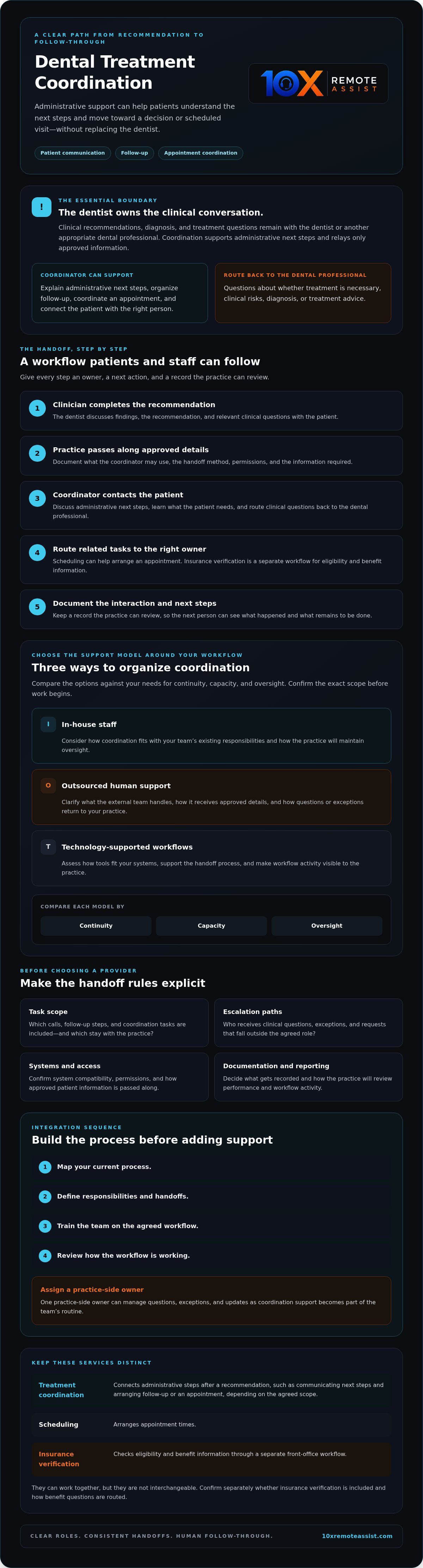
A dental treatment coordination service provides administrative and communication support after a clinician recommends care. The coordinator helps organize next steps, keep patient communication moving, and connect the recommendation with practical follow-through. The service does not replace the dentist or make clinical decisions.
That distinction matters. The dental professional is responsible for diagnosis, treatment recommendations, and answering clinical questions. A coordinator can explain the administrative process, but should not independently interpret a diagnosis or advise whether treatment is clinically appropriate. The role is similar to that of a patient advocate, helping someone navigate a healthcare process while staying within boundaries set by the practice.
For example, after a dentist recommends a procedure, a coordinator might explain the administrative next steps, arrange an appointment, or follow up if the patient needs more time to decide. If the patient asks whether the procedure is necessary or wants to discuss risks, that question should go back to the dental professional. The practice and provider should agree in advance on how that handoff works.
Which tasks can treatment coordinators support?
Possible administrative tasks include patient communication, appointment coordination, and follow-up. 10X Remote Assist offers treatment coordination, patient scheduling, and follow-up support through trained human agents. Before work begins, confirm which calls, follow-up steps, and other coordination tasks are included, and which remain with your practice.
Set the boundary clearly: coordinators can relay approved information and organize next steps, but clinical questions belong with the dentist or another appropriate dental professional. Written escalation rules help coordinators respond consistently and get patients to the right person without blurring responsibilities.
How does coordination differ from scheduling and insurance verification?
Scheduling is the process of arranging appointment times. Insurance verification is a separate front-office workflow for checking eligibility and benefit information. Treatment coordination can connect multiple administrative steps after a recommendation, such as communicating next steps and arranging follow-up or an appointment, depending on the agreed scope.
These services can work together, but they aren’t interchangeable. A patient may need scheduling without treatment coordination, or may need coordination before deciding whether to book. For a closer look at appointment workflows, see this dental patient scheduling guide. Confirm separately whether insurance verification is included, and define how benefit questions are routed to your team.
How a Dental Treatment Coordination Workflow Moves Patients Forward
A reliable workflow doesn’t depend on memory or informal handoffs. Each step should have an owner, a next action, and a record the practice can review. A dental treatment coordination service can support that process, but the practice should define the workflow and confirm which steps the provider handles.
Use this sequence as a starting point, then adapt it to your systems and team:
- Clinician completes the recommendation. The dentist discusses the clinical findings, recommendation, and relevant questions with the patient. The clinician remains responsible for the recommendation and clinical conversation.
- Practice passes along approved details. Staff document what a coordinator may use, such as the next administrative step and any approved patient-facing material. With an external provider, confirm the handoff method, permissions, and required information rather than assuming there is a standard procedure.
- Coordinator contacts the patient. Following the practice’s agreed process, the coordinator discusses administrative next steps and identifies what the patient needs to move forward. Clinical questions or requests for advice go back to the dental professional.
- Related tasks are routed clearly. If the patient is ready, scheduling support can help arrange an appointment. Insurance verification may provide benefit information through a separate workflow. Keep the tasks distinct and make clear who owns each one.
- Next steps are documented. Record the interaction in the practice’s designated system, including the patient’s response, any requested follow-up, and unresolved questions.
Clear ownership at every handoff makes coordination easier to track. Staff can see whether a patient is waiting for an appointment, a response from the clinician, or another administrative step.
How should follow-up and documentation work?
Agree on follow-up timing and communication preferences with the patient, then document both in the practice system. Set escalation rules for unanswered outreach, complex concerns, and clinical questions so coordinators know when to pause and whom to notify. Before implementation, confirm which systems and follow-up workflows the provider supports.
For broader context on how a human team can support front-office communication, read this dental call center services guide. Keep the coordination workflow focused on clear next steps, documented interactions, and a defined route for questions that need the practice team’s attention.
If you’re comparing options for your practice, review 10X Remote Assist’s dental support services and confirm which coordination tasks fit your workflow.
In-House, Outsourced, or Technology-Supported Treatment Coordination?
The right model depends on where your practice needs ownership, capacity, and continuity. Treatment coordination may be handled by your own staff or by external human support, while software can help organize parts of the workflow. Compare the options against your actual processes, not broad promises of better performance.
| Factor | In-house staff | Outsourced human support | Software-supported workflow |
|---|---|---|---|
| Ownership | Managed by practice leadership. | Shared with an external provider; responsibilities need to be defined. | Managed by practice staff using configured tools. |
| Continuity | Built around the internal team and its routines. | Depends on the provider’s staffing and handoff arrangements. | Relies on consistent use and upkeep of the system. |
| Capacity | Bound by available staff time and assigned duties. | Depends on agreed scope and provider capacity. | Supports tracking and reminders, but doesn’t conduct human conversations. |
| System fit | Uses the practice’s existing processes. | Confirm compatibility and access requirements with the provider. | Depends on the software’s features and configuration. |
| Visibility and training | Shaped by internal documentation and staff training. | Agree on records, reporting, training, and review. | Depends on what the system records and how the team uses it. |
When might an in-house coordinator be the right fit?
An in-house role may suit a practice that wants coordination closely connected to clinicians and the front-office team. Before assigning it, assess staff capacity, training time, coverage needs, and who will update the process. In a smaller practice, coordination may sit alongside other duties, so clarify priorities and handoffs. The right staffing model depends on the team’s actual workload and needs.
When should a practice compare external human support?
Consider external support if recurring administrative follow-up is difficult to manage alongside existing responsibilities. Check whether the team can work with your systems and communication standards. For example, 10X Remote Assist uses trained human agents for dental front-office work and integrates with existing practice management, CRM, and scheduling systems. Confirm that your systems are supported, along with the exact task scope and follow-up arrangements.
Outsourcing doesn’t have to mean giving up oversight. Before work begins, define practice-approved language, escalation paths, documentation expectations, and a regular review process. Ask how patient interactions are recorded and how concerns reach your team. 10X Remote Assist also records calls and evaluates them with AI-driven quality scoring. Confirm how those review processes fit your practice’s expectations.
Technology can make activity easier to track, but it doesn’t replace a person handling a patient conversation. A hybrid arrangement may combine internal ownership, external human support, and software. Before considering one, confirm that the provider offers the model and agree on who is accountable for each handoff.
How to Evaluate a Dental Treatment Coordination Provider
Choose a provider by checking how its process would fit your practice, not by relying on broad claims about efficiency. A dental treatment coordination service should have a defined scope, accountable handoffs, and a way to show what happened after patient contact.
Use this checklist to guide your evaluation:
- Dental-specific training: Ask how agents are trained for dental front-office work and how they learn your practice’s terminology and communication standards.
- Task scope: Confirm exactly which coordination, scheduling, and follow-up tasks are included, and which remain with your team.
- Escalation: Ask how clinical questions, patient concerns, and exceptions are routed to the right staff member.
- System access: Confirm compatibility with your practice management, CRM, and scheduling systems, along with the access each role requires.
- Documentation and reporting: Find out where interactions are recorded, what the practice can review, and how often updates are shared.
Which workflow and integration questions should you ask?
Ask the provider to walk through a realistic workflow, from receiving an approved handoff to recording the outcome. Clarify who enters or updates information, how workflow changes are communicated, and what happens when required details are missing. Verify privacy and security safeguards directly. Review the provider’s specific practices and documentation rather than assuming a particular certification or level of protection.
How can you assess service quality and accountability?
Agree on a baseline before the service begins. Choose measures that reflect your process, such as completed follow-ups, documented outcomes, and handoff timeliness. Define how each measure will be counted and reviewed. These measures provide a reference point, not a promise of improved treatment acceptance or clinical results.
Ask how call review, coaching, and quality reporting work. 10X Remote Assist uses human agents, and calls are recorded and evaluated through AI-driven quality scoring. AI supports call evaluation; it doesn’t speak with patients. Confirm what reporting is available and how review findings are shared with your team.
Before deciding, ask the provider to explain its scope, system fit, documentation, and review process in concrete terms. Explore 10X Remote Assist support to assess how its dental front-office services may fit your practice.
Integrating Treatment Coordination Support into Your Practice
A smooth launch starts with a clear picture of your current workflow. Before adding a dental treatment coordination service, identify where patient follow-up slows down, who owns each handoff, and what information needs to be recorded. Introduce support in phases so your team can check each part of the process before changing more.
What should a practice prepare before launch?
Use this checklist to establish a working agreement with your team and provider:
- Map the current process. Trace the steps from a treatment recommendation to the patient’s next action. Note delays, duplicate work, and unclear handoffs.
- Define tasks and boundaries. Specify which administrative tasks the provider will handle, what remains with practice staff, and how clinical questions are routed.
- Document communication rules. Provide approved patient-facing language, scheduling rules, escalation contacts, and guidance for exceptions.
- Confirm system access. Review supported systems, user permissions, and where interactions and outcomes should be documented. Agree on how access changes will be managed.
- Train and test the workflow. Walk staff and the provider through common scenarios before relying on the process in daily operations.
Assign one practice-side owner to answer workflow questions, resolve exceptions, and communicate updates when practice processes change. Before agreeing to a launch plan, ask the provider to confirm its onboarding steps, timeline, and required practice resources. Don’t assume these details are standard.
How can you tell whether the service fits over time?
Set a review period and agree on baseline measures before work begins. Depending on your workflow, these might include completed follow-ups, documented outcomes, handoff timeliness, and staff feedback. Compare results with the baseline during reviews, but avoid attributing every change to the service alone. Consider other factors, such as changes to scheduling rules, patient volume, staffing, or documentation practices.
Review the quality of patient communication, whether tasks are completed and recorded as agreed, and whether handoffs reach the right person. Ask staff where the process still creates friction. Then adjust responsibilities, approved communication, or training as needed. A useful review does more than count activity. It identifies what to refine.
Keep the workflow adaptable. As your team’s needs or systems change, revisit task boundaries and confirm updates with the provider before putting them into practice. Clear ownership and regular review help keep external support aligned with the way your practice works.
Discuss dental treatment coordination support with 10X Remote Assist to explore whether its human-supported services fit your practice’s workflow.
Build a Coordination Workflow Your Team Can Trust
The right dental treatment coordination service makes administrative next steps clearer without taking clinical decisions away from the dentist. Start by defining the tasks, handoffs, and escalation rules your practice needs. Then compare in-house, outsourced, and technology-supported options based on capacity, system fit, and visibility.
Integration matters as much as staffing. Confirm that a provider can work with your practice management, CRM, and scheduling systems, and agree on how patient interactions and follow-ups will be documented. 10X Remote Assist provides trained human agents for dental front-office tasks. Calls are recorded and evaluated with AI-driven quality scoring, while agents remain real people. Confirm the specific task scope and supported systems before moving forward.
A measured rollout gives your team a way to review handoffs, completed tasks, and patient communication against an agreed baseline. It also leaves room to refine responsibilities as your workflow evolves. Discuss dental treatment coordination support with 10X Remote Assist and explore whether its human-supported services fit your practice. With clear ownership and a practical process, your team can support patients more consistently.
Frequently Asked Questions
What does a dental treatment coordination service do?
A dental treatment coordination service provides administrative and communication support to help organize next steps after a clinician recommends care. Depending on the agreed scope, this may include patient follow-up, communicating approved information, and arranging an appointment. Tasks vary by provider, so confirm responsibilities, documentation practices, and escalation procedures before launch. The service supports the practice workflow; it doesn’t replace the dentist’s clinical judgment or guarantee that a patient will proceed with treatment.
How is treatment coordination different from dental patient scheduling?
Dental patient scheduling focuses on arranging appointment times. Treatment coordination can connect scheduling with other administrative steps after a treatment recommendation, such as patient communication and follow-up. The workflows may overlap, but they aren’t identical. A patient may need time to consider a plan before booking, or may need a clinical question answered before an appointment is arranged. Define who handles each step so the patient’s next action doesn’t get lost between tasks.
Can a remote team coordinate dental treatment?
Yes. A remote team can support administrative coordination when responsibilities, communication standards, and handoffs are agreed with the practice. 10X Remote Assist provides trained human agents for dental front-office work, including treatment coordination, patient scheduling, and follow-up. Confirm the exact tasks and workflows available, how patient interactions are documented, and how clinical questions are routed to practice staff. Remote support should work as an extension of the team, not as a substitute for clinical care.
Does a treatment coordinator make clinical recommendations?
No. The dentist or another appropriate dental professional is responsible for diagnosis, clinical recommendations, and answering questions that require clinical judgment. A coordinator’s role is administrative: they may help communicate approved next steps, arrange appointments, or follow up according to the practice’s process. If a patient asks whether treatment is necessary, wants advice about risks, or raises a clinical concern, the coordinator should route the question to the dental professional rather than answer independently.
How do I choose a dental treatment coordination provider?
Choose a dental treatment coordination provider by checking its dental-specific training, precise task scope, escalation process, system compatibility, documentation, and reporting. Ask how patient interactions are recorded, how practice staff stay informed, and how call quality is reviewed. Agree on baseline measures, such as completed follow-ups and documented outcomes, before work begins. Clarify privacy and security safeguards directly. A clear operating plan is more useful than a broad promise of improved performance.
Can treatment coordination services work with my practice management system?
They may, but compatibility depends on the provider and your specific setup. Before committing, name your practice management, CRM, and scheduling systems and ask which are supported. Clarify what access the remote team needs, how user permissions are managed, and where patient interactions and next steps will be documented. 10X Remote Assist states that its service integrates with existing practice management, CRM, and scheduling systems; confirm that your systems and required workflows are supported.
How can a practice measure treatment coordination performance?
Set a baseline before the service starts, then review measures tied to your workflow. Useful examples include completed follow-ups, documented patient outcomes, handoff timeliness, and staff feedback. Decide how each measure is defined, who reviews it, and how often findings are discussed. Assess communication quality and workflow gaps as well as activity counts. These measures help assess accountability, but results can also be influenced by staffing, scheduling, patient needs, and other practice processes.
Frequently Asked Questions
Possible administrative tasks include patient communication, appointment coordination, and follow-up. 10X Remote Assist offers treatment coordination, patient scheduling, and follow-up support through trained human agents. Before work begins, confirm which calls, follow-up steps, and other coordination tasks are included, and which remain with your practice. Set the boundary clearly: coordinators can relay approved information and organize next steps, but clinical questions belong with the dentist or another appropriate dental professional. Written escalation rules help coordinators respond consistently and get patients to the right person without blurring responsibilities.
Scheduling is the process of arranging appointment times. Insurance verification is a separate front-office workflow for checking eligibility and benefit information. Treatment coordination can connect multiple administrative steps after a recommendation, such as communicating next steps and arranging follow-up or an appointment, depending on the agreed scope. These services can work together, but they aren’t interchangeable. A patient may need scheduling without treatment coordination, or may need coordination before deciding whether to book. For a closer look at appointment workflows, see this dental patient scheduling guide. Confirm separately whether insurance verification is included, and define how benefit questions are routed to your team. A reliable workflow doesn’t depend on memory or informal handoffs. Each step should have an owner, a next action, and a record the practice can review. A dental treatment coordination service can support that process, but the practice should define the workflow and confirm which steps the provider handles. Use this sequence as a starting point, then adapt it to your systems and team: Clear ownership at every handoff makes coordination easier to track. Staff can see whether a patient is waiting for an appointment, a response from the clinician, or another administrative step.
Agree on follow-up timing and communication preferences with the patient, then document both in the practice system. Set escalation rules for unanswered outreach, complex concerns, and clinical questions so coordinators know when to pause and whom to notify. Before implementation, confirm which systems and follow-up workflows the provider supports. For broader context on how a human team can support front-office communication, read this dental call center services guide. Keep the coordination workflow focused on clear next steps, documented interactions, and a defined route for questions that need the practice team’s attention. If you’re comparing options for your practice, review 10X Remote Assist’s dental support services and confirm which coordination tasks fit your workflow. The right model depends on where your practice needs ownership, capacity, and continuity. Treatment coordination may be handled by your own staff or by external human support, while software can help organize parts of the workflow. Compare the options against your actual processes, not broad promises of better performance.
An in-house role may suit a practice that wants coordination closely connected to clinicians and the front-office team. Before assigning it, assess staff capacity, training time, coverage needs, and who will update the process. In a smaller practice, coordination may sit alongside other duties, so clarify priorities and handoffs. The right staffing model depends on the team’s actual workload and needs.
Consider external support if recurring administrative follow-up is difficult to manage alongside existing responsibilities. Check whether the team can work with your systems and communication standards. For example, 10X Remote Assist uses trained human agents for dental front-office work and integrates with existing practice management, CRM, and scheduling systems. Confirm that your systems are supported, along with the exact task scope and follow-up arrangements. Outsourcing doesn’t have to mean giving up oversight. Before work begins, define practice-approved language, escalation paths, documentation expectations, and a regular review process. Ask how patient interactions are recorded and how concerns reach your team. 10X Remote Assist also records calls and evaluates them with AI-driven quality scoring. Confirm how those review processes fit your practice’s expectations. Technology can make activity easier to track, but it doesn’t replace a person handling a patient conversation. A hybrid arrangement may combine internal ownership, external human support, and software. Before considering one, confirm that the provider offers the model and agree on who is accountable for each handoff. Choose a provider by checking how its process would fit your practice, not by relying on broad claims about efficiency. A dental treatment coordination service should have a defined scope, accountable handoffs, and a way to show what happened after patient contact. Use this checklist to guide your evaluation:
Ask the provider to walk through a realistic workflow, from receiving an approved handoff to recording the outcome. Clarify who enters or updates information, how workflow changes are communicated, and what happens when required details are missing. Verify privacy and security safeguards directly. Review the provider’s specific practices and documentation rather than assuming a particular certification or level of protection.
Agree on a baseline before the service begins. Choose measures that reflect your process, such as completed follow-ups, documented outcomes, and handoff timeliness. Define how each measure will be counted and reviewed. These measures provide a reference point, not a promise of improved treatment acceptance or clinical results. Ask how call review, coaching, and quality reporting work. 10X Remote Assist uses human agents, and calls are recorded and evaluated through AI-driven quality scoring. AI supports call evaluation; it doesn’t speak with patients. Confirm what reporting is available and how review findings are shared with your team. Before deciding, ask the provider to explain its scope, system fit, documentation, and review process in concrete terms. Explore 10X Remote Assist support to assess how its dental front-office services may fit your practice. A smooth launch starts with a clear picture of your current workflow. Before adding a dental treatment coordination service, identify where patient follow-up slows down, who owns each handoff, and what information needs to be recorded. Introduce support in phases so your team can check each part of the process before changing more.
Use this checklist to establish a working agreement with your team and provider: Assign one practice-side owner to answer workflow questions, resolve exceptions, and communicate updates when practice processes change. Before agreeing to a launch plan, ask the provider to confirm its onboarding steps, timeline, and required practice resources. Don’t assume these details are standard.
Set a review period and agree on baseline measures before work begins. Depending on your workflow, these might include completed follow-ups, documented outcomes, handoff timeliness, and staff feedback. Compare results with the baseline during reviews, but avoid attributing every change to the service alone. Consider other factors, such as changes to scheduling rules, patient volume, staffing, or documentation practices. Review the quality of patient communication, whether tasks are completed and recorded as agreed, and whether handoffs reach the right person. Ask staff where the process still creates friction. Then adjust responsibilities, approved communication, or training as needed. A useful review does more than count activity. It identifies what to refine. Keep the workflow adaptable. As your team’s needs or systems change, revisit task boundaries and confirm updates with the provider before putting them into practice. Clear ownership and regular review help keep external support aligned with the way your practice works. Discuss dental treatment coordination support with 10X Remote Assist to explore whether its human-supported services fit your practice’s workflow. The right dental treatment coordination service makes administrative next steps clearer without taking clinical decisions away from the dentist. Start by defining the tasks, handoffs, and escalation rules your practice needs. Then compare in-house, outsourced, and technology-supported options based on capacity, system fit, and visibility. Integration matters as much as staffing. Confirm that a provider can work with your practice management, CRM, and scheduling systems, and agree on how patient interactions and follow-ups will be documented. 10X Remote Assist provides trained human agents for dental front-office tasks. Calls are recorded and evaluated with AI-driven quality scoring, while agents remain real people. Confirm the specific task scope and supported systems before moving forward. A measured rollout gives your team a way to review handoffs, completed tasks, and patient communication against an agreed baseline. It also leaves room to refine responsibilities as your workflow evolves. Discuss dental treatment coordination support with 10X Remote Assist and explore whether its human-supported services fit your practice. With clear ownership and a practical process, your team can support patients more consistently.
A dental treatment coordination service provides administrative and communication support to help organize next steps after a clinician recommends care. Depending on the agreed scope, this may include patient follow-up, communicating approved information, and arranging an appointment. Tasks vary by provider, so confirm responsibilities, documentation practices, and escalation procedures before launch. The service supports the practice workflow; it doesn’t replace the dentist’s clinical judgment or guarantee that a patient will proceed with treatment.
Dental patient scheduling focuses on arranging appointment times. Treatment coordination can connect scheduling with other administrative steps after a treatment recommendation, such as patient communication and follow-up. The workflows may overlap, but they aren’t identical. A patient may need time to consider a plan before booking, or may need a clinical question answered before an appointment is arranged. Define who handles each step so the patient’s next action doesn’t get lost between tasks.
Yes. A remote team can support administrative coordination when responsibilities, communication standards, and handoffs are agreed with the practice. 10X Remote Assist provides trained human agents for dental front-office work, including treatment coordination, patient scheduling, and follow-up. Confirm the exact tasks and workflows available, how patient interactions are documented, and how clinical questions are routed to practice staff. Remote support should work as an extension of the team, not as a substitute for clinical care.
No. The dentist or another appropriate dental professional is responsible for diagnosis, clinical recommendations, and answering questions that require clinical judgment. A coordinator’s role is administrative: they may help communicate approved next steps, arrange appointments, or follow up according to the practice’s process. If a patient asks whether treatment is necessary, wants advice about risks, or raises a clinical concern, the coordinator should route the question to the dental professional rather than answer independently.
Choose a dental treatment coordination provider by checking its dental-specific training, precise task scope, escalation process, system compatibility, documentation, and reporting. Ask how patient interactions are recorded, how practice staff stay informed, and how call quality is reviewed. Agree on baseline measures, such as completed follow-ups and documented outcomes, before work begins. Clarify privacy and security safeguards directly. A clear operating plan is more useful than a broad promise of improved performance.
They may, but compatibility depends on the provider and your specific setup. Before committing, name your practice management, CRM, and scheduling systems and ask which are supported. Clarify what access the remote team needs, how user permissions are managed, and where patient interactions and next steps will be documented. 10X Remote Assist states that its service integrates with existing practice management, CRM, and scheduling systems; confirm that your systems and required workflows are supported.
Set a baseline before the service starts, then review measures tied to your workflow. Useful examples include completed follow-ups, documented patient outcomes, handoff timeliness, and staff feedback. Decide how each measure is defined, who reviews it, and how often findings are discussed. Assess communication quality and workflow gaps as well as activity counts. These measures help assess accountability, but results can also be influenced by staffing, scheduling, patient needs, and other practice processes.
Build the remote team that runs this for you
We recruit, train and manage a dedicated remote team member for your practice.