
The average dental practice misses 28% of its inbound calls, essentially leaving thousands of dollars on the table every single week. When each missed connection represents a $350 appointment, silence on the other end of the line isn't just an inconvenience. It's a financial leak. It compromises your growth. You've likely felt the strain of high front-desk turnover and the frustration of insurance verification delays slowing down your production. It's exhausting to watch your payroll overhead climb while your team struggles to keep up with patient outreach and billing claims.
We understand that you need more than just a service; you need a high-performance operating system for your business. This guide will show you how to calculate the true dental virtual assistant ROI, proving that specialized human-led remote support is a high-yield revenue engine rather than a cost center. We'll explore how to reduce payroll costs without sacrificing quality, increase case acceptance through persistent follow-ups, and build a scalable administrative structure that integrates seamlessly with your existing practice management software.
Key Takeaways
- Identify the hidden costs of administrative friction and high front-desk turnover that quietly erode your practice's annual profitability.
- Convert every missed call into a high-value appointment with specialized scheduling agents who maintain a 100% capture rate during business hours.
- Master a precise four-step financial framework to calculate your dental virtual assistant ROI by measuring baseline metrics against production growth.
- Bridge the "benefits gap" by replacing heavy in-house payroll taxes and healthcare costs with a streamlined, managed remote support service.
- Leverage AI-driven quality scoring and deep PMS integration to ensure every patient interaction meets elite performance and accountability standards.
Beyond the Hourly Rate: The Real Cost of Front Office Inefficiency
Administrative friction is the silent killer of practice profitability. It is the operational drag created when your front desk is overwhelmed by phone calls, insurance verification, and patient check-ins simultaneously. When systems fail to keep pace with patient volume, the resulting chaos leads to missed opportunities. Calculating your dental virtual assistant ROI begins with acknowledging that an overworked team isn't just tired; they're expensive. It's time to look past the hourly wage and see the total impact on your bottom line.
The Financial Burden of Staff Turnover
The "revolving door" of front-office staff is a major financial drain. Replacing a single employee costs significantly more than their base salary. You face recruitment fees, background checks, and the grueling onboarding process. Even after hiring, there's a three-month productivity dip where the new hire is learning your specific PMS and office culture. This period of inefficiency often leads to errors in insurance verification and billing that can take months to correct.
- Recruitment and onboarding expenses.
- Burnout leading to critical errors in patient data.
- The ripple effect of stressed staff lowering patient retention.
By utilizing independent contractors through a managed service, practices can bypass the traditional employment taxes and healthcare burdens that make in-house turnover so volatile. This shift moves your practice from a reactive hiring cycle to a proactive growth model.
Opportunity Cost: The Revenue You Never See
Every missed call is a financial leak. Statistics show that the average dental practice misses 28% of inbound calls. With an average patient appointment valued at $350, these "invisible leaks" add up to thousands in lost monthly revenue. In 2026, a patient who reaches a voicemail doesn't leave a message. They call the next clinic on their search results. Voicemail is a failed conversion.
Delayed insurance breakdowns also hurt your bottom line. If a patient is ready for treatment but your team can't verify their benefits in real-time, that production walks out the door. High-level dental virtual assistant ROI is found in the revenue captured when your administrative engine never pauses. Whether it's lunch hours or peak morning rushes, total call capture ensures no patient is left waiting.
The true cost of a $4,500 per month in-house hire often exceeds $6,000 once you account for payroll taxes, health benefits, retirement matching, and the management hours required to keep them trained and productive.
Calculating the Revenue Impact of 100% Call Capture
Efficiency isn't just about spending less. It's about capturing more. While many practitioners view remote support as a way to trim the budget, maximizing your dental virtual assistant ROI requires a shift from defensive cost-cutting to offensive revenue generation. When your front desk is occupied with a patient at the window, every ringing phone represents a fork in the road. An unanswered call is a patient who immediately dials your competitor. Total call capture ensures that every inquiry becomes a conversion opportunity.
The correlation between response time and new patient starts is absolute. Patients in 2026 expect immediate gratification. If they reach a live, knowledgeable person on the first try, your case acceptance process begins before they even enter the building. Using 10X Remote Assist agents allows your practice to maintain a "zero-missed-call" standard, even during lunch hours or morning rushes. This proactive stance transforms your administrative department into a high-yield profit center.
Maximizing the Hygiene Schedule
Hygiene is the heartbeat of your practice. A single hole in the hygiene schedule is a permanent loss of production that you can't recover later. The math is compelling. Filling just two additional hygiene spots per week, valued at $350 each, generates roughly $2,800 in additional monthly revenue. In-office staff often lack the time to work a "short-call list" effectively when they're managing clinical flow. Remote assistants focus exclusively on these outbound reactivation calls, ensuring your chairs remain full.
Human-led confirmation calls also drastically reduce no-shows. Unlike automated texts that are easily ignored, a personal connection creates accountability. According to ADA Dental Practice Financial Benchmarks, managing overhead effectively is the difference between a stagnant clinic and a thriving one. Dedicated remote professionals provide the consistent outreach necessary to keep your schedule optimized without adding stress to your local team.
Treatment Coordination and Case Acceptance
Unscheduled treatment plans are a graveyard of potential profit. Most patients don't say "no" to treatment; they say "not right now" because of financial uncertainty. The true dental virtual assistant ROI is found in the production you capture by removing the insurance barrier. When a remote specialist provides an instant, accurate breakdown of benefits, the patient can make an informed decision on the spot.
Following up on pending treatment within 24 hours is critical for high case acceptance. A managed remote assistant can reach out to patients to answer lingering questions and find a place for them on the calendar. This level of persistent, professional follow-up is often the first thing to slide when an in-house team is overwhelmed. If you're ready to streamline your revenue cycle, focusing on these high-impact administrative tasks is the logical first step.
In-House vs. Dental Remote Support: A Side-by-Side Financial Analysis
A salary isn't just a paycheck. It's a commitment to a complex web of overhead. When you hire an in-house receptionist for $4,500 a month, the actual cost to your practice is closer to $6,000. Understanding the dental virtual assistant ROI requires looking past the sticker price and examining the "fully burdened" cost of traditional employment. This involves accounting for the benefits gap, the physical space required for staff, and the management hours spent maintaining team productivity.
The Fully Burdened Cost of In-House Staff
Beyond the base pay, you're responsible for employer-side payroll taxes, workers' compensation, and 401k matching. There's also the hidden cost of "administrative real estate." Every desk requires square footage, a high-speed workstation, a dedicated phone line, and ongoing software licensing. These expenses are fixed liabilities that persist even when patient volume dips. You're paying for the chair even when it's empty.
Training represents another recurring drain on your resources. Keeping staff updated on shifting dental billing codes and compliance regulations takes time away from clinical patient care. Research into AI in Healthcare Administration shows that shifting these heavy administrative loads to specialized, managed systems can reset a practice's cost structure. It removes the burden of constant retraining and allows your local team to focus on the human element of patient care.
Remote Support: Scalability Without the Risk
Transitioning to remote managed services replaces fixed salary liabilities with a predictable, subscription-based model. You gain the ability to handle high-volume periods without the risk of seasonal hiring or the awkwardness of layoffs during slow months. It's a strategic move from managing individual people to managing a high-performance system that scales with your growth. You pay for the results, not the downtime.
This model provides a financial safety net through 10X Remote Assist quality guarantees. You aren't just paying for hours; you're paying for verified performance and accountability. By eliminating the need for expensive hardware upgrades and the management overhead required to keep an in-house team at peak performance, you secure a much higher dental virtual assistant ROI. Your practice becomes more agile, more profitable, and significantly less stressed by the volatility of the local labor market.
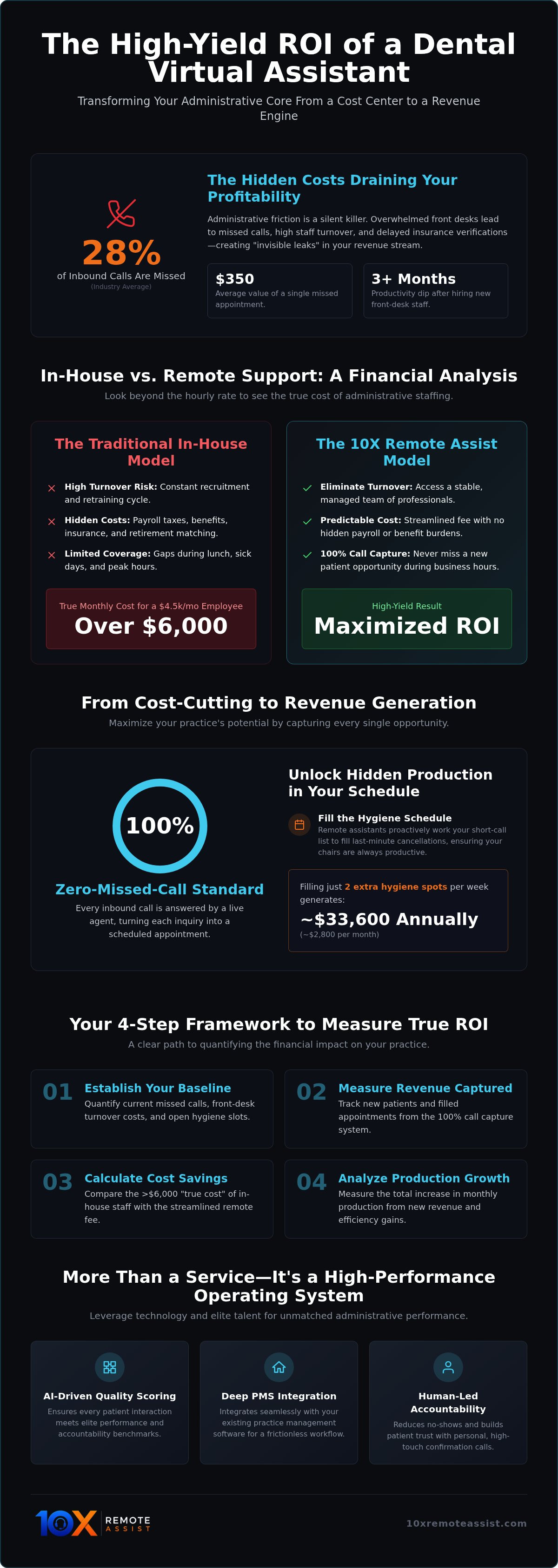
How to Measure Your Practice’s Virtual Assistant ROI in 4 Steps
Measuring dental virtual assistant ROI requires more than a glance at your bank statement. It demands a structured audit of your practice's operational pulse. To move from a cost-center mindset to a revenue-engine reality, you must quantify the efficiency gains that remote support provides. This four-step framework provides the clarity needed to justify your investment and scale your operations with confidence.
- Step 1: Baseline your current "Call Capture" and "Insurance Turnaround" metrics. You cannot improve what you haven't measured. Determine exactly how many calls go to voicemail during a typical week and how long it takes to verify a new patient's benefits.
- Step 2: Calculate the "Production Increase" from a fuller hygiene schedule. As established, filling just two additional spots per week can generate $2,800 in monthly revenue.
- Step 3: Factor in the "Overhead Reduction" from outsourced administrative tasks. Subtract the liabilities of payroll taxes, workers' comp, and benefits from your local budget.
- Step 4: Audit the "Quality Score" impact. Use performance tracking to see how improved call quality correlates with higher patient satisfaction and positive online reviews.
Metric 1: Call-to-Appointment Conversion
Your marketing budget is only as effective as your ability to answer the phone. If you're investing heavily in patient acquisition but missing nearly 30% of those leads, your cost per acquisition skyrockets. Measuring the ROI of every marketing dollar requires a 100% call capture rate. Setting firm benchmarks for new patient call success ensures that your remote team is converting curiosity into clinical production. For a deeper dive into these systems, consult The Ultimate Guide to Dental Call Center Services in 2026.
Metric 2: Insurance Revenue Cycle Efficiency
Revenue cycle efficiency is the backbone of a healthy practice. Measure the reduction in claim denials and the increase in "clean claim" rates. When insurance verification is handled remotely and proactively, your clinical team no longer wastes time on hold with payers. This efficiency translates directly into same-day production. Patients are more likely to accept treatment when their benefits are confirmed instantly. You save hours of clinical time that can be redirected toward higher-value procedures. If you're ready to see these numbers in action, schedule a performance audit to identify your practice's hidden revenue leaks.
Maximizing Your Returns with the 10X Remote Assist Operating System
Hiring a general virtual assistant is a staffing fix. Implementing a managed service is a strategic upgrade. While generic platforms might offer quick placement, they often lack the specialized oversight and dental-specific training required to protect your practice's reputation. To achieve the highest dental virtual assistant ROI, you need a system that offers more than just availability. You need a partner that functions as a high-performance operating system for your front office. This distinction between "extra hands" and a "managed system" is what separates a cost center from a revenue engine.
A managed service provides a layer of intelligence that a generalist simply cannot match. It involves more than just answering phones; it's about integrating specialized human talent with advanced performance tracking. This ensures that every task, from insurance verification to patient scheduling, is executed with professional rigor. By choosing a specialized provider, you aren't just filling a seat. You are installing a proactive solution that anticipates administrative friction before it impacts your bottom line.
The Power of AI Quality Scoring
Accountability is often the missing piece in remote work. 10X Remote Assist solves this by utilizing an AI-driven quality scoring system for every human-led call. This technology provides a level of transparency that's impossible to maintain with a local team. It's not just about oversight; it's about refinement. By recording and evaluating every interaction, we can protect your brand reputation and ensure your team uses the most effective communication scripts.
- Identify and correct tone or script deviations in real-time.
- Use call data to optimize conversion rates for new patient starts.
- Maintain 24/7 visibility into your remote team's performance metrics.
This data-driven approach allows you to see exactly how your investment is performing. You no longer have to guess if your team is following up on unscheduled treatment. The accountability is built into the system, providing you with total operational security.
Strategic Integration with Your PMS
Administrative errors are expensive. Double-entry mistakes in billing or scheduling can cost your practice thousands in lost production or denied claims. Our agents work directly within your existing Practice Management System (PMS) through seamless, real-time integration. This means your calendar is always accurate. There is no lag between a call being answered and an appointment being booked. This technical synergy is vital for maintaining a high dental virtual assistant ROI.
Security is equally paramount. We utilize HIPAA-compliant remote access protocols to ensure that your patient data remains secure while our agents perform their tasks. This isn't a detached call center. It's a strategic extension of your internal culture, backed by the human touch that patients value. By removing the manual entry burden from your local team, you allow them to focus on the high-value, in-person patient experiences that drive long-term loyalty.
Transforming Your Front Office into a Revenue Engine
The transition from traditional administrative staffing to a high-performance remote system is no longer a luxury for modern practices. It's a strategic necessity. By eliminating the high costs of staff turnover and capturing the revenue from missed calls, you turn a persistent liability into a measurable asset. Achieving a superior dental virtual assistant ROI involves more than just cutting payroll. It's about installing a system of total accountability and operational intelligence that scales with your growth.
Our trained human agents specialize in your revenue cycle, working directly within Dentrix, Eaglesoft, or Open Dental to ensure your schedule stays full. With AI-driven quality scoring for 100% accountability, you gain a level of transparency that an in-house team simply cannot provide. Stop letting revenue leak through missed connections and delayed insurance verifications. You've built a practice focused on clinical excellence; your administrative engine should reflect that same standard of care.
Calculate your practice’s growth potential with 10X Remote Assist and reclaim your focus on what matters most. Your practice deserves an administrative partner that works as hard as you do.
Frequently Asked Questions
How do I calculate the ROI of a dental virtual assistant?
To calculate your dental virtual assistant ROI, you must compare your total administrative spend against the revenue captured from previously missed opportunities. Subtract the monthly service fee from the combined value of recovered appointments and the reduction in in-house payroll liabilities. Many practices find that capturing just one or two additional high-value cases per month pays for the entire service. This formula provides a clear picture of how remote support functions as a profit engine.
Is a remote dental assistant cheaper than a full-time in-house employee?
Remote support is significantly more cost-effective than traditional hiring because it eliminates the fully burdened cost of employment. While a base salary is visible, the hidden expenses of payroll taxes, health insurance, 401k matching, and workers' compensation often add 20% to 30% to your overhead. By utilizing a managed service, you pay for specialized performance without the fixed liabilities of a full-time in-house employee. You also save on the physical real estate and hardware required for an on-site desk.
Can a virtual assistant really handle dental insurance verification accurately?
Specialized remote agents handle insurance verification with high precision because they focus exclusively on administrative tasks without the distractions of a busy clinical floor. These professionals perform detailed benefit breakdowns and verify eligibility directly within your practice management software. Because our system uses AI-driven quality scoring, every interaction is monitored for accuracy and compliance. This ensures that your team has reliable data for treatment coordination, reducing the risk of claim denials and billing errors.
What is the average cost of dental front office turnover in 2026?
The cost of front office turnover extends far beyond recruitment fees. When an employee leaves, your practice faces a productivity dip that can last three months during the onboarding of a replacement. You lose revenue from missed calls and delayed insurance processing while the new hire learns your systems. Industry benchmarks suggest that replacing a skilled administrative professional can cost between 50% and 150% of their annual salary when you factor in lost production and management time.
How does remote scheduling impact patient case acceptance rates?
Remote scheduling directly boosts case acceptance by removing the financial uncertainty that often stalls patient decisions. When a remote assistant provides an instant insurance breakdown, patients can commit to treatment on the spot. Consistent follow-up on unscheduled treatment plans ensures that no patient falls through the cracks. This persistent, professional outreach is often impossible for an overwhelmed in-house team to maintain, making remote support a critical component for increasing your total production.
Will my patients know they are talking to a remote assistant?
Patients won't notice a difference because our agents function as a seamless extension of your local team. These are real people, not AI voices, who are trained to reflect your specific practice culture and tone. They use your phone system and have real-time access to your calendar, allowing them to answer questions and book appointments with the same authority as an in-office receptionist. The goal is a high-touch, human experience that prioritizes patient care and professional confidence.
Do I need to change my practice management software to use a virtual assistant?
You don't need to change your current systems to implement remote support. 10X Remote Assist provides seamless integration with major platforms like Dentrix, Eaglesoft, and Open Dental. Our agents work directly within your existing software, ensuring that data is updated in real-time without the need for manual double-entry. This technical synergy allows your practice to maintain its established workflows while gaining the scalability and efficiency of a managed administrative team.
How long does it take to see a return on investment with remote support?
Most practices see a positive impact on their dental virtual assistant ROI within the first 30 days of implementation. The most immediate return comes from the 100% call capture rate, which ensures that no new patient leads are lost to voicemail. As the remote team clears insurance verification backlogs and fills hygiene holes, the revenue gains become even more apparent. Within the first quarter, the reduction in payroll overhead and increased case acceptance typically solidify the service as a high-yield investment.
Frequently Asked Questions
To calculate your dental virtual assistant ROI, you must compare your total administrative spend against the revenue captured from previously missed opportunities. Subtract the monthly service fee from the combined value of recovered appointments and the reduction in in-house payroll liabilities. Many practices find that capturing just one or two additional high-value cases per month pays for the entire service. This formula provides a clear picture of how remote support functions as a profit engine.
Remote support is significantly more cost-effective than traditional hiring because it eliminates the fully burdened cost of employment. While a base salary is visible, the hidden expenses of payroll taxes, health insurance, 401k matching, and workers' compensation often add 20% to 30% to your overhead. By utilizing a managed service, you pay for specialized performance without the fixed liabilities of a full-time in-house employee. You also save on the physical real estate and hardware required for an on-site desk.
Specialized remote agents handle insurance verification with high precision because they focus exclusively on administrative tasks without the distractions of a busy clinical floor. These professionals perform detailed benefit breakdowns and verify eligibility directly within your practice management software. Because our system uses AI-driven quality scoring, every interaction is monitored for accuracy and compliance. This ensures that your team has reliable data for treatment coordination, reducing the risk of claim denials and billing errors.
The cost of front office turnover extends far beyond recruitment fees. When an employee leaves, your practice faces a productivity dip that can last three months during the onboarding of a replacement. You lose revenue from missed calls and delayed insurance processing while the new hire learns your systems. Industry benchmarks suggest that replacing a skilled administrative professional can cost between 50% and 150% of their annual salary when you factor in lost production and management time.
Remote scheduling directly boosts case acceptance by removing the financial uncertainty that often stalls patient decisions. When a remote assistant provides an instant insurance breakdown, patients can commit to treatment on the spot. Consistent follow-up on unscheduled treatment plans ensures that no patient falls through the cracks. This persistent, professional outreach is often impossible for an overwhelmed in-house team to maintain, making remote support a critical component for increasing your total production.
Patients won't notice a difference because our agents function as a seamless extension of your local team. These are real people, not AI voices, who are trained to reflect your specific practice culture and tone. They use your phone system and have real-time access to your calendar, allowing them to answer questions and book appointments with the same authority as an in-office receptionist. The goal is a high-touch, human experience that prioritizes patient care and professional confidence.
You don't need to change your current systems to implement remote support. 10X Remote Assist provides seamless integration with major platforms like Dentrix, Eaglesoft, and Open Dental. Our agents work directly within your existing software, ensuring that data is updated in real-time without the need for manual double-entry. This technical synergy allows your practice to maintain its established workflows while gaining the scalability and efficiency of a managed administrative team.
Most practices see a positive impact on their dental virtual assistant ROI within the first 30 days of implementation. The most immediate return comes from the 100% call capture rate, which ensures that no new patient leads are lost to voicemail. As the remote team clears insurance verification backlogs and fills hygiene holes, the revenue gains become even more apparent. Within the first quarter, the reduction in payroll overhead and increased case acceptance typically solidify the service as a high-yield investment.
Build the remote team that runs this for you
We recruit, train and manage a dedicated remote team member for your practice.