
What if earning more five-star reviews had less to do with asking harder and more to do with asking consistently? Patients can leave a visit happy and move on without thinking to share feedback, while a busy front desk may not have time for reliable follow-up. A dental appointment reminder service can help keep patient communication organized, but review requests still need to feel personal, optional, and separate from care.
It’s reasonable to worry that asking for reviews could feel awkward or put pressure on patients. The answer isn’t to script a sales pitch or pursue only positive feedback. Instead, build a simple, patient-first process that invites honest comments from everyone and gives your team a clear, comfortable way to follow through.
This guide explains when and how to ask, how to make the invitation easy to decline, and what shortcuts to avoid. You’ll also learn how to respond thoughtfully and use recurring themes to improve communication and practice workflows. The goal is a steady stream of genuine insight, not a perfect-looking profile at any cost.
Key Takeaways
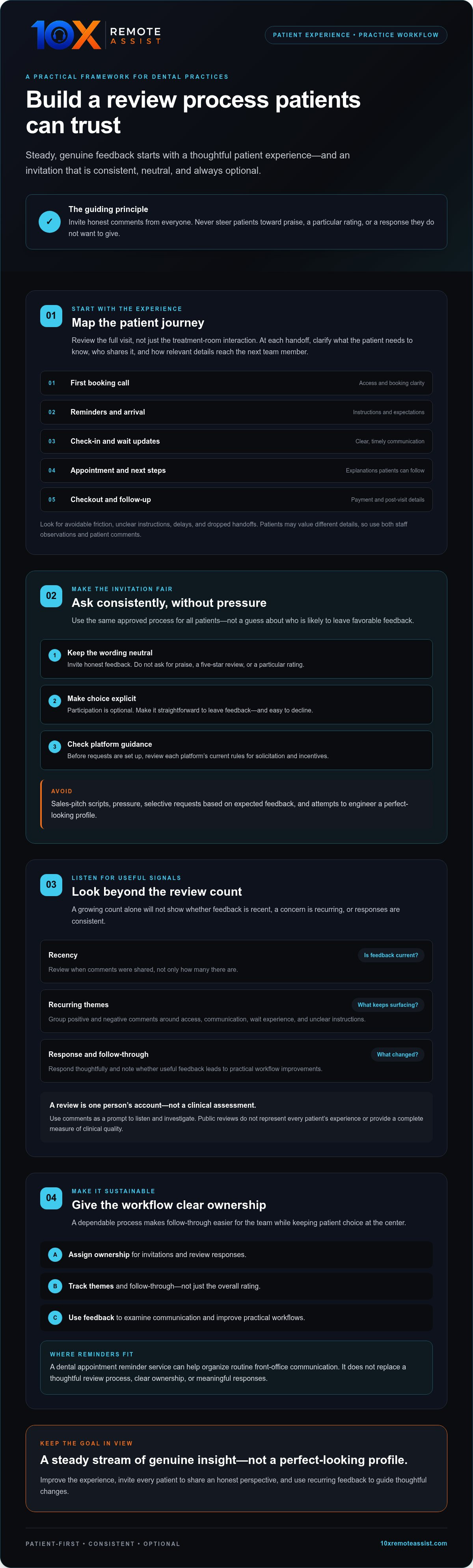
- Map each step of the patient journey to spot communication gaps that could affect the overall experience.
- Use a neutral invitation and the same approved process for all patients, rather than choosing who to ask based on expected feedback.
- Review positive and negative comments for recurring themes, then turn useful feedback into practical improvements.
- A dental appointment reminder service can support consistent front-office communication, but it isn’t a substitute for a thoughtful review process.
- Assign clear ownership for invitations and responses, then track feedback themes and follow-through to keep the workflow sustainable.
Why a Patient-First Review Process Matters for Dental Practices
A patient-first review process is a consistent invitation for voluntary, honest feedback. It doesn’t depend on guessing who had a good visit, and it doesn’t ask anyone to leave a positive or five-star rating. The purpose is to make sharing an experience straightforward while leaving each patient free to respond or not.
Reviews give prospective patients a window into how a practice communicates and what a visit may feel like. Comments may describe everyday details, such as whether booking was straightforward, the team explained next steps, or follow-up felt organized. This feedback offers useful context, but it isn’t a complete measure of clinical quality. Public reviews reflect individual experiences, not every patient’s experience or the care delivered in a clinical setting.
That distinction matters. The goal isn’t to engineer a perfect-looking rating or promise a particular result. It’s to improve the experience, then make it easy for patients to share their own perspective. A patient experience includes more than satisfaction with one interaction, so feedback can point to communication and process details worth examining.
What makes a dental review request feel trustworthy?
Trust starts with a clear, optional invitation. Ask for honest feedback, not praise. Use neutral wording, provide a straightforward way to leave a review, and make it clear that participation is the patient’s choice. Apply the same criteria consistently rather than inviting only patients expected to leave favorable comments. Before setting up requests, check the current rules of each review platform, including its guidance on solicitation and incentives.
An authentic review request invites honest feedback without steering the patient toward a particular rating.
Why review volume is not the only measure of progress
A growing review count can be encouraging, but it doesn’t show whether feedback is recent, whether the same concern keeps surfacing, or whether the practice responds consistently. Track those signals alongside the overall rating. A pattern of comments about unclear instructions, for example, may reveal a communication step the team can improve.
Keep the measures in perspective. A review is one person’s account, not a clinical assessment or a complete picture of the practice. Use it as a prompt to listen and investigate, not as a verdict on care. A dental appointment reminder service may help organize routine patient communication, but it isn’t a review-management tool. The lasting value comes from a dependable process that respects patient choice and helps the team act on useful feedback.
How to Build a Patient Experience Worth Reviewing
A review-worthy experience is built across the whole visit, not just in the treatment room. Map the patient journey from the first booking call through arrival, check-in, the appointment, checkout, and any follow-up. At each step, note what the patient needs to know, who provides that information, and how the next team member receives relevant details. Clear ownership helps prevent dropped handoffs and keeps patients from having to repeat themselves.
Consistent communication about booking, reminders, arrival instructions, wait updates, payment steps, and follow-up reduces uncertainty and helps the visit feel more coordinated. The Agency for Healthcare Research and Quality describes patient experience as an integral component of healthcare quality. That makes the practical details patients encounter worth examining alongside the care delivered during an appointment.
Which touchpoints most influence a patient’s impression?
Start with the moments where expectations are set or changed. Check whether patients can reach the practice to book, understand reminders and arrival instructions, and know what to expect at check-in. Then review how the team explains delays, treatment plans, payment steps, and what happens after the visit. A dental appointment reminder service can support one part of this communication flow, but it can’t resolve unclear instructions or inconsistent handoffs on its own.
Use more than one perspective. Ask staff where questions or delays tend to arise, and review patient comments for clues about confusing steps. Don’t assume every patient values the same details. One person may care most about getting a timely update; another may need clearer next-step instructions. The objective is to spot avoidable friction and make communication easier to follow.
How to turn recurring feedback into workflow improvements
Convert comments into operational signals. Group them by themes such as access, communication, wait experience, or follow-up. If comments repeatedly mention uncertainty about what happens after checkout, review whether the team gives consistent next-step guidance.
- Choose one issue: Focus on a recurring, specific point of friction.
- Assign an owner: Name the team member responsible for reviewing or updating the workflow.
- Check the change: Revisit staff observations and later feedback to see whether the issue continues.
Keep the measurement grounded. A rating can help show how patients describe their experiences, but it isn’t proof of a clinical outcome. Look for patterns, make a focused adjustment, and check whether communication feels clearer in practice. If front-office capacity makes consistent scheduling and follow-up difficult, explore how dental front-office support may fit into existing workflows.
How to Ask for Dental Reviews Without Pressuring Patients
A reliable request process should be easy for staff to follow and easy for patients to decline. Keep it simple: choose a suitable moment, make a neutral invitation, share one approved route for feedback, and record whether the invitation was offered. That final step helps the practice check whether the process is happening consistently, without treating a patient’s choice to respond as a staff performance measure.
Use the same criteria for who receives an invitation. Don’t ask only patients staff expect to be pleased, or divert others away from public feedback. A dental appointment reminder service supports appointment communication; it shouldn’t turn a review request into a demand or suggest that every patient must respond.
When should a practice invite patients to share feedback?
Choose a natural point after the visit, once the patient has had a chance to reflect. Avoid interrupting a clinical conversation, a sensitive moment, or urgent care. There’s no universal best time for every practice or patient. Test where a request fits your workflow, then check whether it feels comfortable for patients and manageable for staff.
For example, a team might offer the invitation during checkout or include it in a later follow-up, depending on the practice’s communication process. Keep the timing consistent, and make sure the request doesn’t compete with important care instructions.
What can staff say when asking for an honest review?
Use warm, plain language. Avoid asking for a particular star rating or implying that a positive review is expected. A brief script gives staff a dependable starting point while leaving room for a natural conversation:
“If you’d like to share feedback about your experience, you can leave an honest review here. It’s completely optional, and your feedback can include whatever you think is useful.”
Then offer one clear next step, such as the practice’s approved review link or printed instructions. Don’t offer a reward or make service conditional on posting. The FTC’s 2024 rule prohibits paying for reviews and suppressing negative reviews. Review-platform rules can also differ, so verify current guidance before choosing channels, considering incentives, or designing a process that routes patients based on how satisfied staff think they are.
Train the whole team to use the same core wording and explain how to mark an invitation as offered, without recording unnecessary personal details. A steady, low-pressure approach makes the request part of a clear workflow, not an awkward exception or a push for praise.
How to Respond to Dental Reviews and Learn From Them
Reviews are most useful when the practice has a clear routine for reading, responding, and acting on what patients share. Assign an owner to check review channels on a defined schedule, such as at set points during the workweek, and establish who handles responses when that person is unavailable. A dependable process prevents comments from being overlooked and gives the team time to respond thoughtfully rather than react in the moment.
For positive feedback, keep the reply brief and specific to the comment. Thank the reviewer for sharing, and acknowledge a detail they mentioned without disclosing information about their care. Avoid pasting the same generic response under every review. A little variation makes the practice sound attentive while keeping the reply professional.
How should a practice handle a negative dental review?
Stay calm. Acknowledge the concern without arguing, blaming, or confirming that the reviewer is a patient. Don’t discuss appointment details, treatment, billing, or other identifiable information in public, even if the reviewer includes those details first. Offer a private way to continue the conversation, such as contacting the practice through its established phone or office channel.
For example, a neutral reply can say that the practice takes feedback seriously and invite the person to get in touch privately. Route clinical, safety, or service concerns through the practice’s established internal process, so the appropriate team can assess them without turning a public reply into a case discussion.
How can review themes improve front-office workflows?
Look for repeated signals, not just individual complaints. Compare comments about reaching the office, booking, wait updates, or post-visit communication with the related call-handling, scheduling, and follow-up workflows. If scheduling access appears repeatedly, review where calls or requests may be getting delayed, then see the dental patient scheduling services guide for more context.
Use a short team review to select one practical improvement, name an owner, and decide how you’ll check whether the change is working. For instance, if patients mention unclear next steps, review the checkout communication and follow-up handoff. A dental front-office burnout solutions guide may also help practices examine whether workload is making consistent communication harder to maintain.
Front-office support can help protect team capacity for clear, dependable communication. If your practice needs help with scheduling or follow-up workflows, explore dental front-office support. A dental appointment reminder service can assist with routine appointment communication, but it isn’t a review-response system. Use review themes to identify process opportunities, and don’t treat ratings as evidence of clinical outcomes.
How to Make Review Requests a Sustainable Practice Workflow
A review process lasts when it fits the practice’s daily operations. Keep the workflow short, document it where the team can find it, and assign a clear owner. Include the approved wording, who receives an invitation, the channel and timing, how staff record that an invitation was offered, and a privacy check before any message is sent. Patients can choose whether to respond; no rating or review-count outcome should be promised.
What should a dental practice track?
Track whether the process is being followed, not whether patients comply. A simple practice-approved system can capture invitations offered, responses received, recurring feedback themes, and improvements completed. Limit notes to what the workflow needs, and restrict access to sensitive information. Before adopting a tool, confirm that it fits the practice’s systems and supports the intended workflow.
Review the process on a regular schedule. If invitations are being missed, adjust ownership or clarify handoffs. If patients respond but the same operational concern continues to appear, assign a practical improvement and record whether it was completed. Keep measures focused on learning and consistency, not pressuring staff or patients to produce a target rating.
How can practices protect staff capacity while improving follow-up?
Separate responsibilities clearly. The practice team remains responsible for approved review wording, channel choices, privacy checks, monitoring feedback, and decisions about workflow changes. Routine administrative work, such as scheduling, phone answering, insurance verification, and follow-up, may be supported by trained human front-office agents when the practice needs additional capacity. A dental call center services guide offers broader context on this type of operational support.
A dental appointment reminder service may help coordinate appointment communications, but it isn’t a substitute for a defined review workflow or review-management software. Confirm how any system fits with existing practice processes before relying on it, and keep a team member accountable for oversight.
Start with a workflow the team can maintain: one owner, clear steps, limited tracking, and a regular check-in. If your practice is reviewing how administrative work is handled, explore 10X Remote Assist for dental administrative support.
Build a Review Process Patients Can Trust
More genuine reviews start with a consistent patient experience, followed by a clear, optional invitation to share honest feedback. Make the process fair for all patients, respond to comments without revealing private information, and use recurring themes to improve communication. The goal isn’t to guarantee five-star ratings. It’s to build a practice that listens and keeps making useful changes.
A dental appointment reminder service can support routine patient communication, but it doesn’t replace a thoughtful review workflow. Consistent follow-up also depends on front-office capacity. 10X Remote Assist provides trained human agents for dental administrative tasks, including phone answering, insurance verification, scheduling, and follow-up. Calls are recorded and evaluated with AI-driven quality scoring, while the agents remain real people. The service integrates with existing practice management, CRM, and scheduling systems.
If your team is working to protect time for reliable communication and follow-up, explore how 10X Remote Assist supports dental front-office workflows. A manageable process, built around patient choice and steady improvement, gives your practice a strong foundation for earning honest feedback.
Frequently Asked Questions
How do I get more 5-star reviews for my dental practice?
Build an experience patients value, then make it easy for them to share honest feedback. Invite patients consistently, use neutral wording, and don’t ask only those you expect to be satisfied. A dental appointment reminder service can support routine patient communication, but it isn’t a review-management tool. Track whether invitations are offered and look for feedback themes you can use to improve communication, rather than promising a particular rating.
Is it appropriate to ask dental patients for an online review?
Yes, a practice can invite patients to share an honest review, as long as the request is optional and doesn’t steer them toward a positive rating. Use a consistent approach rather than selecting patients based on expected feedback. Before inviting reviews, check the current rules of the platform you plan to use. Keep the request separate from clinical conversations, and make clear that declining won’t affect the patient’s care.
Can a dental practice offer incentives for reviews?
Avoid paying or rewarding patients for reviews. The FTC’s 2024 rule prohibits paying for reviews, and the American Dental Association advises against paying for online reviews. Incentives can also affect whether feedback appears independent, and individual platforms may have additional rules. Check current platform policies before designing a review process, and never make an incentive or any aspect of service depend on whether a patient posts feedback.
When should a dental office ask a patient to leave a review?
Choose a natural point after the visit, when the patient has had time to reflect and isn’t focused on an urgent concern or clinical discussion. The right moment depends on the practice’s workflow and patient interactions, so there’s no universal best time. Test a consistent approach, such as offering the invitation at checkout or through an approved follow-up, then assess whether it feels comfortable for patients and staff.
What should a dentist do after receiving a negative review?
Respond calmly and professionally. Acknowledge the concern without arguing, blaming anyone, or discussing case-specific details in public. Invite the reviewer to contact the practice privately so the team can understand the issue through an appropriate channel. If the review raises a clinical, safety, or service concern, route it through the practice’s established internal process. Treat the comment as a signal to assess, not as a complete account of care.
Can a dental practice respond publicly to a patient review?
Yes, but the response must protect privacy. HIPAA privacy guidance prohibits a practice from acknowledging that a reviewer is a patient or disclosing protected health information in a public reply, even if the reviewer shares details first. Keep the response general, courteous, and brief. Thank reviewers for feedback or invite a reviewer with concerns to contact the practice privately. Check current privacy guidance when creating response procedures.
How can a dental office request reviews without pressuring patients?
Use a short, neutral invitation that asks for honest feedback and makes participation optional. For example: “If you’d like to share feedback about your experience, you can leave an honest review here. It’s completely up to you.” Offer one practice-approved route, apply the same invitation process consistently, and avoid requesting a specific rating. Record whether the invitation was offered, not whether the patient complied.
Frequently Asked Questions
Trust starts with a clear, optional invitation. Ask for honest feedback, not praise. Use neutral wording, provide a straightforward way to leave a review, and make it clear that participation is the patient’s choice. Apply the same criteria consistently rather than inviting only patients expected to leave favorable comments. Before setting up requests, check the current rules of each review platform, including its guidance on solicitation and incentives. An authentic review request invites honest feedback without steering the patient toward a particular rating.
Start with the moments where expectations are set or changed. Check whether patients can reach the practice to book, understand reminders and arrival instructions, and know what to expect at check-in. Then review how the team explains delays, treatment plans, payment steps, and what happens after the visit. A dental appointment reminder service can support one part of this communication flow, but it can’t resolve unclear instructions or inconsistent handoffs on its own. Use more than one perspective. Ask staff where questions or delays tend to arise, and review patient comments for clues about confusing steps. Don’t assume every patient values the same details. One person may care most about getting a timely update; another may need clearer next-step instructions. The objective is to spot avoidable friction and make communication easier to follow.
Choose a natural point after the visit, once the patient has had a chance to reflect. Avoid interrupting a clinical conversation, a sensitive moment, or urgent care. There’s no universal best time for every practice or patient. Test where a request fits your workflow, then check whether it feels comfortable for patients and manageable for staff. For example, a team might offer the invitation during checkout or include it in a later follow-up, depending on the practice’s communication process. Keep the timing consistent, and make sure the request doesn’t compete with important care instructions.
Use warm, plain language. Avoid asking for a particular star rating or implying that a positive review is expected. A brief script gives staff a dependable starting point while leaving room for a natural conversation: “If you’d like to share feedback about your experience, you can leave an honest review here. It’s completely optional, and your feedback can include whatever you think is useful.” Then offer one clear next step, such as the practice’s approved review link or printed instructions. Don’t offer a reward or make service conditional on posting. The FTC’s 2024 rule prohibits paying for reviews and suppressing negative reviews. Review-platform rules can also differ, so verify current guidance before choosing channels, considering incentives, or designing a process that routes patients based on how satisfied staff think they are. Train the whole team to use the same core wording and explain how to mark an invitation as offered, without recording unnecessary personal details. A steady, low-pressure approach makes the request part of a clear workflow, not an awkward exception or a push for praise. Reviews are most useful when the practice has a clear routine for reading, responding, and acting on what patients share. Assign an owner to check review channels on a defined schedule, such as at set points during the workweek, and establish who handles responses when that person is unavailable. A dependable process prevents comments from being overlooked and gives the team time to respond thoughtfully rather than react in the moment. For positive feedback, keep the reply brief and specific to the comment. Thank the reviewer for sharing, and acknowledge a detail they mentioned without disclosing information about their care. Avoid pasting the same generic response under every review. A little variation makes the practice sound attentive while keeping the reply professional.
Stay calm. Acknowledge the concern without arguing, blaming, or confirming that the reviewer is a patient. Don’t discuss appointment details, treatment, billing, or other identifiable information in public, even if the reviewer includes those details first. Offer a private way to continue the conversation, such as contacting the practice through its established phone or office channel. For example, a neutral reply can say that the practice takes feedback seriously and invite the person to get in touch privately. Route clinical, safety, or service concerns through the practice’s established internal process, so the appropriate team can assess them without turning a public reply into a case discussion.
Look for repeated signals, not just individual complaints. Compare comments about reaching the office, booking, wait updates, or post-visit communication with the related call-handling, scheduling, and follow-up workflows. If scheduling access appears repeatedly, review where calls or requests may be getting delayed, then see the dental patient scheduling services guide for more context. Use a short team review to select one practical improvement, name an owner, and decide how you’ll check whether the change is working. For instance, if patients mention unclear next steps, review the checkout communication and follow-up handoff. A dental front-office burnout solutions guide may also help practices examine whether workload is making consistent communication harder to maintain. Front-office support can help protect team capacity for clear, dependable communication. If your practice needs help with scheduling or follow-up workflows, explore dental front-office support. A dental appointment reminder service can assist with routine appointment communication, but it isn’t a review-response system. Use review themes to identify process opportunities, and don’t treat ratings as evidence of clinical outcomes. A review process lasts when it fits the practice’s daily operations. Keep the workflow short, document it where the team can find it, and assign a clear owner. Include the approved wording, who receives an invitation, the channel and timing, how staff record that an invitation was offered, and a privacy check before any message is sent. Patients can choose whether to respond; no rating or review-count outcome should be promised.
Track whether the process is being followed, not whether patients comply. A simple practice-approved system can capture invitations offered, responses received, recurring feedback themes, and improvements completed. Limit notes to what the workflow needs, and restrict access to sensitive information. Before adopting a tool, confirm that it fits the practice’s systems and supports the intended workflow. Review the process on a regular schedule. If invitations are being missed, adjust ownership or clarify handoffs. If patients respond but the same operational concern continues to appear, assign a practical improvement and record whether it was completed. Keep measures focused on learning and consistency, not pressuring staff or patients to produce a target rating.
Separate responsibilities clearly. The practice team remains responsible for approved review wording, channel choices, privacy checks, monitoring feedback, and decisions about workflow changes. Routine administrative work, such as scheduling, phone answering, insurance verification, and follow-up, may be supported by trained human front-office agents when the practice needs additional capacity. A dental call center services guide offers broader context on this type of operational support. A dental appointment reminder service may help coordinate appointment communications, but it isn’t a substitute for a defined review workflow or review-management software. Confirm how any system fits with existing practice processes before relying on it, and keep a team member accountable for oversight. Start with a workflow the team can maintain: one owner, clear steps, limited tracking, and a regular check-in. If your practice is reviewing how administrative work is handled, explore 10X Remote Assist for dental administrative support. More genuine reviews start with a consistent patient experience, followed by a clear, optional invitation to share honest feedback. Make the process fair for all patients, respond to comments without revealing private information, and use recurring themes to improve communication. The goal isn’t to guarantee five-star ratings. It’s to build a practice that listens and keeps making useful changes. A dental appointment reminder service can support routine patient communication, but it doesn’t replace a thoughtful review workflow. Consistent follow-up also depends on front-office capacity. 10X Remote Assist provides trained human agents for dental administrative tasks, including phone answering, insurance verification, scheduling, and follow-up. Calls are recorded and evaluated with AI-driven quality scoring, while the agents remain real people. The service integrates with existing practice management, CRM, and scheduling systems. If your team is working to protect time for reliable communication and follow-up, explore how 10X Remote Assist supports dental front-office workflows. A manageable process, built around patient choice and steady improvement, gives your practice a strong foundation for earning honest feedback.
Build an experience patients value, then make it easy for them to share honest feedback. Invite patients consistently, use neutral wording, and don’t ask only those you expect to be satisfied. A dental appointment reminder service can support routine patient communication, but it isn’t a review-management tool. Track whether invitations are offered and look for feedback themes you can use to improve communication, rather than promising a particular rating.
Yes, a practice can invite patients to share an honest review, as long as the request is optional and doesn’t steer them toward a positive rating. Use a consistent approach rather than selecting patients based on expected feedback. Before inviting reviews, check the current rules of the platform you plan to use. Keep the request separate from clinical conversations, and make clear that declining won’t affect the patient’s care.
Avoid paying or rewarding patients for reviews. The FTC’s 2024 rule prohibits paying for reviews, and the American Dental Association advises against paying for online reviews. Incentives can also affect whether feedback appears independent, and individual platforms may have additional rules. Check current platform policies before designing a review process, and never make an incentive or any aspect of service depend on whether a patient posts feedback.
Choose a natural point after the visit, when the patient has had time to reflect and isn’t focused on an urgent concern or clinical discussion. The right moment depends on the practice’s workflow and patient interactions, so there’s no universal best time. Test a consistent approach, such as offering the invitation at checkout or through an approved follow-up, then assess whether it feels comfortable for patients and staff.
Respond calmly and professionally. Acknowledge the concern without arguing, blaming anyone, or discussing case-specific details in public. Invite the reviewer to contact the practice privately so the team can understand the issue through an appropriate channel. If the review raises a clinical, safety, or service concern, route it through the practice’s established internal process. Treat the comment as a signal to assess, not as a complete account of care.
Yes, but the response must protect privacy. HIPAA privacy guidance prohibits a practice from acknowledging that a reviewer is a patient or disclosing protected health information in a public reply, even if the reviewer shares details first. Keep the response general, courteous, and brief. Thank reviewers for feedback or invite a reviewer with concerns to contact the practice privately. Check current privacy guidance when creating response procedures.
Use a short, neutral invitation that asks for honest feedback and makes participation optional. For example: “If you’d like to share feedback about your experience, you can leave an honest review here. It’s completely up to you.” Offer one practice-approved route, apply the same invitation process consistently, and avoid requesting a specific rating. Record whether the invitation was offered, not whether the patient complied.
Build the remote team that runs this for you
We recruit, train and manage a dedicated remote team member for your practice.