
In 2026, your patients aren't leaving because your clinical work is subpar; they're leaving because they feel like a ticket number in an automated system. Technology was supposed to make things easier, yet many practices find themselves trapped between ignored text blasts and rising insurance friction. It's a cycle that drains your team and leaves your hygiene chairs empty.
You know that a full schedule requires more than just a software login. It demands a seamless blend of professional rigor and human empathy. To truly improve dental patient retention rates, you must address the administrative bottlenecks that cause patients to quietly slip away. High front-desk turnover and complex billing shouldn't be the reason your practice growth stalls.
This strategic guide promises to show you how to stop patient attrition and build long-term loyalty by mastering operational excellence. We'll explore the systems needed to eliminate insurance frustration, stabilize your scheduling, and lower administrative stress for your in-house team. It's time to move beyond reactive fixes and implement a proactive, human-centric operating system for your business.
Key Takeaways
- Calculate the true value of a loyal patient and identify why traditional retention metrics are failing in 2026.
- Discover why live human interaction outperforms automated voices in building the trust required for long-term clinical loyalty.
- Identify the administrative friction points, like insurance verification and billing disputes, that drive patients to your competitors.
- Implement a structured five-step framework designed to improve dental patient retention rates by offloading non-clinical tasks.
- Learn how integrating specialized remote support into your existing systems creates a seamless, high-touch experience for every caller.
The Leaky Bucket: Why Dental Patient Retention Rates Stall in 2026
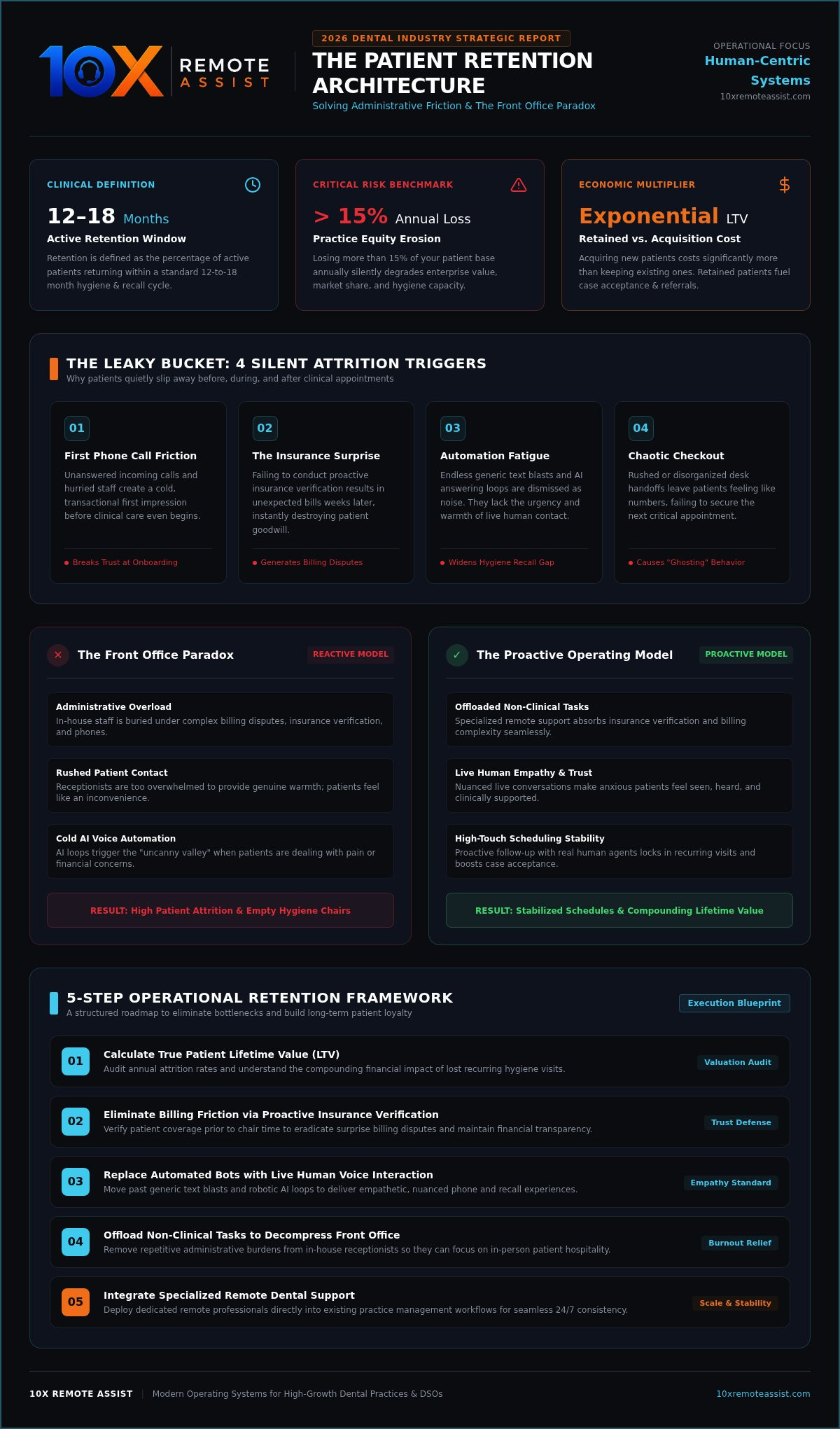
The "leaky bucket" isn't a new metaphor. It is, however, more dangerous in 2026 than it was a decade ago. In the dental industry, patient retention is defined as the percentage of active patients who return for a visit within a 12 to 18 month period. If your practice is losing more than 15% of its base annually, you aren't just losing appointments; you're losing the equity of your business. To improve dental patient retention rates, you must look beyond the clinical chair. Patients are exhausted by the automation fatigue that comes from endless generic text blasts and AI voice loops. They crave a personalized interaction that proves they're valued as individuals.
Traditional practices often focus exclusively on new patient acquisition. This is a strategic error. The cost of acquiring a new patient is significantly higher than the cost of keeping one. Retained patients represent exponential value through high-case acceptance and consistent hygiene revenue. They are the engine of your growth. When this engine stalls, it's usually due to friction at key attrition points: the first phone call, the checkout process, or the follow-up. These moments of truth determine whether a patient becomes a lifelong advocate or a one-time visitor.
The True Cost of a Lost Patient
A single lost patient is a multi-thousand dollar hit to your bottom line. When you calculate the Lifetime Value (LTV), you're looking at years of recurring hygiene, restorative work, and potential referrals. Dissatisfied patients don't just leave; they stop referring their social circles. This ghosting phenomenon creates a quiet erosion of your market share. For DSOs and private owners, high attrition rates directly lower practice valuations. A stable, recurring patient base is the most valuable asset you have. High patient satisfaction is the foundation of this stability. Without it, you're constantly spending more on marketing just to stay in the same place.
Identifying the 'Silent' Attrition Triggers
Attrition often starts before the patient even meets the doctor. It begins with an unanswered phone call or a one-and-done experience where a patient feels like a transaction. One of the most common triggers is the insurance surprise. When a practice fails to perform proactive insurance verification, the patient is hit with an unexpected bill weeks later. This instantly kills trust. Additionally, the hygiene gap is widening. Automated reminders are being ignored because they lack the urgency and personal touch of a live human agent. If your checkout process is chaotic or your follow-ups feel robotic, you're signaling that the relationship doesn't matter. To improve dental patient retention rates, you must eliminate these administrative friction points once and for all.
The Human Connection: Building Trust Beyond Automated Reminders
Clinical excellence is a baseline expectation. In 2026, the real differentiator is how a patient feels when they aren't in the chair. Most practices rely on automated text blasts to fill their schedules, yet these digital pings are often dismissed as noise. To truly improve dental patient retention rates, you must prioritize the human voice. Trust isn't built through a software algorithm; it's forged through nuanced conversation and active listening. It's the difference between a patient who shows up and a patient who advocates for your brand.
We see a recurring "Front Office Paradox" in modern dentistry. Your staff is often too overwhelmed with administrative tasks to be genuinely friendly, yet that friendliness is exactly what keeps patients from switching providers. When a receptionist is rushed, the patient feels like an inconvenience. This friction creates a disconnect that no amount of clinical skill can repair. Empathy is a powerful clinical tool, especially for high-anxiety patients who need reassurance before they ever step foot in your office. It's about making them feel seen, heard, and valued.
Why Your Patients Hate AI Voices
Patients today are hyper-aware of the "uncanny valley" in healthcare communication. Robotic voices and AI-driven answering services feel cold and dismissive when a patient is dealing with physical pain or financial concerns. Complex scheduling and insurance nuances require human judgment that technology simply cannot replicate. The Empathy Gap in automated dental communication occurs when efficiency is prioritized over the patient's need to be heard. Considering oral health statistics from the CDC, which highlight the prevalence of dental issues and the need for regular care, the requirement for accessible, human-led support is more critical than ever.
Mastering the 'Welcome' Call and the 'Care' Follow-Up
The first phone call is your practice's digital handshake. A live human answering on the first ring signals professional rigor and respect for the patient's time. Similarly, post-operative "care" calls are the highest-ROI activity for building long-term loyalty. They demonstrate that your concern for the patient extends beyond the billing cycle. Utilizing specialized dental patient scheduling services ensures that these vital touchpoints are never missed, even during your busiest hours. By offloading these tasks to a dental virtual assistant, you ensure every patient receives a premium, bespoke experience. This level of intentionality is how you masterfully improve dental patient retention rates while reducing the burden on your in-house team.
Eliminating Administrative Friction: The Role of Insurance and Billing
Financial friction is the silent killer of practice growth. While clinical care happens in the operatory, the decision to return is often made at the front desk or upon opening a surprise bill weeks later. Billing disputes are the primary reason patients switch dentists, far outweighing clinical dissatisfaction. To improve dental patient retention rates, you must treat financial transparency as an extension of your clinical protocol. When a patient understands their investment, they trust your recommendations. When they feel blindsided by costs, that trust evaporates instantly.
Administrative hurdles often act as significant barriers to consistent care. According to CDC oral health statistics, financial constraints and lack of coverage are major factors preventing individuals from seeking necessary dental services. If your billing process is opaque or reactive, you're inadvertently reinforcing these barriers. Trust is fragile; it's easily broken by a miscalculated co-pay or an unexpected claim denial. Reducing checkout friction by ensuring the patient knows their exact responsibility before they leave the chair is a non-negotiable standard for 2026.
Proactive Verification vs. Reactive Billing
The traditional reactive model is a recipe for churn. A patient arrives, your team guesses their coverage, and the patient receives a bill for the balance a month later. This surprise billing structure is the fastest way to lose a loyal patient. Transitioning to a proactive model involves mastering dental insurance eligibility verification before the patient even walks through the door. By providing a detailed breakdown of benefits upfront, you eliminate checkout friction and increase case acceptance. Software alone cannot navigate the nuances of complex claim statuses. It requires specialized expertise to ensure accuracy and accountability.
Handling Denials Without Losing the Patient
When an insurer denies a claim, patients rarely blame the insurance company. They blame the office that provided the treatment. This psychological shift can turn a long-term advocate into a vocal critic. Specialized billing and claims support acts as an advocate for the patient, navigating the complexities of denials without your clinical staff losing focus. Maintaining a human touch during these difficult financial conversations is vital. It’s about solving the problem alongside the patient rather than leaving them to face a financial burden alone. This level of professional rigor is essential to improve dental patient retention rates in an increasingly competitive market.
A 5-Step Framework to Improve Dental Patient Retention Rates
Retention is not a byproduct of good luck; it is the direct output of a disciplined operational system. To improve dental patient retention rates, you must move beyond reactive fixes and implement a repeatable framework that minimizes human error. This process begins with an honest assessment of your current administrative gaps. By auditing your phone and scheduling data, you can pinpoint exactly where patients are falling through the cracks, whether it's unreturned voicemails or hygiene appointments that were never rebooked.
Step 2: The Power of Remote Front-Office Support
The "Staffing Paradox" is real. Your front-desk team cannot provide a premium patient experience while the phones ring every ninety seconds. Implementing dental call center services acts as a secret weapon for growing practices. These specialized remote teams serve as a seamless extension of your in-house staff, handling high-volume tasks like insurance verification and scheduling. This offloading prevents front-desk burnout and ensures that the human touch remains consistent, regardless of how busy the clinical side becomes.
Once you've stabilized the phones, you must introduce accountability. Step 3 involves using AI-driven call quality scoring for every interaction. This system ensures that every live human agent, whether remote or in-house, is meeting your practice's standards for empathy and professional rigor. It turns "gut feelings" about performance into actionable data points that can be used for continuous improvement.
Step 4: Proactive Reactivation Strategies
Automated text reminders are a commodity; a live reactivation call is a relationship. Step 4 focuses on executing a proactive hygiene reactivation campaign to improve dental patient retention rates through live, human-led outreach. The goal isn't just to fill a chair; it's to invite the patient back into a health-focused partnership. By tracking your "Reactivation ROI," you can see exactly how much revenue is recovered from patients who otherwise would have ghosted the practice. Finally, Step 5 requires standardizing the insurance breakdown process to ensure total financial transparency before the patient arrives.
Ready to bring order to your administrative chaos? Explore our dental remote support solutions to see how we can stabilize your patient base today.
Scaling Loyalty: How 10X Remote Assist Secures Your Patient Base
Operational security is the final piece of the retention puzzle. At 10X Remote Assist, our philosophy centers on a masterfully balanced approach: high-tech systems paired with high-touch human talent. We don't believe in the impersonal nature of modern automation. Instead, we provide live, trained human agents who act as a specialized extension of your front office. These agents integrate directly with your existing PMS and scheduling software. This ensures that every interaction is recorded, every appointment is synchronized, and no patient ever feels like they've been handed off to an impersonal third party.
Transitioning from a "busy" office to a "productive" practice requires a shift in mindset. A busy office reacts to the ringing phone; a productive practice manages the patient relationship proactively. By offloading scheduling, insurance verification, and billing support to our remote team, your in-house staff can focus on the patients currently in your office. This synergy is the most effective way to improve dental patient retention rates without increasing your local headcount or operational overhead.
Real-Time Performance and Accountability
Accountability is built into our DNA. Our proprietary operating system tracks every patient interaction with professional rigor. We utilize AI-driven quality scoring to monitor real human conversations, ensuring that our agents maintain the highest standards of empathy and intelligence. This isn't about surveillance; it's about performance tracking that leads to better patient outcomes. You can use this real-time data to identify which strategies actually improve dental patient retention rates and where adjustments are needed. Every call is recorded for quality assurance, providing a transparent look into the health of your patient pipeline.
Joining the 10X Ecosystem
We offer customizable monthly managed services designed for practices of all sizes. Whether you're a boutique private office or a multi-location DSO, our remote team adapts to your specific culture and workflow. We provide a "living" presence that grows with your practice, ensuring that your administrative systems are never the bottleneck for your clinical success. It's time to bring order to the chaos of the front desk. Stop the churn and start growing with 10X Remote Assist today to build a practice that patients never want to leave.
Mastering the Human-Centric Operating System
Patient loyalty in 2026 is the direct result of intentional, high-performance systems. You've learned that administrative friction and automation fatigue are the primary drivers of churn. To improve dental patient retention rates, your practice must prioritize human connection while maintaining professional rigor. This involves eliminating billing surprises and ensuring every caller feels like a priority rather than a distraction. When you remove the administrative burden from your in-house team, you create space for genuine patient care.
10X Remote Assist provides the specialized talent and intelligence needed to stabilize your patient base. Our dental-only trained agents provide a premium experience, backed by AI-driven call quality scoring on every interaction for total accountability. We offer seamless integration with Dentrix, Open Dental, and Eaglesoft, functioning as a bespoke extension of your internal culture. This isn't just a service; it's an operating system for practice growth.
Stop the cycle of attrition and reclaim your time. Secure Your Patient Base with 10X Remote Assist and build a practice that thrives on loyalty. Your patients deserve a human touch, and your practice deserves operational security.
Frequently Asked Questions
What is a good dental patient retention rate in 2026?
Industry benchmarks typically suggest that a healthy retention rate for a growing practice sits between 80% and 85%. While some elite offices target 90%, anything below 70% suggests a "leaky bucket" that demands operational changes. To improve dental patient retention rates, you must shift your focus from constant acquisition to the administrative excellence that keeps existing patients in your chairs.
How do I calculate my practice's patient retention rate?
You can calculate this by dividing the number of active patients who visited in the last 18 months by your total unique patients from the preceding 18-month period. Multiply that result by 100 to get your percentage. This metric serves as a vital sign for your practice's long-term health. Tracking it monthly allows you to identify seasonal trends and measure the direct impact of your reactivation efforts.
Can remote agents really sound like they are in my office?
Yes, because our live human agents are trained as a seamless extension of your specific office culture. Unlike impersonal answering services, our agents utilize your practice management software and follow your preferred protocols. Patients don't feel a difference in quality or knowledge between an in-house staff member and a dedicated remote professional. This creates a unified brand experience that builds long-term trust.
Why is my hygiene schedule always empty despite automated reminders?
Automation fatigue has made patients increasingly likely to ignore generic text messages and emails. A text is easy to dismiss; a professional phone call from a live human agent is a relationship. Human outreach allows for real-time objection handling and personal connection. If your schedule is stalled, it's likely because your system lacks the proactive human touch required to overcome modern digital noise.
Does insurance verification really impact patient retention?
Insurance friction is one of the leading causes of patient churn. When a patient receives an unexpected bill due to poor verification, it destroys the trust built in the clinical chair. Proactive insurance verification ensures total financial transparency before the appointment begins. By eliminating billing surprises, you remove the primary reason patients seek out competitors who offer a more seamless administrative experience.
How does call quality scoring help improve patient loyalty?
Call quality scoring provides objective data on how your team handles patient concerns, empathy, and scheduling. By evaluating recorded interactions with AI-driven scoring, you ensure every caller receives a premium experience. This level of accountability prevents "dropped balls" and ensures that your front-office standards remain consistent. High-quality interactions lead to higher case acceptance and help improve dental patient retention rates over time.
What is the difference between a virtual assistant and a specialized dental remote team?
General virtual assistants often lack the industry-specific knowledge required to handle complex dental billing, coding, and scheduling. A specialized dental remote team is comprised of experts trained exclusively in dental practice management. These teams integrate directly with systems like Dentrix, Open Dental, and Eaglesoft. They understand clinical terminology and insurance nuances, acting as a high-performance operating system rather than just a basic administrative helper.
How long does it take to see an improvement in retention after starting with 10X?
Most practices observe a stabilized hygiene schedule and reduced phone abandonment within the first 30 to 60 days. Initial improvements often come from clearing the backlog of insurance verifications and executing immediate reactivation calls to ghosted patients. Long-term loyalty gains typically solidify over six months as your new administrative standards become the baseline for every patient interaction, ensuring total operational security.
Frequently Asked Questions
Industry benchmarks typically suggest that a healthy retention rate for a growing practice sits between 80% and 85%. While some elite offices target 90%, anything below 70% suggests a "leaky bucket" that demands operational changes. To improve dental patient retention rates, you must shift your focus from constant acquisition to the administrative excellence that keeps existing patients in your chairs.
You can calculate this by dividing the number of active patients who visited in the last 18 months by your total unique patients from the preceding 18-month period. Multiply that result by 100 to get your percentage. This metric serves as a vital sign for your practice's long-term health. Tracking it monthly allows you to identify seasonal trends and measure the direct impact of your reactivation efforts.
Yes, because our live human agents are trained as a seamless extension of your specific office culture. Unlike impersonal answering services, our agents utilize your practice management software and follow your preferred protocols. Patients don't feel a difference in quality or knowledge between an in-house staff member and a dedicated remote professional. This creates a unified brand experience that builds long-term trust.
Automation fatigue has made patients increasingly likely to ignore generic text messages and emails. A text is easy to dismiss; a professional phone call from a live human agent is a relationship. Human outreach allows for real-time objection handling and personal connection. If your schedule is stalled, it's likely because your system lacks the proactive human touch required to overcome modern digital noise.
Insurance friction is one of the leading causes of patient churn. When a patient receives an unexpected bill due to poor verification, it destroys the trust built in the clinical chair. Proactive insurance verification ensures total financial transparency before the appointment begins. By eliminating billing surprises, you remove the primary reason patients seek out competitors who offer a more seamless administrative experience.
Call quality scoring provides objective data on how your team handles patient concerns, empathy, and scheduling. By evaluating recorded interactions with AI-driven scoring, you ensure every caller receives a premium experience. This level of accountability prevents "dropped balls" and ensures that your front-office standards remain consistent. High-quality interactions lead to higher case acceptance and help improve dental patient retention rates over time.
General virtual assistants often lack the industry-specific knowledge required to handle complex dental billing, coding, and scheduling. A specialized dental remote team is comprised of experts trained exclusively in dental practice management. These teams integrate directly with systems like Dentrix, Open Dental, and Eaglesoft. They understand clinical terminology and insurance nuances, acting as a high-performance operating system rather than just a basic administrative helper.
Most practices observe a stabilized hygiene schedule and reduced phone abandonment within the first 30 to 60 days. Initial improvements often come from clearing the backlog of insurance verifications and executing immediate reactivation calls to ghosted patients. Long-term loyalty gains typically solidify over six months as your new administrative standards become the baseline for every patient interaction, ensuring total operational security.
Build the remote team that runs this for you
We recruit, train and manage a dedicated remote team member for your practice.