
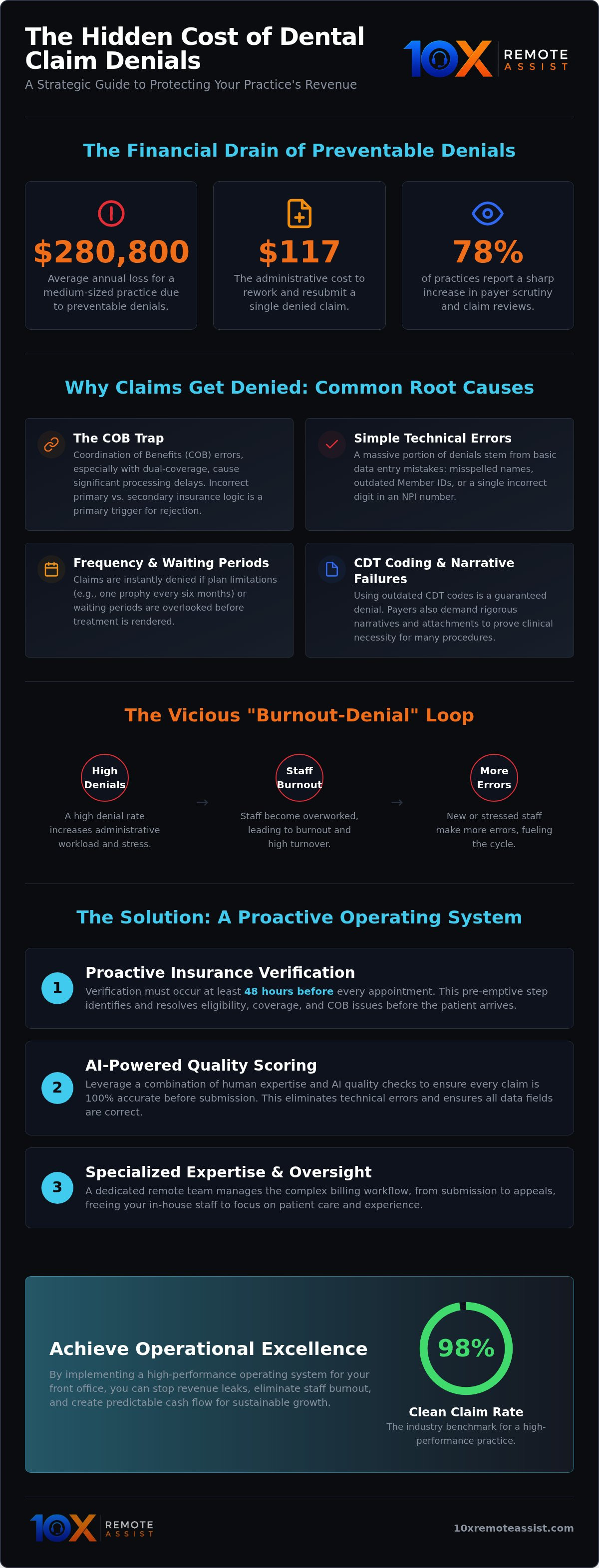
A medium-sized dental practice loses an average of $280,800 annually to claim denials that were entirely preventable. This isn't just a line item on a balance sheet. It represents hundreds of hours of staff burnout and a fractured patient experience. Mastering how to prevent dental claim denials is now a core strategic necessity, especially since 78% of practices reported a sharp increase in payer scrutiny by March 2026.
You're likely exhausted by the cycle of repetitive phone calls and the "missing information" notices that stall your cash flow. It feels like the insurance landscape is designed to be an intentional maze. We're here to provide the map. By implementing a high-performance operating system for your front office, you can achieve a clean claim rate above 95% and finally stabilize your reimbursement cycles.
This guide outlines a systematic approach to eliminating denials through proactive insurance verification, precise documentation, and expert administrative workflows. We'll show you how to transform your billing process from a reactive headache into a seamless, predictable engine for growth.
Key Takeaways
- Stop the revenue leak. A single denied claim costs $117 to rework and drains your internal team's morale.
- Discover how to prevent dental claim denials by identifying technical errors and Coordination of Benefits hurdles before submission.
- Build a proactive workflow. Learn why insurance verification must happen at least 48 hours prior to every patient appointment.
- Integrate specialized expertise. See how human intelligence and AI quality scoring create a seamless, high-performance extension of your front office.
- Achieve operational security. Use performance tracking and a proprietary operating system to maintain a 98% clean claim rate.
The Financial Impact of Dental Claim Denials in 2026
Every denied claim is a leak in your practice’s financial foundation. In 2026, the stakes have never been higher. Industry data confirms that the average cost to rework and resubmit a single denied claim is $117. For a medium-sized practice, these administrative friction points accumulate into an average annual loss of $280,800. This isn't just a minor inconvenience. It’s a systemic failure. Understanding how dental insurance works in today's legislative environment is the first step in learning how to prevent dental claim denials and reclaiming your lost revenue.
The "standard" verification processes of the past are failing. The CDT 2026 code set introduced 60 changes this year, including 31 new codes and 12 revisions. Practices that failed to update their systems saw a 34% spike in denial rates in the first quarter of 2026. Beyond the immediate cash flow delay, these denials poison patient trust. When a patient receives an unexpected bill because a claim was rejected, their confidence in your office dissolves, and treatment acceptance rates for future procedures inevitably plummet.
Revenue Cycle Management (RCM) Leakage
RCM leakage represents the quantifiable gap between the clinical services your team provides and the actual revenue your practice collects, typically driven by fragmented administrative workflows and preventable claim errors. When your denial rate hovers around 10%, you're likely facing a six-figure deficit in annual growth. This leakage is often invisible until it’s aggregated. It stems from a lack of specialized oversight and a reliance on reactive billing rather than proactive revenue protection. By the time you realize a claim is denied, the window for efficient resolution has already started to close, dragging down your practice's overall valuation.
The Burden on In-House Staff
There is a direct, measurable correlation between front-desk turnover and rising denial rates. We call this the "Burnout-Denial" loop. Your team didn't join the dental profession to spend six hours a day "insurance wrestling" with payers. The psychological toll of repetitive phone calls and technical data entry is the primary driver of administrative burnout. When a stressed staff member misses a single digit on a birthday or an NPI number, the cycle resets.
High turnover means you're constantly operating with a "training-level" front office. This lack of continuity ensures that how to prevent dental claim denials remains a mystery to your revolving door of employees. Shifting this burden to a high-performance operating system allows your local team to return to what they do best: providing a premium patient experience. Proactive revenue protection isn't just about the money. It's about preserving the culture of your practice.
Root Causes: Why Dental Claims Get Denied
Denials are often the byproduct of administrative invisibility. A misspelled name, an outdated member ID, or a single digit error in an NPI number can trigger an immediate rejection. These technical denials account for a massive portion of revenue leakage. While 78% of practices report increased payer scrutiny in 2026, many still struggle with the basics. Precise data entry is the only way to ensure a first-pass approval. Understanding the root causes is the foundation for anyone learning how to prevent dental claim denials effectively.
Frequency limitations and waiting period oversights are equally destructive. If a patient had a prophy four months ago and their plan only allows one every six months, the claim is dead on arrival. These details are frequently buried in the fine print of a benefit breakdown. Without a proactive system to flag these limitations before the patient sits in the chair, your practice is essentially providing free clinical care.
The Coordination of Benefits (COB) Trap
Dual-coverage households are a primary source of administrative friction. Automated bots often struggle with the logic of primary versus secondary insurance, leading to processing delays. The Birthday Rule remains a standard in 2026, but human oversight is required to verify which plan takes precedence before the claim is even generated. Human verification catches these errors early. Specialized billing and claims support ensures these complexities are resolved during the verification phase, preventing the back-and-forth that stalls your cash flow. It's about getting the logic right the first time.
CDT Coding and Narrative Failures
The CDT 2026 code set arrived with 60 significant changes, including 31 new codes and 12 revisions. Using outdated codes is a guaranteed path to denial. Beyond the codes themselves, payers now demand rigorous proof of clinical necessity for even routine procedures. A standard claim for a crown or a complex extraction often requires a custom narrative and high-quality intraoral photos to meet approval criteria. This increased scrutiny is part of a broader trend that has led to significant advocacy against retroactive denials by professional organizations. You can't rely on generic templates anymore. Every claim needs a "clinical story" backed by high-quality radiographs and clear, descriptive narratives that justify the treatment to the insurance adjuster.
A 5-Step Workflow for Dental Insurance Claim Denial Management
Efficiency isn't an accident. It's the result of a repeatable, disciplined system that removes the guesswork from your revenue cycle. While many practices rely on automated bots for verification, these tools often miss the policy nuances that lead to rejections. A high-performance strategy requires human intelligence to interpret complex plan limitations. If you want to master how to prevent dental claim denials, you must move from a reactive "hope it pays" mindset to a proactive, five-step operating system.
- Step 1: Comprehensive Insurance Verification: Perform this at least 48 hours before the patient arrives to clear any eligibility hurdles.
- Step 2: Real-time Data Entry and PMS Synchronization: Update patient records immediately to ensure the billing software reflects the most current coverage data.
- Step 3: Pre-Submission Audit: Conduct a "Clean Claim" check to catch technical errors before they leave your office.
- Step 4: Systematic Claim Tracking: Monitor every submission's status to identify and resolve "stuck" claims before they age past 30 days.
- Step 5: Denial Analysis and Feedback Loops: Review every rejected claim to identify patterns and adjust your front-office training accordingly.
Mastering the Pre-Appointment Verification
Verifying "active coverage" is no longer enough to protect your cash flow. In the 2026 insurance environment, you need a full breakdown of benefits that includes remaining annual maximums, specific frequency limits, and any pending claims from other offices. This granular data allows your treatment coordinator to present accurate out-of-pocket estimates, which builds patient trust. For a deeper dive into these standards, see our Mastering Dental Eligibility Verification 2026 Guide. When your team knows the exact limitations of a plan, they can flag potential denials before the clinical work even begins.
Establishing a Pre-Submission Audit
Every claim should pass through a rigorous checklist before submission. This is especially critical for multi-doctor practices where NPI alignment and provider credentials can easily get crossed. Adhering to the latest CMS billing and coding guidelines ensures that your clinical data matches payer expectations. A comprehensive pre-submission audit requires verifying the patient’s legal name, current subscriber ID, specific CDT code accuracy, NPI alignment for the treating provider, and the inclusion of all required clinical attachments. By catching these details early, you reduce the administrative burden on your staff and accelerate your reimbursement cycles. It's a simple process that yields massive financial security.
Leveraging Specialized Remote Teams to Prevent Denials
Technology alone cannot solve a human-made problem. While many vendors claim that automation is the silver bullet for revenue recovery, the reality of the 2026 insurance market is far more nuanced. Mastering how to prevent dental claim denials requires a hybrid approach: specialized human expertise amplified by intelligent quality scoring systems. By integrating a dedicated remote team, your practice gains an elite administrative layer that functions as a seamless extension of your local staff. This isn't just about outsourcing. It's about upgrading your practice's operating system.
Insurance companies haven't fully automated their side of the fence. They still rely on complex call trees and manual adjudicators who require specific clinical explanations. Human agents are simply better at navigating these obstacles. They understand the subtext of a representative's response. They know when to push back on a secondary insurance error. This specialized oversight ensures that every insurance breakdown is accurate and every follow-up is documented with professional rigor. It effectively eliminates the "hold time" burden that currently drains your in-house clinical staff's productivity.
Human Intelligence vs. AI Automation
Automation has its limits. While AI can scan a document for missing fields, it cannot negotiate with an insurance adjuster over a contested crown narrative. Our model utilizes live human agents who are supported by AI-driven quality scoring for every interaction. This creates a double layer of accountability. You get the nuanced problem-solving of a dental professional combined with the data-driven precision of modern tech. This hybrid structure allows for "always-on" claim status follow-ups, ensuring that no submission lingers in limbo for more than 30 days. It turns a reactive billing cycle into a proactive engine for growth.
Seamless PMS and CRM Integration
Your existing workflow shouldn't have to change to accommodate better results. High-performance remote support operates directly within your Practice Management System (PMS) and CRM. 10X Remote Assist agents log in to your software, update patient records in real-time, and ensure that data synchronization is flawless. This maintains your existing tools while significantly upgrading the intelligence behind them. You can learn more about these integrated workflows in our ultimate guide to dental call center services in 2026. By having a dedicated team focused exclusively on verification and billing, your in-house staff is finally free to focus on the patient in the chair. It's a strategic division of labor that secures your revenue without disrupting your office culture.
Ready to stop the revenue leak? Secure your practice’s growth by partnering with specialized billing and claims support experts today.
Clean Claims and Operational Excellence with 10X Remote Assist
Operational excellence is the inevitable result of a superior system. While many practices settle for a baseline denial rate of 15% or higher, our partners consistently achieve a 98% clean claim rate. This level of precision is only possible when you move beyond manual oversight and adopt a high-performance administrative framework. Understanding how to prevent dental claim denials at scale requires more than just better software. It requires an integrated workforce that specializes in the intricate nuances of dental insurance breakdowns and payer behavior.
The most significant impact of this system is felt by your local team. When you remove the burden of insurance wrestling, your staff can finally focus on patient experience and case acceptance. A front desk that isn't tethered to a phone tree is a front desk that has the time to build relationships and close treatment plans. Whether you manage a single boutique practice or a multi-location DSO, this model is fully scalable. It provides the administrative stability needed to expand without increasing your local headcount or overhead costs.
The 10X Remote Assist Advantage
We provide more than just remote support. We provide a proprietary operating system designed for performance tracking and total accountability. Every interaction processed by our agents undergoes AI-driven quality scoring to ensure absolute accuracy. This double-layer of verification catches the technical errors that typically slip through the cracks of a busy front office. Our agents aren't generalists. They are specialists who live and breathe CDT codes and payer policies. This specialized focus transforms your billing from a chaotic cost center into a predictable engine for growth.
Next Steps for Your Practice
The first step toward recovery is identifying where your revenue is leaking. Evaluate your current denial rate and quantify the staff hours lost to re-submissions. Most practices find that a hybrid model, combining their in-house clinical culture with our specialized billing and claims support, is the most efficient path forward. You don't have to overhaul your entire office to see results. We integrate directly into your existing PMS to start plugging the leaks immediately. Contact us today for a proactive workflow audit. It is the most direct way to begin mastering how to prevent dental claim denials through a structured, data-driven approach.
Secure Your Financial Future Through Administrative Rigor
Claim denials are not an inevitable cost of doing business. They are a clear signal that your current administrative systems require a high-performance upgrade. By shifting to a 48-hour pre-verification window and utilizing specialized human intelligence, you eliminate the technical errors that currently drain your practice's cash flow. You've discovered that mastering how to prevent dental claim denials is less about fighting insurance companies and more about building a bulletproof, repeatable front-office workflow.
It's time to transition from administrative chaos to systematic growth. Our team of live, trained human agents specializes exclusively in dental workflows, providing the nuanced oversight that automated bots simply cannot match. We ensure total accountability through AI-driven quality scoring, offering national support for high-growth practices ready to scale without the burden of staff burnout. Your team deserves to focus on the patient in the chair, and your practice deserves to be paid for the clinical excellence it provides.
Stop losing revenue to denials; schedule your 10X Remote Assist consultation today. Let's build a more profitable and predictable future for your practice together.
Frequently Asked Questions
How much does dental insurance claim denial management cost?
Managed service subscriptions and per-task administrative fees provide a structured way to handle denial management. Instead of fixed overhead, you pay for specialized outputs like insurance breakdowns and claim status follow-ups. This model replaces the hidden costs of staff burnout and the average $117 rework fee per claim. Investing in professional oversight ensures your practice captures more revenue while reducing the administrative load on your local front-desk team.
Can a remote assistant really work within my existing dental software?
Yes, our specialized agents operate as a high-performance extension of your team by working directly inside your existing Practice Management System (PMS). We utilize secure, seamless integration to update patient records and synchronize data in real-time. This approach ensures your in-house staff maintains total visibility without having to learn new software. It's a "plug-and-play" operating system that upgrades your administrative intelligence while keeping your current tools exactly as they are.
What is the most common reason for dental insurance claim denials?
Administrative errors and outdated coding are the primary drivers of revenue leakage in 2026. Simple mistakes like misspelled names or incorrect NPI numbers trigger immediate rejections. Additionally, the CDT 2026 update introduced 60 changes that caused a 34% spike in denial rates for practices using obsolete codes. Learning how to prevent dental claim denials starts with mastering these technical details. Proactive verification catches these discrepancies before they ever reach the insurance payer's desk.
How often should we verify a patient’s dental insurance eligibility?
You should verify insurance eligibility for every patient at least 48 hours before their scheduled appointment. Relying on "active coverage" status is no longer sufficient to protect your cash flow. A full breakdown of benefits, including remaining annual maximums and specific frequency limitations, is essential for every visit. This proactive schedule allows your team to address potential coverage gaps or coordination of benefits hurdles before the patient arrives for clinical treatment.
Is it better to use an AI bot or a human for insurance verification?
Human agents are superior for navigating the complex call trees and manual adjudication processes required by most insurance payers. While AI-driven quality scoring is vital for accountability, AI voice automation often fails to resolve nuanced coordination of benefits logic. Our model utilizes live, trained professionals who understand the intricate details of dental billing. This human touch, supported by performance tracking, ensures a 98% clean claim rate that static software simply cannot achieve.
What happens if a claim is denied due to timely filing limits?
Timely filing denials are often irreversible and result in a total loss of revenue for the clinical services provided. Most payers enforce strict windows, typically ranging from 90 days to one year, for submission. Once this deadline passes, you lose the legal right to collect payment from the insurer. Implementing a systematic tracking process is a critical part of how to prevent dental claim denials. It ensures no claim lingers in administrative limbo.
How does coordination of benefits affect dental claim approvals?
Coordination of Benefits (COB) is a frequent source of administrative friction that leads to secondary claim denials. Errors typically occur when the primary versus secondary logic is misapplied or when the "Birthday Rule" is ignored. Human verification is essential to catch these complexities early. By resolving COB hurdles during the insurance verification phase, your practice avoids the repetitive cycle of re-submissions and delayed cash flow that plagues most dual-coverage households.
Can 10X Remote Assist help with secondary insurance claims?
Yes, our specialized Billing & Claims Support agents handle the entire lifecycle of both primary and secondary insurance claims. Managing secondary claims requires meticulous attention to the Explanation of Benefits (EOB) from the primary payer to ensure precise coordination. We provide the expertise needed to navigate these multi-layered submissions, operating as an extension of your local team. This specialized oversight ensures that your practice collects every dollar it is rightfully owed from all available payers.
Frequently Asked Questions
Managed service subscriptions and per-task administrative fees provide a structured way to handle denial management. Instead of fixed overhead, you pay for specialized outputs like insurance breakdowns and claim status follow-ups. This model replaces the hidden costs of staff burnout and the average $117 rework fee per claim. Investing in professional oversight ensures your practice captures more revenue while reducing the administrative load on your local front-desk team.
Yes, our specialized agents operate as a high-performance extension of your team by working directly inside your existing Practice Management System (PMS). We utilize secure, seamless integration to update patient records and synchronize data in real-time. This approach ensures your in-house staff maintains total visibility without having to learn new software. It's a "plug-and-play" operating system that upgrades your administrative intelligence while keeping your current tools exactly as they are.
Administrative errors and outdated coding are the primary drivers of revenue leakage in 2026. Simple mistakes like misspelled names or incorrect NPI numbers trigger immediate rejections. Additionally, the CDT 2026 update introduced 60 changes that caused a 34% spike in denial rates for practices using obsolete codes. Learning how to prevent dental claim denials starts with mastering these technical details. Proactive verification catches these discrepancies before they ever reach the insurance payer's desk.
You should verify insurance eligibility for every patient at least 48 hours before their scheduled appointment. Relying on "active coverage" status is no longer sufficient to protect your cash flow. A full breakdown of benefits, including remaining annual maximums and specific frequency limitations, is essential for every visit. This proactive schedule allows your team to address potential coverage gaps or coordination of benefits hurdles before the patient arrives for clinical treatment.
Human agents are superior for navigating the complex call trees and manual adjudication processes required by most insurance payers. While AI-driven quality scoring is vital for accountability, AI voice automation often fails to resolve nuanced coordination of benefits logic. Our model utilizes live, trained professionals who understand the intricate details of dental billing. This human touch, supported by performance tracking, ensures a 98% clean claim rate that static software simply cannot achieve.
Timely filing denials are often irreversible and result in a total loss of revenue for the clinical services provided. Most payers enforce strict windows, typically ranging from 90 days to one year, for submission. Once this deadline passes, you lose the legal right to collect payment from the insurer. Implementing a systematic tracking process is a critical part of how to prevent dental claim denials. It ensures no claim lingers in administrative limbo.
Coordination of Benefits (COB) is a frequent source of administrative friction that leads to secondary claim denials. Errors typically occur when the primary versus secondary logic is misapplied or when the "Birthday Rule" is ignored. Human verification is essential to catch these complexities early. By resolving COB hurdles during the insurance verification phase, your practice avoids the repetitive cycle of re-submissions and delayed cash flow that plagues most dual-coverage households.
Yes, our specialized Billing & Claims Support agents handle the entire lifecycle of both primary and secondary insurance claims. Managing secondary claims requires meticulous attention to the Explanation of Benefits (EOB) from the primary payer to ensure precise coordination. We provide the expertise needed to navigate these multi-layered submissions, operating as an extension of your local team. This specialized oversight ensures that your practice collects every dollar it is rightfully owed from all available payers.
Build the remote team that runs this for you
We recruit, train and manage a dedicated remote team member for your practice.