
Your front office isn't just a reception area; it's the most expensive leak in your practice’s revenue bucket. You likely feel the daily friction of high staff turnover and the nagging uncertainty of why some callers book while others simply vanish. This lack of visibility is why dental call quality scoring has become the essential operating system for modern practices. According to a Q1 2026 ADA report, only 53% of dentists felt confident in their practice at the end of 2025. Much of that uncertainty stems from a lack of objective data, leaving you to rely on gut feelings rather than hard evidence when providing staff feedback. You know that every unbooked call is a missed opportunity for growth, yet the "why" remains a mystery.
We'll show you how AI-driven analysis transforms phone interactions from simple conversations into measurable revenue engines. You'll discover a clear system for improving patient conversion while gaining the objective metrics needed to provide professional coaching. We are moving beyond the chaos of manual monitoring to build a high-performance framework for your dental practice. From specialized protocols to real-time performance tracking, this is how you master the human touch at scale. This guide provides the roadmap to turn your front office into a predictable growth machine.
Key Takeaways
- Shift from random call monitoring to 100% oversight by adopting AI-driven analysis that captures every patient interaction.
- Build a balanced scorecard that weights clinical empathy alongside hard conversion metrics for a complete view of front-desk performance.
- Transform subjective staff feedback into objective growth by implementing a systematic approach to dental call quality scoring.
- Discover why high-performing practices prioritize human connection enhanced by AI precision over the limitations of automated voice bots.
- Connect your phone data with your Practice Management System to gain total visibility into why patients call but don't book.
The Evolution of Dental Call Quality Scoring in 2026
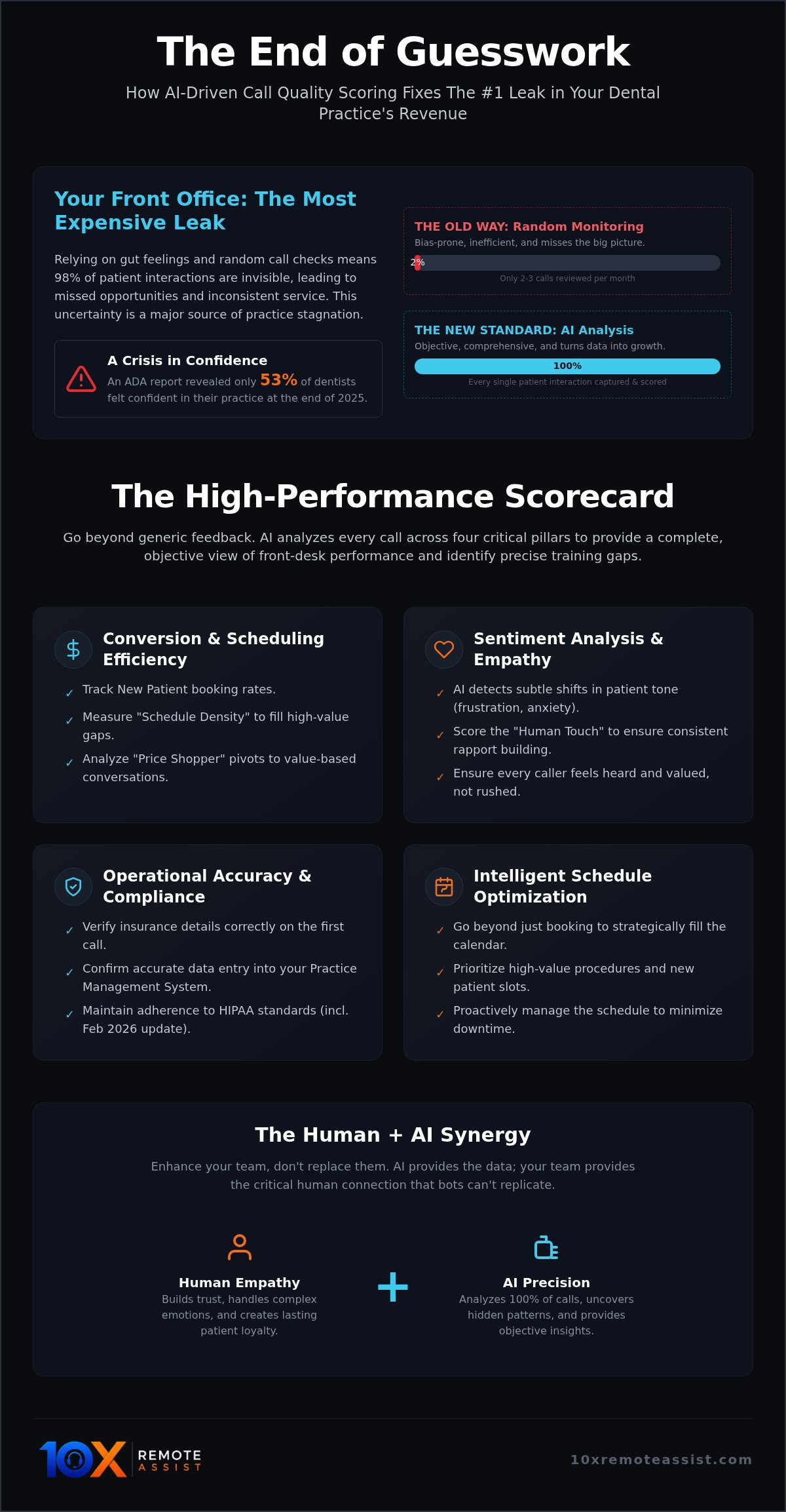
Efficiency is no longer a luxury. It's the baseline for survival. Dental call quality scoring is the objective evaluation of every phone interaction, shifting the focus from anecdotal evidence to hard data. For years, practices relied on "random listening," where a manager might audit two or three calls a month. This approach is a rounding error. It fails to capture the thousands of dollars in lost revenue hiding in the other 98% of conversations. Relying on gut feelings about front-desk performance is a recipe for stagnation. In 2026, the standard has shifted to 100% call coverage through Conversation Intelligence. This technology turns every "hello" into a measurable data point for growth.
From Subjective Feedback to Objective Data
Manual call monitoring is outdated. It's prone to bias, fatigue, and the "halo effect," where one polite interaction masks a week of missed opportunities. Modern systems borrow from a sophisticated Lead scoring methodology to rank interactions based on intent, sentiment, and outcome. AI identifies patterns in patient objections that humans often miss, such as subtle hesitations about pricing or scheduling friction. Instead of waiting for a monthly review, practices now utilize real-time performance tracking. This allows for immediate course correction and professional coaching. Implementing dental call quality scoring ensures your team stays aligned with your practice's core values while removing the guesswork from administration.
The Impact on Patient Experience and Retention
Consistency is the bedrock of trust. When your front desk provides a high-quality first impression every single time, patient loyalty follows naturally. Scoring ensures that every caller receives the same level of empathy and professional rigor, regardless of how busy the office feels. It removes the "luck of the draw" from the patient experience. By identifying exactly where conversations stall, you can refine your protocols to ensure no patient feels like just another number. This data-driven approach fosters a culture of accountability and excellence. Call scoring acts as the bridge between clinical excellence and administrative efficiency.
Key Metrics: What Actually Matters in a Dental Call Scorecard
Data without context is just noise. To drive true practice growth, your dental call quality scoring framework must focus on four distinct pillars: conversion efficiency, clinical empathy, operational accuracy, and schedule optimization. By analyzing specific customer service metrics, practices move beyond generic feedback and start identifying precise training gaps. This is especially critical in areas like insurance verification and complex scheduling where a single mistake can derail a high-value lead. You need to know not just that a call failed, but whether the failure was a lack of product knowledge or a breakdown in rapport.
Compliance isn't optional in 2026. Every scoring system must account for the mandatory HIPAA Notice of Privacy Practices update that went into effect on February 16, 2026. With the pending HIPAA Security Rule updates requiring multi-factor authentication and mandatory encryption for ePHI, your call monitoring must be as secure as your clinical records. Integrating a professional dental remote support team ensures these compliance standards are met while maintaining a high level of performance.
Conversion and Scheduling Efficiency
The primary goal of any front-desk interaction is the booked appointment. We track the percentage of new patient calls that result in a firm commitment on the calendar. However, elite practices look deeper at "Schedule Density." This metric measures how effectively agents fill specific gaps in the hygiene calendar rather than just placing appointments randomly. We also analyze the handling of "price shoppers." A high-performing agent doesn't just quote a fee; they pivot the conversation toward the value of your clinical expertise, turning a skeptical caller into a scheduled patient through structured value-proposition protocols.
Sentiment Analysis and Empathy Scoring
Soft skills are the engine of case acceptance. Modern dental call quality scoring uses AI to detect subtle shifts in patient tone, identifying frustration or anxiety that a human manager might miss during a quick review. We score the "Human Touch" by ensuring agents aren't just reading scripts; they are actively building rapport through active listening and keyword mirroring. High empathy scores directly correlate with higher acceptance rates for high-value treatments like implants or full-mouth restorations. It's about making the patient feel heard before they ever step foot in the operatory.
The Human-AI Synergy: Why Scoring Real People Trumps Bots
Automation is everywhere, but it isn't always the right solution for a clinical environment. Many practices are currently being lured by the low sticker price of AI voice bots. While these tools promise to cut overhead, they often fail to account for the high-trust nature of dentistry. A bot cannot empathize with a patient in acute pain or navigate the labyrinth of a complex insurance breakdown. Patients want to feel cared for, not processed by a logic tree. True efficiency doesn't come from removing the human element; it comes from making that human element more accountable and precise.
The Problem with Pure AI Voice Automation
Patients feel alienated by robotic voices. When someone calls with a dental emergency, they need a reassuring human presence that can adapt to their emotional state. AI often struggles with the nuance of strategies for effective patient communication, which require active listening and keyword mirroring. This is why we explored this topic in our guide, Real Humans vs. Bots: Why Your Patients Hate AI Voices. While a bot might save pennies on the call, the long-term cost of a lost high-value patient is catastrophic for your bottom line. Dentistry is a relationship business, and you can't build a relationship with an algorithm.
Empowering Humans with Machine Intelligence
The true power of modern technology lies in enhancement, not replacement. Professional dental phone answering services use AI to provide instant feedback to human agents during and after every interaction. This eliminates the "Accountability Gap" that plagues traditional front-desk staffing. In most offices, performance is rarely measured objectively, leading to inconsistent patient experiences and unbooked chairs. 10X Remote Assist utilizes dental call quality scoring to maintain elite performance across our remote teams. Every call is analyzed to ensure agents are following proven protocols, mirroring patient sentiment, and maximizing scheduling opportunities.
This synergy creates a culture of continuous improvement. Agents receive data-backed coaching that feels like specialized professional development rather than surveillance. By combining rigorous dental-only training with AI-driven performance tracking, we ensure your practice runs on a high-performance operating system. It's the data of a software company with the execution of a deeply integrated human team. This is how you scale the human touch without sacrificing quality. It allows your practice to remain proactive rather than reactive, bringing order to the chaos of high-volume patient inquiries and ensuring every lead is handled with professional rigor.
Implementing a Quality Scoring System in Your Practice
Transitioning from manual observation to a systematic dental call quality scoring framework requires a methodical integration into your daily operations. It isn't enough to simply record calls. You must establish a workflow where data insights directly inform administrative actions. By analyzing call volume and duration patterns, you can effectively prevent missed calls in your dental office. This proactive approach ensures that your staffing levels match patient demand, eliminating the silent revenue leaks caused by long hold times or abandoned calls. To see how these metrics transform your bottom line, explore our dental remote support solutions.
PMS Integration and Workflow Sync
True operational intelligence happens when your call data flows directly into your Practice Management System (PMS). This creates a 360-degree view of the patient journey, from the first ring to the final treatment plan. When dental call quality scoring is synced with your patient records, you gain the ability to identify which marketing channels are producing high-intent callers versus mere price shoppers. This level of transparency allows for Proactive Workflow Support, where your remote team anticipates patient needs based on historical interaction data. It turns your front office from a reactive cost center into a high-performance engine for growth.
Creating a Feedback Loop for Growth
Data should empower your team, not intimidate them. The most successful practices use call scores to turn low-performing interactions into targeted coaching opportunities rather than disciplinary actions. By focusing on objective metrics, you remove the personality clashes often found in subjective performance reviews. Celebrating high scores and perfect calls boosts front-office morale and fosters a culture of excellence. Providing clear, data-driven feedback significantly reduces the "revolving door" of dental front-desk staff by offering a transparent path to professional mastery. When employees understand exactly how they're being measured, they feel more secure and invested in their roles. This creates a stable, high-functioning environment that patients can sense the moment they hear a friendly, competent voice on the other end of the line.
10X Remote Assist: Where AI Precision Meets Human Empathy
Data is a diagnostic tool, but execution is the cure. While many practices invest in software to monitor their front desk, few have the bandwidth to act on those insights. 10X Remote Assist represents the logical conclusion for practices that want data-backed human support without the management headache. We don't just provide a dashboard; we provide a high-performance team. By utilizing dental call quality scoring within our proprietary operating system, we track agent performance in real-time. This ensures every interaction meets the rigorous standards of your practice culture. It’s time to move beyond simply watching data and start having the work done by experts.
The Managed Service Advantage
Hiring, training, and scoring are full-time jobs. 10X handles the entire administrative lifecycle so you can focus on clinical excellence. Our agents aren't just call handlers; they are a seamless extension of your office. We provide the "Problem-Solved" certainty of administrative excellence through specialized dental-only training. Unlike general virtual assistants, our team understands the nuances of procedure codes and patient psychology. For a deeper look at how this fits into your larger strategy, see The Ultimate Guide to Dental Call Center Services in 2026. This hybrid approach offers the scalability of a call center with the intimacy of a local hire.
Getting Started with Data-Driven Support
Integration is immediate and unobtrusive. Our proprietary OS syncs with your existing CRM and scheduling systems, allowing our agents to step in without disrupting your current flow. Elite practices are increasingly choosing specialized dental virtual assistants over generalists because specialized knowledge translates to higher conversion. We use dental call quality scoring to refine our approach daily, ensuring your hygiene calendar remains dense and your case acceptance stays high. You deserve an operating system that brings order to the chaos of the front desk. It's time to elevate your patient interactions with a team that values precision as much as you do. Scale your practice with 10X Remote Assist and turn every phone call into a measurable engine for growth.
Securing Your Practice’s Growth Engine
The shift toward data-driven administration is no longer a trend; it's a requirement for operational security. You've seen how dental call quality scoring moves your front office from a reactive cost center to a proactive revenue engine. By replacing subjective feedback with objective metrics, you empower your team to achieve professional mastery while ensuring every patient receives a high-trust experience. 10X Remote Assist bridges the gap between clinical excellence and administrative precision. We combine AI-driven quality scoring on 100% of calls with real-time performance tracking via our proprietary OS. You get the intelligence of a tech innovator and the execution of specialized, dental-trained human agents who act as a true extension of your practice.
It's time to stop guessing why chairs are empty and start building a predictable, scalable patient pipeline. Our systems bring order to the chaos of the phone lines, giving you the freedom to focus on what happens in the operatory. Book a Demo to see how 10X Remote Assist uses AI scoring to drive your practice revenue and take the first step toward a more secure, data-backed future. Your practice deserves the clarity of total operational visibility.
Frequently Asked Questions
What is the most important metric in dental call quality scoring?
Conversion rate is the primary driver of practice growth. However, true efficiency is measured by "Schedule Density," which tracks how effectively agents fill specific gaps in the hygiene calendar. A high-performing scorecard evaluates the ratio of new patient inquiries to firm commitments. This metric tells you if your front desk is building clinical value or just quoting prices. Tracking this ensures every marketing dollar results in a chair being filled.
How does AI call scoring differ from manual call monitoring?
The main difference is scale and objectivity. Manual monitoring typically covers less than 2% of calls and is prone to human bias or fatigue. In contrast, dental call quality scoring powered by AI evaluates 100% of interactions with total consistency. It identifies subtle patterns in patient objections and sentiment that a manager might miss during a random audit. This technology turns every conversation into a structured data point for practice growth.
Can call quality scoring help with dental insurance verification?
Yes, it identifies specific breakdowns in how agents handle complex benefit inquiries. Scoring reveals if staff are missing key details or failing to explain out-of-pocket costs clearly to patients. By analyzing these interactions, managers can provide targeted training on insurance protocols. This reduces claim denials and prevents patients from canceling appointments due to financial surprises. It ensures the verification process remains both administratively accurate and patient-centric.
Is call recording and scoring HIPAA compliant for dental offices?
It is compliant as long as you use a secure system and follow proper protocols. Practices must obtain patient consent before recording and ensure all data is encrypted. As of February 2026, updated HIPAA regulations require specific language in your Notice of Privacy Practices regarding the handling of sensitive records. Using a professional service ensures your dental call quality scoring data is stored and managed within a fully HIPAA-compliant framework.
How does call scoring help reduce front-desk staff turnover?
It reduces turnover by replacing subjective criticism with objective, data-backed feedback. Staff often feel frustrated when they don't understand how they are being evaluated. A clear scorecard provides a transparent roadmap for professional development. When employees receive consistent coaching based on facts rather than a manager's mood, they feel more secure in their roles. This culture of accountability and growth fosters long-term loyalty and reduces the administrative revolving door.
Do I need to listen to every call if I have a scoring system?
No, the system does the heavy lifting for you. The scoring engine flags specific calls that fall below your quality threshold or contain high-intent patient objections. Instead of wasting hours on random audits, you only review the interactions that require immediate attention. This allows office managers to focus on high-impact coaching rather than manual surveillance. You gain total visibility into your front-desk performance without the time-consuming busywork.
What is a "good" conversion score for a dental practice?
A "good" score varies by practice type, but elite offices typically target a 70% to 80% conversion rate for new patient inquiries. This means the majority of qualified callers are successfully scheduled on the first interaction. Scoring helps you identify why your current rate might be lower, such as friction in the scheduling process or poor handling of price shoppers. Consistently tracking this metric allows you to benchmark your performance against industry leaders.
How does 10X Remote Assist use call scoring for its agents?
10X Remote Assist utilizes a proprietary operating system to evaluate every agent interaction. While our agents are real, highly trained humans, we use AI-driven scoring to ensure they follow proven dental protocols. This real-time performance tracking allows us to maintain elite standards across our remote teams. It ensures that every patient receives a consistent, high-quality experience that mirrors the clinical excellence of your own internal practice culture.
Frequently Asked Questions
Conversion rate is the primary driver of practice growth. However, true efficiency is measured by "Schedule Density," which tracks how effectively agents fill specific gaps in the hygiene calendar. A high-performing scorecard evaluates the ratio of new patient inquiries to firm commitments. This metric tells you if your front desk is building clinical value or just quoting prices. Tracking this ensures every marketing dollar results in a chair being filled.
The main difference is scale and objectivity. Manual monitoring typically covers less than 2% of calls and is prone to human bias or fatigue. In contrast, dental call quality scoring powered by AI evaluates 100% of interactions with total consistency. It identifies subtle patterns in patient objections and sentiment that a manager might miss during a random audit. This technology turns every conversation into a structured data point for practice growth.
Yes, it identifies specific breakdowns in how agents handle complex benefit inquiries. Scoring reveals if staff are missing key details or failing to explain out-of-pocket costs clearly to patients. By analyzing these interactions, managers can provide targeted training on insurance protocols. This reduces claim denials and prevents patients from canceling appointments due to financial surprises. It ensures the verification process remains both administratively accurate and patient-centric.
It is compliant as long as you use a secure system and follow proper protocols. Practices must obtain patient consent before recording and ensure all data is encrypted. As of February 2026, updated HIPAA regulations require specific language in your Notice of Privacy Practices regarding the handling of sensitive records. Using a professional service ensures your dental call quality scoring data is stored and managed within a fully HIPAA-compliant framework.
It reduces turnover by replacing subjective criticism with objective, data-backed feedback. Staff often feel frustrated when they don't understand how they are being evaluated. A clear scorecard provides a transparent roadmap for professional development. When employees receive consistent coaching based on facts rather than a manager's mood, they feel more secure in their roles. This culture of accountability and growth fosters long-term loyalty and reduces the administrative revolving door.
No, the system does the heavy lifting for you. The scoring engine flags specific calls that fall below your quality threshold or contain high-intent patient objections. Instead of wasting hours on random audits, you only review the interactions that require immediate attention. This allows office managers to focus on high-impact coaching rather than manual surveillance. You gain total visibility into your front-desk performance without the time-consuming busywork.
A "good" score varies by practice type, but elite offices typically target a 70% to 80% conversion rate for new patient inquiries. This means the majority of qualified callers are successfully scheduled on the first interaction. Scoring helps you identify why your current rate might be lower, such as friction in the scheduling process or poor handling of price shoppers. Consistently tracking this metric allows you to benchmark your performance against industry leaders.
10X Remote Assist utilizes a proprietary operating system to evaluate every agent interaction. While our agents are real, highly trained humans, we use AI-driven scoring to ensure they follow proven dental protocols. This real-time performance tracking allows us to maintain elite standards across our remote teams. It ensures that every patient receives a consistent, high-quality experience that mirrors the clinical excellence of your own internal practice culture.
Build the remote team that runs this for you
We recruit, train and manage a dedicated remote team member for your practice.