
What if another round of training isn’t the fix for recurring front-office errors? If your team understands the process but still can’t keep up, the issue may be workload or workflow design, not a lack of skill. That distinction matters when you’re weighing dental front office training alternatives, because the wrong solution can pull staff away from patients without changing the pattern.
It’s frustrating to invest time in coaching and still see inconsistent scheduling, call handling, or follow-up. Repeated mistakes don’t always mean people need more instruction. They may need clearer procedures, a simpler handoff, or more administrative capacity to complete the work reliably.
This article helps you identify the operational cause before choosing a response. We’ll compare targeted coaching, practical documentation, workflow changes, and external administrative support. The goal isn’t to outsource by default. It’s to find the next step that fits the actual constraint: skill, systems, or capacity.
Key Takeaways
- Repeated errors can point to a workflow or capacity problem, not just a knowledge gap. Diagnose the cause before choosing a fix.
- Compare coaching, refreshers, job aids, workflow redesign, and administrative support by the problem each is equipped to address.
- Use relevant baseline indicators to assess whether a change is helping, rather than relying on assumptions or invented benchmarks.
- Test your chosen approach with one defined task, clear ownership, and a planned review before expanding it.
- Explore dental front office training alternatives to determine whether your practice needs stronger skills, better systems, or added administrative capacity.
Dental Front Office Training Alternatives Start with Diagnosing the Problem
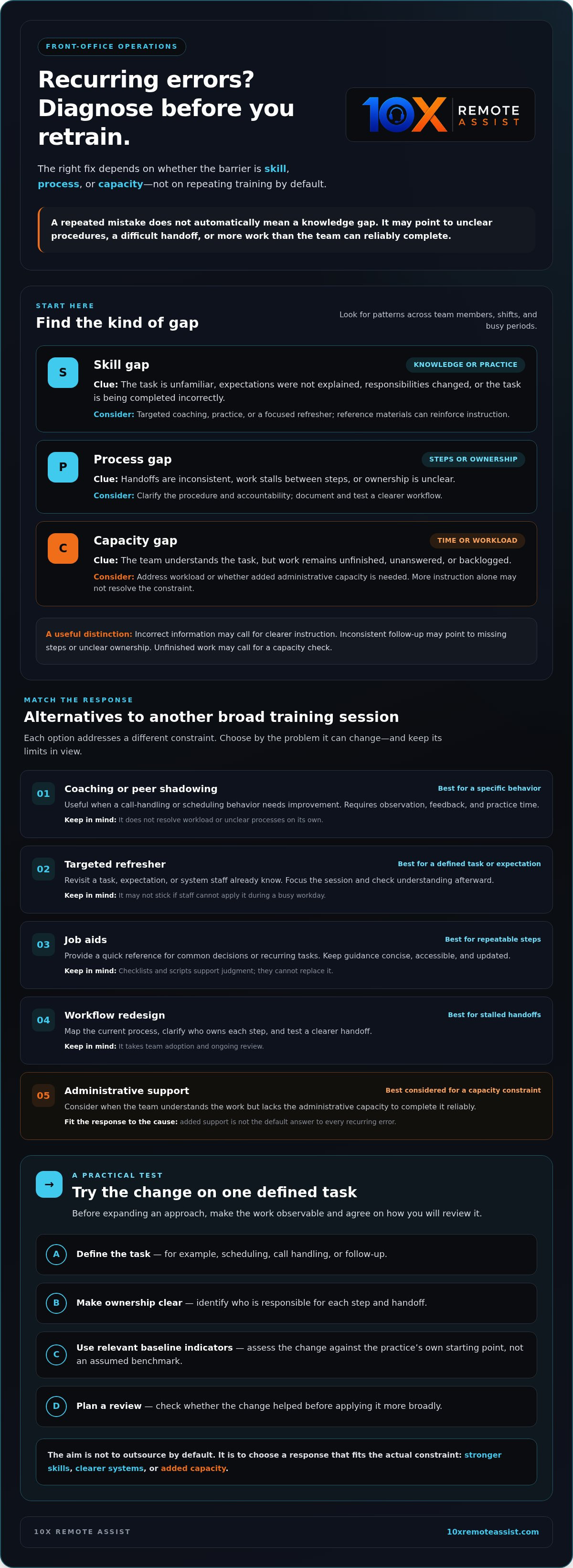
Repeated training can feel like the responsible response when front-office errors continue. But another session may not change the outcome if the real obstacle is unclear ownership, a cumbersome handoff, or too much work for the team to complete. A training alternative addresses the cause of a performance gap instead of repeating instruction by default.
Diagnose the gap before scheduling another training session; the right fix depends on whether the barrier is knowledge, process, or capacity. Dental administration involves coordinated responsibilities, much like the field of health administration. Trace how a task moves through your practice to see whether the issue belongs to an individual or to the system around them.
Is the issue a skill gap, a process gap, or a capacity gap?
Start with patterns, not assumptions about an individual. Incorrect information may indicate that someone needs clearer instruction or practice. Inconsistent handoffs, such as follow-up being handled differently depending on who is working, may point to missing steps or unclear ownership.
Unanswered work and growing backlogs raise a different question: does the team know what to do but lack time to do it? Review the same task across team members, shifts, and busy periods. If the same kind of friction recurs in similar circumstances, it may signal a workflow or capacity constraint rather than an isolated learning need.
- Skill: Is the task unfamiliar or being completed incorrectly?
- Process: Are steps, ownership, or handoffs inconsistent?
- Capacity: Does work remain unfinished even though the team understands it?
When does more training help, and when does it fall short?
Training is a sound response when a team member is learning an unfamiliar system, expectations haven’t been explained, or responsibilities have changed. Targeted coaching and time to practice can build the knowledge needed to perform the task correctly. Reference materials can reinforce the instruction once the employee returns to the daily workflow.
Training has limits. Repeating the same guidance won’t resolve excessive workload, unclear task ownership, or a system that makes the correct steps difficult to follow. In those cases, adjust the process or consider whether more administrative capacity is needed. The best dental front office training alternatives don’t replace learning where it’s needed; they match the response to the actual cause.
Compare Dental Front Office Training Alternatives by the Gap They Address
Once you’ve identified the likely constraint, compare interventions by what they change and what they require from your manager. These dental front office training alternatives aren’t interchangeable: some build individual capability, while others clarify work or add capacity. The right fit depends on the task, the cause of the problem, and the time your practice can commit to implementation.
| Option | Best-fit problem | Manager involvement | Implementation effort | Limitation |
|---|---|---|---|---|
| Coaching or peer shadowing | A specific call-handling or scheduling behavior needs improvement. | High at first; the manager observes, gives feedback, and sets expectations. | Low to moderate; schedule observation and practice time. | Doesn’t resolve workload or unclear processes on its own. |
| Targeted refresher | Staff need to revisit a task, expectation, or system they already know. | Moderate; identify the gap and check understanding afterward. | Low to moderate; focus the session on a defined task. | May not stick if staff can’t apply it during a busy workday. |
| Job aids | Staff need a quick reference for repeatable steps or common decisions. | Moderate; create, review, and update the material. | Low to moderate; keep guidance concise and easy to access. | Checklists and scripts support judgment, but can’t replace it. |
| Workflow redesign | Tasks stall at handoffs or ownership is unclear. | High during mapping and rollout; assign accountability for each step. | Moderate; document the current process, then test a clearer one. | Requires team adoption and ongoing review. |
| Administrative support | The team understands the work but lacks capacity to complete it. | Moderate; define responsibilities, access, and escalation rules. | Moderate; align the support model with practice systems and workflows. | Doesn’t train existing staff or fix a flawed process by itself. |
Coaching, peer shadowing, and targeted refreshers
For a specific behavior, observe the work in context. A manager can listen to a call or review a scheduling interaction, then give focused feedback against clear expectations. Peer shadowing lets team members see how colleagues apply practice-specific procedures. Both options require protected time; without it, coaching becomes another task squeezed between patient needs.
Job aids, standard workflows, and administrative support
Checklists, scripts, and decision guides make key steps easier to recall at the point of work. Workflow redesign goes further by clarifying who owns each task, what happens next, and when an issue should be escalated. For example, a follow-up checklist can specify where to record an open item and who is responsible for the next action.
Administrative support is different: it adds capacity rather than serving as a training product. Human remote agents can support dental administrative work such as phone answering, scheduling, and insurance verification, with responsibilities coordinated around the practice’s systems and processes. To understand how that model may fit your operations, review dental administrative support options.
Coaching builds capability; administrative support adds capacity. One practice may need both, but neither is a universal fix. Choose based on the gap you’ve observed, then account for the manager time, setup, and follow-through each option demands.
How to Choose an Alternative to Dental Front Office Training
Choosing among dental front office training alternatives works best as a simple operating review, not a guess about what the team needs. Define the recurring issue, identify its likely cause, choose an intervention that addresses it, then review whether the pattern changes. Before making a change, record a baseline using measures tied to the issue. You don’t need an outside benchmark; you need a clear picture of how the task works now.
What should a practice assess before changing its approach?
Map recurring duties, such as calls, scheduling, insurance verification, and follow-up, to their current owners. Check whether staff can find written steps and know when and how to escalate exceptions. Then consider when work peaks and which tasks depend on another person or system. A backlog may reflect workload, a bottleneck, or unclear responsibility, so don’t assume that hiring or training alone is the answer.
Match the intervention to your practice’s operating conditions. Consider task volume, the level of patient communication involved, the manager’s ability to coach or oversee a change, and whether added support can work with existing systems. The American Dental Association’s dental team management resources offer broader context for managing and developing a dental team. For a related look at workload and process pressures, see this dental front office burnout guide.
Which indicators can show whether the alternative is working?
Choose measures that reflect the original problem. If work is being left unfinished, track completion patterns. If tasks stall during handoffs, review whether the next owner receives the information needed to act. For call or scheduling concerns, assess relevant call quality and scheduling activity; for follow-up issues, check whether assigned follow-up is completed.
Interpret those signals alongside patient experience and team feedback. A change that improves task completion but creates confusing patient communication may need adjustment. A metric can also shift because workload or demand changed, not because the intervention worked. Review new observations against the baseline and in context, then decide whether to keep, refine, or replace the approach.
- Define: State the recurring issue in observable terms.
- Diagnose: Check for a skill, process, capacity, or system constraint.
- Select: Choose a targeted intervention that fits the task and available oversight.
- Review: Compare relevant indicators and team and patient feedback with the baseline.
Put the Chosen Alternative into Practice Without Losing Consistency
A useful change should be small enough to manage and clear enough to evaluate. Choose one recurring task or workflow for a pilot, such as handling a defined category of calls or completing a follow-up process. Set the owner, document the expected steps, define when an issue should be escalated, and agree on when the team will review the change. This makes it easier to spot friction before expanding the approach.
Build a repeatable process around daily front-office work
Write down the task sequence, the information needed at each step, and the situations that require help from a manager or another team member. Keep the guide easy to find, and assign someone to update it when practice procedures change. Brief check-ins during the pilot can surface unclear instructions, missed handoffs, or overlapping responsibilities while there’s still time to adjust.
Before the pilot begins, walk through how the task moves between people and practice management systems. Confirm who enters or reviews information, how the next person knows a task is ready, and where unresolved items go. Sustainable team practices also matter: see this guide to reducing dental front desk turnover for related operational context.
Integrate additional support without disrupting the patient experience
If the pilot includes remote administrative support, define which calls or tasks the internal and remote team members handle. Confirm appropriate system permissions, privacy procedures, communication standards, and escalation contacts before work begins. Decide how handoffs will be recorded and how staff can identify the current owner of an open task. Clear boundaries help keep patient communication coordinated rather than sending people between disconnected processes.
Plan for the patient experience as well as task completion. Decide how the team should respond when a request falls outside the assigned workflow, and make sure there’s a clear route to the appropriate practice contact. If you’re comparing receptionist support models, this guide to choosing a virtual dental receptionist can help frame the decision.
During the review, ask staff what slowed the work down, check whether documentation matched what happened, and assess the indicators connected to the original issue. Keep the pilot, revise it, or stop it based on what you learn. If added administrative capacity is part of the plan, explore dental remote support as an option for extending your team’s administrative support.
When Dental Administrative Support Is a Better Fit Than More Training
The decision rule is straightforward: address knowledge gaps with learning, and capacity gaps with resourcing. If team members understand the process but can’t consistently complete calls, scheduling, verification, or follow-up within available time, more instruction may not relieve the bottleneck. Administrative support can add capacity, but it isn’t a substitute for training when staff need to learn a task or for workflow changes when ownership is unclear.
Before choosing an external support model, weigh how much control your practice needs over each task, how the work will fit with existing systems, and how patients should experience the interaction. Clarify who owns open tasks, who handles exceptions, and how the provider will share performance information. These criteria help you compare dental front office training alternatives against the operational need, rather than treating added support as a universal fix.
What human-led remote support can take on
10X Remote Assist provides human-led dental administrative support for tasks such as phone answering, patient scheduling, insurance verification, and follow-up. Agents can operate as an extension of the practice team, following agreed workflows and working with existing practice systems. Confirm which systems are supported and how responsibilities will be coordinated before selecting a service.
Calls are recorded and evaluated with AI-driven quality scoring, while the people speaking with patients remain human. That distinction matters if your practice is comparing service models: technology can support performance review without replacing the human interaction. For a broader look at how these arrangements may be structured, read about dental call center services.
Questions to ask before selecting an external support model
Ask practical questions before responsibilities shift. How will the provider work with your practice systems? Which workflows are included, and who owns a task after a call or handoff? What happens when a request falls outside the agreed process? Confirm communication standards, escalation contacts, and how performance information will be shared so your team can review execution and address issues.
- Systems: Which practice tools can the support team access and use?
- Ownership: Who handles each task, open item, and exception?
- Patient experience: How will communication remain consistent with your practice?
- Accountability: What call or workflow information is available for review?
Choose support only when the work and accountability model are clear. If added administrative capacity fits your practice’s needs, explore dental front-office support as a possible next step.
Choose the Next Step That Fits Your Practice
More training isn’t always the answer. First identify whether the recurring issue comes from a knowledge gap, an unclear workflow, or limited administrative capacity. Then choose a focused response, define who owns it, and review how it affects task completion and patient communication.
The right dental front office training alternatives follow that diagnosis. Coaching and job aids can strengthen capability; workflow changes can clarify responsibilities; additional support can help when the team knows the work but lacks time to complete it.
For practices considering added capacity, 10X Remote Assist provides human agents for dental administrative work, not AI voice automation. Calls are recorded and evaluated with AI-driven quality scoring. Support can integrate with existing practice management, CRM, and scheduling systems, though you should confirm compatibility with your specific systems before moving forward.
Explore human-led dental front-office support to see whether it fits your practice’s needs. With a clear diagnosis and a measured next step, you can build more consistent front-office operations without defaulting to another training session.
Frequently Asked Questions
What are alternatives to dental front office training?
Alternatives include targeted coaching, peer shadowing, brief refreshers, job aids, workflow redesign, and additional administrative support. The right option depends on the cause of the recurring problem. Coaching can build a specific skill; a checklist can make steps easier to follow; a clearer handoff can address process confusion. If staff understand the work but lack time to complete it, added capacity may be more appropriate. These dental front office training alternatives address different gaps.
Can workflow changes replace dental front desk training?
Workflow changes can resolve problems caused by unclear task ownership, inconsistent handoffs, or unnecessary steps, but they don’t replace training when staff lack essential knowledge or practice. For example, assigning a clear owner to follow-up may prevent tasks from being missed, while instruction may still be needed to complete the follow-up correctly. Review both the process and the team’s capabilities before deciding which intervention, or combination, fits.
How do I know whether my dental front office needs training or more support?
Look for patterns in the work. Incorrect information or difficulty using a system may point to a knowledge or skill gap. Unfinished tasks, backlogs, or delays despite staff understanding the process may signal limited capacity. Inconsistent handoffs can indicate unclear workflows. Map recurring duties to their owners and review performance across tasks and work periods before attributing a repeated issue to an individual.
Are dental front office job aids effective?
Job aids can help staff follow repeatable steps without relying on memory, especially for tasks with several stages or common exceptions. A concise checklist, script, or decision guide should be easy to find, specific to the practice’s process, and updated when that process changes. Use these tools as in-the-moment references, not substitutes for training, professional judgment, or a clear escalation path when a situation falls outside the guide.
Can a virtual dental receptionist reduce front office workload?
A virtual dental receptionist may reduce some front-office workload by handling defined administrative tasks, such as phone answering and patient scheduling. The effect depends on which responsibilities are included, how calls and open tasks are handed off, and whether the support model fits the practice’s systems and communication standards. Clarify task ownership and escalation procedures first. A virtual receptionist adds administrative capacity; it doesn’t automatically resolve unclear workflows or skill gaps.
How should a dental practice compare front office support options?
Compare options against the specific issue you want to address. Consider task volume, patient communication needs, manager time, system compatibility, and how responsibilities will be monitored. Ask what work is included, who owns exceptions and follow-up, and what performance information is available. You can also run a small pilot around one workflow, record a baseline, and review the results alongside staff feedback and patient experience before expanding the change.
Does 10X Remote Assist provide dental front office training?
No. 10X Remote Assist provides human-led dental administrative support, not front-office training. Its agents can handle phone answering, insurance verification, patient scheduling, and follow-up as an extension of a practice team. Calls are recorded and evaluated with AI-driven quality scoring, while agents remain real people. The service can integrate with existing practice management, CRM, and scheduling systems; confirm compatibility with your specific systems before selecting support.
Frequently Asked Questions
Start with patterns, not assumptions about an individual. Incorrect information may indicate that someone needs clearer instruction or practice. Inconsistent handoffs, such as follow-up being handled differently depending on who is working, may point to missing steps or unclear ownership. Unanswered work and growing backlogs raise a different question: does the team know what to do but lack time to do it? Review the same task across team members, shifts, and busy periods. If the same kind of friction recurs in similar circumstances, it may signal a workflow or capacity constraint rather than an isolated learning need.
Training is a sound response when a team member is learning an unfamiliar system, expectations haven’t been explained, or responsibilities have changed. Targeted coaching and time to practice can build the knowledge needed to perform the task correctly. Reference materials can reinforce the instruction once the employee returns to the daily workflow. Training has limits. Repeating the same guidance won’t resolve excessive workload, unclear task ownership, or a system that makes the correct steps difficult to follow. In those cases, adjust the process or consider whether more administrative capacity is needed. The best dental front office training alternatives don’t replace learning where it’s needed; they match the response to the actual cause. Once you’ve identified the likely constraint, compare interventions by what they change and what they require from your manager. These dental front office training alternatives aren’t interchangeable: some build individual capability, while others clarify work or add capacity. The right fit depends on the task, the cause of the problem, and the time your practice can commit to implementation.
Map recurring duties, such as calls, scheduling, insurance verification, and follow-up, to their current owners. Check whether staff can find written steps and know when and how to escalate exceptions. Then consider when work peaks and which tasks depend on another person or system. A backlog may reflect workload, a bottleneck, or unclear responsibility, so don’t assume that hiring or training alone is the answer. Match the intervention to your practice’s operating conditions. Consider task volume, the level of patient communication involved, the manager’s ability to coach or oversee a change, and whether added support can work with existing systems. The American Dental Association’s dental team management resources offer broader context for managing and developing a dental team. For a related look at workload and process pressures, see this dental front office burnout guide.
Choose measures that reflect the original problem. If work is being left unfinished, track completion patterns. If tasks stall during handoffs, review whether the next owner receives the information needed to act. For call or scheduling concerns, assess relevant call quality and scheduling activity; for follow-up issues, check whether assigned follow-up is completed. Interpret those signals alongside patient experience and team feedback. A change that improves task completion but creates confusing patient communication may need adjustment. A metric can also shift because workload or demand changed, not because the intervention worked. Review new observations against the baseline and in context, then decide whether to keep, refine, or replace the approach. A useful change should be small enough to manage and clear enough to evaluate. Choose one recurring task or workflow for a pilot, such as handling a defined category of calls or completing a follow-up process. Set the owner, document the expected steps, define when an issue should be escalated, and agree on when the team will review the change. This makes it easier to spot friction before expanding the approach.
Alternatives include targeted coaching, peer shadowing, brief refreshers, job aids, workflow redesign, and additional administrative support. The right option depends on the cause of the recurring problem. Coaching can build a specific skill; a checklist can make steps easier to follow; a clearer handoff can address process confusion. If staff understand the work but lack time to complete it, added capacity may be more appropriate. These dental front office training alternatives address different gaps.
Workflow changes can resolve problems caused by unclear task ownership, inconsistent handoffs, or unnecessary steps, but they don’t replace training when staff lack essential knowledge or practice. For example, assigning a clear owner to follow-up may prevent tasks from being missed, while instruction may still be needed to complete the follow-up correctly. Review both the process and the team’s capabilities before deciding which intervention, or combination, fits.
Look for patterns in the work. Incorrect information or difficulty using a system may point to a knowledge or skill gap. Unfinished tasks, backlogs, or delays despite staff understanding the process may signal limited capacity. Inconsistent handoffs can indicate unclear workflows. Map recurring duties to their owners and review performance across tasks and work periods before attributing a repeated issue to an individual.
Job aids can help staff follow repeatable steps without relying on memory, especially for tasks with several stages or common exceptions. A concise checklist, script, or decision guide should be easy to find, specific to the practice’s process, and updated when that process changes. Use these tools as in-the-moment references, not substitutes for training, professional judgment, or a clear escalation path when a situation falls outside the guide.
A virtual dental receptionist may reduce some front-office workload by handling defined administrative tasks, such as phone answering and patient scheduling. The effect depends on which responsibilities are included, how calls and open tasks are handed off, and whether the support model fits the practice’s systems and communication standards. Clarify task ownership and escalation procedures first. A virtual receptionist adds administrative capacity; it doesn’t automatically resolve unclear workflows or skill gaps.
Compare options against the specific issue you want to address. Consider task volume, patient communication needs, manager time, system compatibility, and how responsibilities will be monitored. Ask what work is included, who owns exceptions and follow-up, and what performance information is available. You can also run a small pilot around one workflow, record a baseline, and review the results alongside staff feedback and patient experience before expanding the change.
No. 10X Remote Assist provides human-led dental administrative support, not front-office training. Its agents can handle phone answering, insurance verification, patient scheduling, and follow-up as an extension of a practice team. Calls are recorded and evaluated with AI-driven quality scoring, while agents remain real people. The service can integrate with existing practice management, CRM, and scheduling systems; confirm compatibility with your specific systems before selecting support.
Build the remote team that runs this for you
We recruit, train and manage a dedicated remote team member for your practice.