
Replacing a front desk employee won’t fix a role that overwhelms the next person, too. If you’re trying to reduce dental front desk turnover, start by understanding what the work demands instead of treating staff as interchangeable.
It’s reasonable to review pay when someone leaves. But phone calls, scheduling, insurance questions, billing tasks, and patient conversations can collide throughout the day. Staff may be left to manage competing priorities without enough support. Repeated recruiting and onboarding then add pressure to the people who stay.
This article separates common turnover myths from preventable sources of strain. You’ll learn how to spot workflow problems, clarify responsibilities, and make the role more manageable without sacrificing thoughtful patient communication. We’ll also look at when trained human support for repetitive administrative tasks may complement your in-house team, while keeping workplace improvements at the center of retention.
Key Takeaways
- Separate common turnover assumptions from the specific, fixable pressures shaping your team’s experience.
- Use staff conversations, workflow observation, and available operational data to identify where the role becomes difficult to sustain.
- To reduce dental front desk turnover, clarify task ownership, strengthen onboarding, and make manager check-ins consistent.
- Choose one focused workflow change, assign someone to own it, and set a date to review whether it’s helping.
- Consider trained human remote support for selected administrative work as a complement to your team, not a substitute for addressing workplace issues.
Why Dental Front Desk Turnover Is More Than a Hiring Problem
A vacancy is visible. The conditions that led to it may not be. Turnover describes employees leaving and being replaced, whether departures are voluntary or involuntary. As a broad starting point, employee turnover can be understood as movement into and out of an organization. For a dental practice, the practical question is whether departures are isolated or recurring, and what the work experience might be telling you.
Recruitment fills an open position; retention improves the conditions that help people stay. Hiring may restore coverage, but it won’t necessarily change an overloaded schedule, unclear task ownership, or constant switching between patient needs and back-office work. If the role remains difficult to sustain, a new employee can inherit the same pressures.
What does dental front desk turnover reveal?
One person leaving doesn’t prove the practice has a workplace problem. People move on for different reasons. A repeated pattern, especially across roles or after similar periods of employment, is a signal to investigate rather than assume a single cause.
Vacancies can also create a cycle. Calls still need answers, appointments still need scheduling, and administrative work still needs attention. Remaining staff may absorb those duties while helping onboard a new hire, interrupting patient-facing work and adding pressure to the team. That disruption is operational information, not a reason to blame the person who left or the people still working.
Which pressures can make the role harder to sustain?
The demands vary by practice, but the job can involve frequent interruptions and competing priorities. A staff member may be speaking with a patient, monitoring incoming calls, adjusting the schedule, and trying to finish an administrative task at the same time. Phone volume or insurance-related work may contribute in some offices, but neither is a universal explanation.
Patient conversations can add another layer, particularly when someone is worried, frustrated, or trying to understand next steps. Unclear responsibilities make the mix harder: if no one knows who owns a task, it can be delayed, duplicated, or passed between employees. To reduce dental front desk turnover, examine how work is assigned and experienced before deciding that recruiting more people is the fix. These patterns point to questions worth asking, but they don’t diagnose the cause on their own.
Three Turnover Myths That Keep Dental Front Desks Stuck
Quick fixes can make a staffing problem look solved without changing the daily experience of the role. Before choosing a solution, separate what fills a vacancy from what makes the job sustainable.
Myth: Front desk turnover is solved by hiring faster
Recruiting quickly can restore coverage, but it doesn’t automatically clarify expectations or prevent the same problems from recurring. A new employee may find unclear task ownership, limited onboarding, or competing priorities that haven’t changed since the last person left.
Review the role as it’s actually performed, not just as it appears in a job description. Compare stated responsibilities with recurring tasks, identify what onboarding leaves uncertain, and ask staff where work regularly piles up. Not every departure is preventable, but repeated vacancies are a reason to examine the conditions around the role before restarting the hiring cycle.
Myth: Higher pay alone guarantees retention
Compensation matters, and practices should assess whether pay is competitive for the role. But a raise by itself may not resolve confusing expectations, weak communication, or a workday that feels unmanageable. Retention calls for more than a compensation review. Robert Half’s guidance on effective retention strategies also points to factors such as onboarding, mentorship, and work-life balance. Use those themes to consider the whole employee experience, rather than assuming one tactic fits every practice.
Myth: Technology or outsourcing automatically fixes retention
A tool helps only if it removes meaningful friction. A new system that creates duplicate entry, extra monitoring, or a separate queue can add work instead of easing it. Map the task first, then ask whether the tool simplifies the process, fits existing workflows, and leaves a clear path for staff to handle situations requiring judgment.
AI voice automation and trained human administrative support are different approaches. Neither guarantees better retention. Human support for tasks such as calls, scheduling, or insurance verification may redistribute selected work while keeping patient conversations with people, but management, communication, and role clarity still matter.
Workload relief and employee retention are related, but distinct: easing a task can help, while retention also depends on how the role is managed and supported. If you’re assessing whether human administrative support fits a specific workflow, explore dental front-office support options as one possible complement to internal improvements.
How to Find the Real Causes of Dental Front Desk Turnover
Before changing the role, build a clearer picture of how it works in practice. Call volume, scheduling pressure, or insurance tasks may contribute to strain, but don’t treat any of them as the cause without evidence from your own team. A useful diagnosis combines three views: the work itself, employees’ experiences, and operational signals.
Review the work employees actually perform
Map a typical workday, including recurring tasks, interruptions, handoffs, and busy periods. Compare the responsibilities assigned on paper with what staff say they complete, including work that gets delayed or squeezed between patient interactions.
Look for duplicate data entry, unclear task ownership, and frequent switches between unrelated duties. Don’t assume a particular system is responsible. Follow a process from start to finish and note where information is entered more than once, work waits for a handoff, or employees have to decide who should take the next step. A dental front office burnout solutions guide can offer additional workflow questions to consider.
Ask staff and interpret operational signals carefully
Invite employees to share what makes the role difficult to sustain in private, non-punitive conversations. Ask for specific examples: Which tasks compete most often? Where do responsibilities feel unclear? What gets harder during a busy period? Listen for repeated themes instead of treating one comment as a complete diagnosis.
Then compare those themes with available operational information. Turnover timing, open shifts, call handling, and schedule disruptions can help identify when pressure may be building. They provide context, not proof. For example, a scheduling disruption may reflect several factors, so ask staff what was happening before deciding on a cause.
- Separate observations from interpretations. Record what happened, then note possible explanations to verify.
- Look for patterns. Check whether the same friction appears across shifts, tasks, or employee feedback.
- Identify what managers can change. Clarify ownership, adjust a handoff, or improve training before adding a larger intervention.
This sequence helps you reduce dental front desk turnover by addressing a demonstrated source of strain rather than guessing. If calls emerge as a specific pressure point, review how dental call center services might fit after diagnosis. First define the task, the desired handoff, and how patient communication will remain clear.
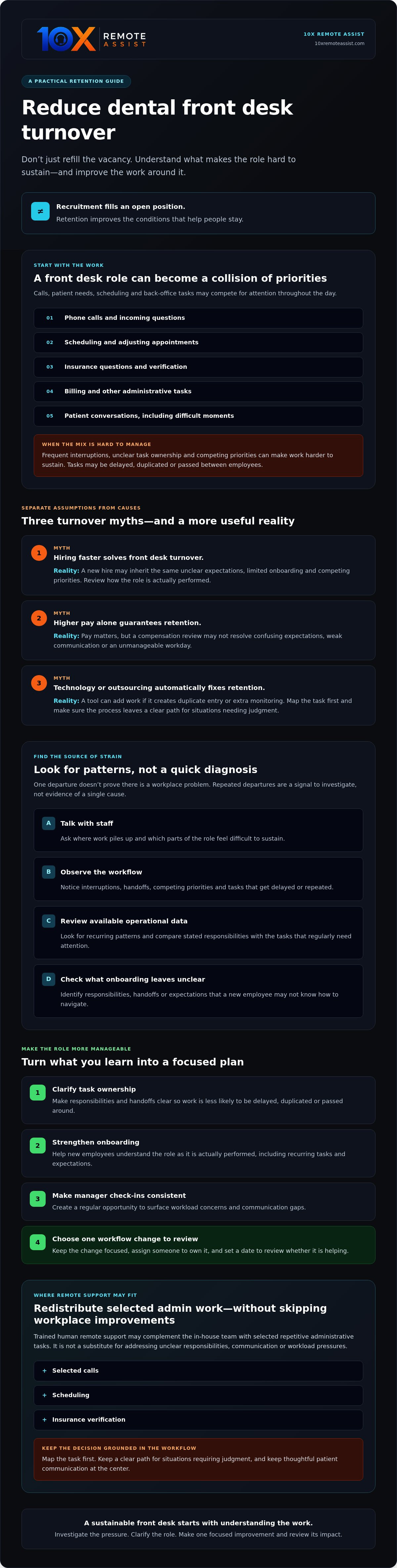
Practical Ways to Reduce Dental Front Desk Turnover
Once you’ve identified where pressure builds, make targeted changes in sequence. Start with the work itself before adding a tool or changing staffing. Clear ownership, realistic priorities, and supportive management can make daily responsibilities easier to understand and manage.
Improve the role before adding another tool
Define who owns incoming calls, scheduling changes, follow-ups, and administrative handoffs. Make the process visible, including what should happen when the assigned person is already helping a patient. During busy periods, clarify which tasks take priority and how employees can request backup without uncertainty or blame.
Then strengthen the foundation for new and current staff. Use a structured onboarding plan, practical job aids for recurring tasks, and regular manager check-ins. Invite questions early, and use feedback conversations to catch unclear instructions before they become daily friction. For ideas on building sustainable skill support, see these dental front office training alternatives.
Reduce avoidable workload without losing the human touch
Review which repetitive calls or administrative tasks could be redistributed, based on the needs you’ve actually observed. Keep sensitive or nuanced patient conversations with the team members best placed to handle them. Before changing systems, check whether a proposed tool fits existing workflows and integrates with the practice’s current setup. A change that creates duplicate entry or extra handoffs may add friction instead of removing it.
Remote human support may be worth evaluating when the practice has clearly defined tasks that can be handled outside the in-house team. Trained agents can support dental front-office work such as phone answering, scheduling, and insurance verification as an extension of practice staff. That model can complement an in-house team, but it won’t replace clear responsibilities or consistent management. This overview of remote dental front office support offers a deeper comparison of support models.
Keep the improvement plan manageable: choose one recurring pressure point, assign an owner, and review whether the change reduces interruptions or makes task ownership clearer. To explore support for defined front-office tasks, review dental remote support options alongside your workflow priorities.
Build a Sustainable Retention Plan for Your Dental Front Desk
Retention isn’t a one-time project. Workflows shift, patient needs change, and a fix that helps one part of the day may reveal pressure elsewhere. A sustainable plan treats improvement as a cycle: listen, make a focused change, review what happened, and adjust. The goal is practical: make the role more manageable without treating employees as replaceable.
Turn findings into a measured improvement cycle
Start with one or two friction points supported by staff feedback and workflow observations. If employees describe confusion around follow-ups, for example, clarify who owns them and what a completed handoff looks like. Avoid changing several processes at once. A focused adjustment makes it easier to understand what staff experience afterward.
Write down three things before you begin: the change, the person responsible for coordinating it, and the date the team will review it. At that review, compare employee feedback with relevant operational signals, such as schedule disruptions or open shifts. These indicators can show whether conditions changed, but they don’t prove that one adjustment caused a particular staffing outcome.
Ask the team what feels clearer, what still creates friction, and whether the new process fits the actual workday. Keep what helps and revise what doesn’t. This steady feedback loop gives managers a grounded way to reduce dental front desk turnover without relying on assumptions or a single broad intervention.
When additional human support may be worth evaluating
Consider added support when routine administrative work consistently crowds out essential front desk duties, even after responsibilities and handoffs have been reviewed. 10X Remote Assist provides trained human agents for dental administrative tasks, including phone answering, scheduling, insurance verification, and follow-up. This support may complement an in-house team, but it isn’t a substitute for clear management, appropriate onboarding, or addressing workplace concerns.
Before evaluating any support arrangement, define which tasks need coverage, how work should pass between the support team and practice staff, and which patient conversations should remain with the in-house team. Confirm system compatibility and task scope for your practice rather than assuming every workflow or platform will be supported. Then include the arrangement in the same review cycle: gather staff feedback and check whether the intended tasks are being handled as planned.
If your practice is assessing whether trained human support fits its front-office needs, explore dental front-office support as one option alongside ongoing workplace improvements.
Make the Front Desk Role More Sustainable
Reducing turnover starts with understanding the work behind each departure. Look for recurring friction, listen to staff, and make practical improvements to role clarity, task ownership, onboarding, and manager communication. Then review the change with your team and adjust based on what they experience.
To reduce dental front desk turnover, focus on building a role people can do well, not simply filling vacancies faster. If routine administrative work continues to crowd out essential duties, trained human support may complement your in-house team. 10X Remote Assist agents handle dental front-office tasks, and calls are recorded and evaluated with AI-driven quality scoring. Confirm task scope and system compatibility for your practice before making a decision.
Explore human dental front-office support as one option alongside your retention plan. Small, consistent changes can create a more manageable front desk and a stronger experience for both employees and patients.
Frequently Asked Questions
What is the most common reason dental front desk employees leave?
There isn’t one reason that applies to every practice. Workload, unclear responsibilities, management support, scheduling pressure, compensation, and workplace culture may all play a role. Rather than assuming a cause, look for recurring themes in private staff conversations and compare them with the way work is assigned and completed. Use what you learn to choose a focused response, since a generic fix may miss the issue employees are actually experiencing.
How can I reduce dental front desk turnover without hiring more staff?
Start by reviewing responsibilities, interruptions, handoffs, and repetitive tasks. Clarify priorities during busy periods, improve onboarding, and schedule consistent check-ins so employees can raise concerns before small frustrations build. Then determine whether a task can be simplified or reassigned appropriately. These steps may make the role more manageable, but they don’t replace a thoughtful review of compensation, workplace culture, or other concerns staff identify.
Does outsourcing dental front desk tasks reduce employee turnover?
Outsourcing may help redistribute selected administrative tasks if those duties are contributing to staff strain, but it doesn’t automatically improve retention. First identify the specific workload issue and decide which tasks are appropriate for outside support. Make responsibilities and patient communication expectations clear across the in-house and remote teams. Continue addressing onboarding, management, compensation, and workplace concerns directly rather than expecting outsourcing alone to resolve them.
Can technology help prevent dental front desk burnout?
Technology can support a smoother workflow when it reduces duplicate work, improves visibility, or fits the systems the practice already uses. A poorly matched tool can create extra steps and add to staff workload. Map the process first, involve front desk employees in evaluating options, and confirm system compatibility, task ownership, and handoffs before making a change. Then ask staff whether the tool is actually reducing friction in daily work.
How do I know whether front desk turnover is caused by workload?
Turnover alone can’t establish that workload is the cause. Review task volume, interruptions, handoffs, open shifts, and peak periods alongside confidential staff feedback. Compare what employees describe with observed workflows, and look for recurring themes rather than relying on one incident. Operational measures can point to questions worth investigating, but they don’t prove why someone left. Avoid assuming the same conditions affect every employee in the same way.
What should a dental front desk retention plan include?
A practical plan should include employee input, clear role expectations, manageable priorities, structured onboarding, and a safe way to raise concerns. Choose one or two workflow changes, assign an owner, and set a date to review progress with the team. Compare staff feedback and relevant operational signals before and after the change. Use what you learn to adjust the plan, rather than treating retention as a one-time project.
Are remote dental assistants a replacement for an in-house front desk team?
Not necessarily. Remote support can complement an in-house team by handling selected administrative tasks, depending on the practice’s needs and workflows. 10X Remote Assist provides trained human agents for dental front-office work, including phone answering, scheduling, insurance verification, and follow-up. Before deciding whether support fits, confirm task scope, system compatibility, responsibilities, and how patient communication will be coordinated. It isn’t a universal replacement or a guaranteed retention solution.
Frequently Asked Questions
One person leaving doesn’t prove the practice has a workplace problem. People move on for different reasons. A repeated pattern, especially across roles or after similar periods of employment, is a signal to investigate rather than assume a single cause. Vacancies can also create a cycle. Calls still need answers, appointments still need scheduling, and administrative work still needs attention. Remaining staff may absorb those duties while helping onboard a new hire, interrupting patient-facing work and adding pressure to the team. That disruption is operational information, not a reason to blame the person who left or the people still working.
The demands vary by practice, but the job can involve frequent interruptions and competing priorities. A staff member may be speaking with a patient, monitoring incoming calls, adjusting the schedule, and trying to finish an administrative task at the same time. Phone volume or insurance-related work may contribute in some offices, but neither is a universal explanation. Patient conversations can add another layer, particularly when someone is worried, frustrated, or trying to understand next steps. Unclear responsibilities make the mix harder: if no one knows who owns a task, it can be delayed, duplicated, or passed between employees. To reduce dental front desk turnover, examine how work is assigned and experienced before deciding that recruiting more people is the fix. These patterns point to questions worth asking, but they don’t diagnose the cause on their own. Quick fixes can make a staffing problem look solved without changing the daily experience of the role. Before choosing a solution, separate what fills a vacancy from what makes the job sustainable.
There isn’t one reason that applies to every practice. Workload, unclear responsibilities, management support, scheduling pressure, compensation, and workplace culture may all play a role. Rather than assuming a cause, look for recurring themes in private staff conversations and compare them with the way work is assigned and completed. Use what you learn to choose a focused response, since a generic fix may miss the issue employees are actually experiencing.
Start by reviewing responsibilities, interruptions, handoffs, and repetitive tasks. Clarify priorities during busy periods, improve onboarding, and schedule consistent check-ins so employees can raise concerns before small frustrations build. Then determine whether a task can be simplified or reassigned appropriately. These steps may make the role more manageable, but they don’t replace a thoughtful review of compensation, workplace culture, or other concerns staff identify.
Outsourcing may help redistribute selected administrative tasks if those duties are contributing to staff strain, but it doesn’t automatically improve retention. First identify the specific workload issue and decide which tasks are appropriate for outside support. Make responsibilities and patient communication expectations clear across the in-house and remote teams. Continue addressing onboarding, management, compensation, and workplace concerns directly rather than expecting outsourcing alone to resolve them.
Technology can support a smoother workflow when it reduces duplicate work, improves visibility, or fits the systems the practice already uses. A poorly matched tool can create extra steps and add to staff workload. Map the process first, involve front desk employees in evaluating options, and confirm system compatibility, task ownership, and handoffs before making a change. Then ask staff whether the tool is actually reducing friction in daily work.
Turnover alone can’t establish that workload is the cause. Review task volume, interruptions, handoffs, open shifts, and peak periods alongside confidential staff feedback. Compare what employees describe with observed workflows, and look for recurring themes rather than relying on one incident. Operational measures can point to questions worth investigating, but they don’t prove why someone left. Avoid assuming the same conditions affect every employee in the same way.
A practical plan should include employee input, clear role expectations, manageable priorities, structured onboarding, and a safe way to raise concerns. Choose one or two workflow changes, assign an owner, and set a date to review progress with the team. Compare staff feedback and relevant operational signals before and after the change. Use what you learn to adjust the plan, rather than treating retention as a one-time project.
Not necessarily. Remote support can complement an in-house team by handling selected administrative tasks, depending on the practice’s needs and workflows. 10X Remote Assist provides trained human agents for dental front-office work, including phone answering, scheduling, insurance verification, and follow-up. Before deciding whether support fits, confirm task scope, system compatibility, responsibilities, and how patient communication will be coordinated. It isn’t a universal replacement or a guaranteed retention solution.
Build the remote team that runs this for you
We recruit, train and manage a dedicated remote team member for your practice.