
Randomly dialing insurance payers isn't a revenue strategy; it's an administrative trap. Systematic dental claim status follow up demands strict aging triggers, decisive investigation, and structured workflows rather than hours of waiting on hold. You already know the friction firsthand. Front-office staff struggle to balance patient checkout with endless carrier phone trees, while valuable revenue quietly slips into 30, 60, and 90-day aging buckets due to vague denial codes and repetitive attachment requests.
Your practice deserves a predictable operational engine instead of constant administrative triage. Discover the exact step-by-step protocol to track, investigate, and resolve aging insurance claims to accelerate your dental practice cash flow. From establishing disciplined daily and weekly aging schedules to deploying proven call scripts and documentation checklists, this guide outlines the exact framework you need to resolve claims on the first contact and protect your practice's bottom line.
Key Takeaways
- Transform reactive billing into a predictable revenue engine by executing a disciplined dental claim status follow up protocol across structured aging buckets.
- Distinguish front-end clearinghouse rejections from payer-level clinical denials using EDI 277 acknowledgment data before dialing an adjuster.
- Streamline payer phone communications with standardized documentation checklists and scripts engineered to bypass IVR loops for first-contact resolution.
- Implement strict daily and weekly aging cadences inside your practice management system to eliminate timely filing write-offs permanently.
- Protect front-desk retention and patient hospitality by delegating complex insurance accounts receivable recovery to dedicated remote billing specialists.
The Mechanics of Dental Claim Aging: Why Passive Follow-Up Stalls Practice Cash Flow
Dental claim status follow up isn't simply checking off a task list; it is the systematic tracking of submitted claims through every stage until final adjudication. Reactive dental practices wait for paper explanations of benefits or patient complaints before taking action. Proactive practices track receivables daily, capturing trapped revenue before it stalls practice cash flow. Understanding how dental insurance works highlights why active tracking matters. Complex payer benefit structures, annual maximums, and policy exclusions create constant procedural hurdles. When claims sit unmonitored, collectibility plunges drastically after 60 and 90 days, turning legitimate clinical production into permanent write-offs. A modern dental billing and claims support system transforms this vulnerability into a disciplined financial engine.
The Anatomy of the Dental Insurance Aging Report
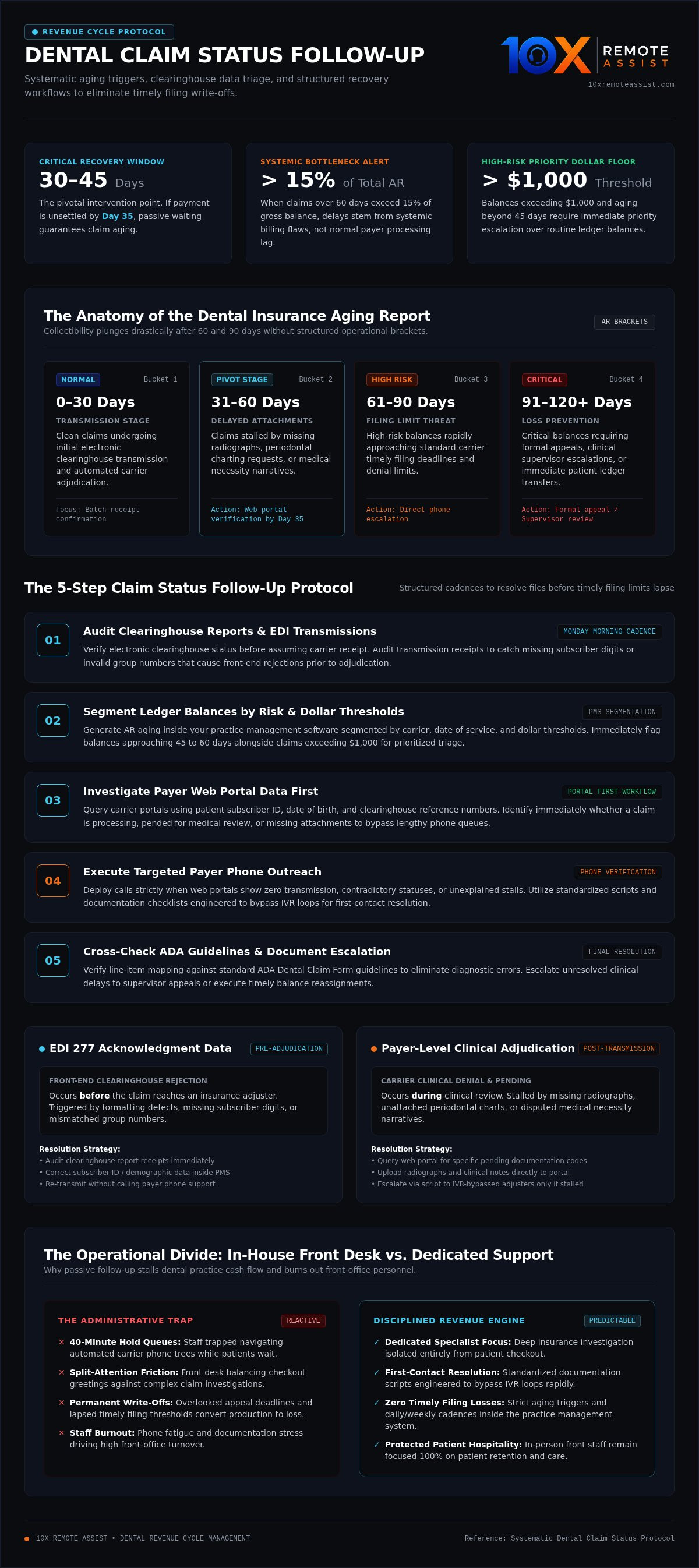
Managing aging accounts receivable requires categorizing outstanding balances across distinct operational brackets:
- 0-30 Days: Clean claims undergoing initial clearinghouse transmission and automated payer adjudication.
- 31-60 Days: Claims delayed by requests for radiographs, periodontal charting, or medical necessity narratives.
- 61-90 Days: High-risk balances approaching standard payer timely filing thresholds.
- 91-120+ Days: Critical claims requiring formal appeals, supervisor escalations, or patient balance transfers.
The 30-to-45-day window represents the critical pivot point for claim recovery. If an insurer hasn't settled payment by day 35, passive waiting guarantees aging. When claims over 60 days exceed 15% of your total accounts receivable, you are not facing normal carrier lag. You are dealing with systemic billing bottlenecks.
The Hidden Cost of Front-Desk Phone Fatigue
On-site receptionists are rarely positioned to execute rigorous dental claim status follow up. Juggling in-person patient greetings, coordinating daily schedules, and navigating forty-minute payer hold queues destroys administrative focus. Split-attention environments inevitably cause documentation errors, forgotten appeal deadlines, and missed filing limits. Over time, persistent administrative friction fuels front-office burnout and drives high staff turnover. Separating deep insurance investigation from front-desk customer service protects both practice revenue and the patient experience.
The 5-Step Dental Claim Status Follow-Up Protocol
Systematic revenue recovery requires strict execution rather than guesswork. When your team follows a standardized dental claim status follow up protocol, unadjudicated claims rarely slip through the cracks. Establishing structured operational cadences ensures that aging files are resolved before timely filing limits permanently wipe out hard-earned production.
Step 1 & Step 2: Audit Clearinghouse Reports and Segment Outstanding Balances
Never rely solely on high-level ledger totals. Every Monday morning, generate your accounts receivable aging report inside your practice management software. Segment these files by carrier, date of service, and dollar balance thresholds.
- Audit Transmission Receipts: Check electronic clearinghouse status before assuming carrier receipt. Missing subscriber digits or invalid group numbers trigger front-end rejections before reaching adjudication.
- Prioritize Risk Buckets: Flag claims approaching 45 to 60 days, alongside balances exceeding $1,000, for immediate intervention.
- Cross-Check the Source: Verify that line items map accurately to the standard ADA Dental Claim Form guidelines to eliminate preventable diagnostic errors.
Step 3 & Step 4: Investigate Portal Data and Execute Targeted Payer Outreach
Query payer web portals first. Entering the patient subscriber ID, date of birth, and clearinghouse reference number instantly exposes whether a claim is processing, pended for medical review, or missing radiographic attachments. Skip the phone queue whenever digital updates provide clear direction.
Pick up the phone only when portal records show zero transmission, contradictory statuses, or unexplained adjudication stalls. Direct calls should target unresolved files where electronic workflows fail, maximizing administrative time on high-friction accounts.
Step 5: Document Ledger Records and Re-Queue for Adjudication
Vague notations sabotage future team efforts. When logging an investigation, record the carrier representative's full name, call reference number, confirmed submission method, and explicit next steps inside the patient ledger. Set an automated task trigger to re-evaluate the account within 10 to 14 business days. If adjudication shifts responsibility to patient co-insurance or deductible balances, issue an updated patient statement immediately.
Practices struggling to maintain this rigorous cadence often partner with specialized dental remote support specialists to run aging reports, investigate rejections, and secure prompt insurance reimbursement.
Clearinghouse Errors vs. Payer Processing: Investigating Claims Pre-Adjudication
A submitted claim is not necessarily an adjudicated claim. Before an insurer reviews clinical documentation, claims pass through electronic clearinghouses designed to scrub file formatting. A clearinghouse rejection happens instantly at the front door; a payer denial arrives weeks later on an Explanation of Benefits (EOB). Effective dental claim status follow up begins by analyzing Electronic Data Interchange (EDI) 277 claim acknowledgment transactions. Pinpointing where a file stalled prevents your team from chasing ghost claims on the phone. Proactively running a thorough dental insurance eligibility verification process stops many of these front-end drops before transmission.
| Friction Point | Clearinghouse Rejection | Payer Adjudication Stall |
|---|---|---|
| Root Cause | Formatting error, invalid NPI, inactive ID | Medical necessity review, missing attachments |
| Visibility | EDI 277 report within 24-48 hours | Payer portal status or formal EOB |
| Resolution | Correct data field and retransmit | Submit clinical narrative or file formal appeal |
Common Electronic Data Interchange (EDI) Drop-Off Points
Electronic claims fail level-one validation when basic demographic fields don't match payer databases. Mismatched National Provider Identifier (NPI) numbers or incorrect dental taxonomy codes immediately freeze electronic batches. Similarly, transposing subscriber birthdates, misspelling maiden names, or using outdated payer IDs triggers silent drop-offs. Always verify that electronic data interchange records mirror the exact structure of the standardized ADA Dental Claim Form before re-queueing transactions.
Handling Attachment Requirements and Clinical Documentation Holds
Payers routinely hold major procedure codes for clinical review. Claims for scaling and root planing, crowns, and surgical extractions stall without supporting diagnostics. When conducting dental claim status follow up, check whether the carrier halted processing for periodontal charting, pre-operative radiographs, or tooth-specific narratives. In dual-coverage cases, payers often pause adjudication while awaiting the primary EOB. Ensuring strict compliance with dental insurance coordination of benefits guidelines eliminates cross-payer bottlenecks and accelerates final payment.
Payer Phone Verification: Essential Data, Call Scripts, and Escalation Standards
Calling an insurance carrier without a clear plan wastes valuable clinic hours. Interactive voice response (IVR) mazes and scripted representative answers are designed to minimize call handling times, not solve your revenue bottlenecks. Systematic dental claim status follow up requires total command of patient documentation before dialing. When your staff controls the conversation with verified transaction records, call times drop from thirty minutes to under five.
The Pre-Call Information Checklist
Never place a follow-up call without these six core data points visible on a single screen:
- Billing Identifiers: Practice Tax ID, billing entity NPI, and treating provider NPI.
- Subscriber Details: Complete policy ID, group number, patient legal name, and exact date of birth.
- Claim Metrics: Date of service, billed total, and clearinghouse Electronic Data Interchange (EDI) trace number.
- Clinical History: Exact CDT procedure codes, tooth numbers, surface markings, and original attachment tracking IDs.
Keep your practice management ledger open alongside previous call notes. Instant access prevents fumbling when a representative asks for validation parameters.
Assertive Payer Dialogue and Supervisor Escalation Protocols
Cut through circular carrier responses with concise, closed-ended questions. If an adjuster claims a file is "still in routine processing," deploy this standard verification script:
"This clean claim was received on [Date] under trace number [ID], which exceeds your standard 30-day adjudication window. Has this file been assigned to an examiner, or is additional clinical documentation required for code [CDT Code]?"
Always demand the representative's direct operator ID, full name, and a unique call reference number before ending the call. If the representative insists on an open-ended "additional 30 to 45 business days for re-review" without identifying a specific medical necessity hold, immediately trigger your escalation protocol:
"Because this balance is nearing timely filing limits without an actionable requirement, I need this escalated to a claims supervisor or senior adjudicator while I am on the line."
To eliminate these grueling hold times entirely, schedule a consultation with 10X Remote Assist to deploy dedicated administrative professionals who master payer negotiations on your behalf.
Scaling Accounts Receivable Recovery: Front-Desk Delegation vs. Dedicated Remote Support
Dental practices reach an operational ceiling when they force front-office teams to double as full-time collections agents. Mastering dental claim status follow up requires undivided attention, forensic auditing, and uninterrupted carrier engagement. When your administrative staff splits focus between waiting room arrivals and complex claims management, revenue recovery stalls. Transforming this bottleneck into a reliable revenue cycle requires assessing the structural limitations of in-house administration against dedicated remote support.
The Limitations of In-House Front-Desk Insurance Management
Front-desk environments are inherently chaotic. Constant patient check-ins, ringing phones, and operatory turnover shatter the concentration needed to investigate complex claim disputes. When a staff member is pulled away from a payer representative, that call ends without resolution, resetting the hold queue clock. Relying on a single internal insurance coordinator exposes the business to massive operational risk. If that employee departs, your aging claims sit completely unattended. Meanwhile, recruiting, onboarding, and training replacement billing personnel drains months of payroll while aging receivables silently accumulate into bad debt.
The 10X Remote Assist Approach: Seamless Practice Integration
Modern dental organizations treat claims management as an integrated operational engine rather than an isolated front-desk chore. By partnering with dedicated remote billing teams, practices decouple patient hospitality from aggressive accounts receivable recovery. 10X Remote Assist bridges this gap with a systematic, hybrid operational model:
- Live Human Billing Specialists: Deploy 100% live human dental administrative professionals who work directly inside your practice management software and clearinghouses, never unassisted voice bots.
- Total Administrative Relief: Eliminate phone hold fatigue by delegating aging follow-up, insurance verification, and documentation resubmissions to dedicated specialists.
- Intelligent Quality Scoring: Maintain absolute operational oversight through synchronized tracking and AI-driven call quality scoring across payer communications.
- Predictable Cash Flow: Prevent claims from deteriorating past 30, 60, and 90 days with daily aging audit cadences.
Protect your staff from burnout while accelerating insurance cash flow. Book a discovery consultation with 10X Remote Assist to optimize your dental claim status follow up and secure your revenue cycle.
Transform Your Revenue Cycle into a Predictable Engine
Unresolved insurance aging shouldn't drain your practice's daily energy or disrupt patient care. Transforming your dental claim status follow up from a chaotic front-desk chore into a disciplined operational standard protects your cash flow and restores team morale. Auditing electronic clearinghouse transmissions early, enforcing structured aging cadences, and deploying assertive payer call checklists stop revenue leakage before claims lapse past timely filing limits.
You don't have to carry this administrative burden alone. Partner with 10X Remote Assist to eliminate aging claims and reclaim your team’s focus. Our live, specialized dental administrative professionals integrate directly into your practice management software, resolving complex aging balances without automated voice bots. Backed by comprehensive AI quality scoring to ensure standard operating procedure compliance, we deliver the operational clarity, consistency, and steady revenue your practice deserves. Take command of your collections today.
Frequently Asked Questions
How often should a dental office follow up on unpaid insurance claims?
Follow up on unpaid claims weekly, running accounts receivable aging reports every Monday to review claims past the 30-day mark. Segment files by aging tier to prioritize high-risk balances. Clean electronic claims should be audited at 14 to 21 days via payer web portals, while claims reaching 45 days require direct phone outreach before timely filing windows close. Consistent weekly cadences prevent aging files from becoming permanent bad debt.
What is the most common reason dental insurance claims are delayed?
Missing attachments and incomplete clinical documentation cause the majority of dental claim delays. Payers routinely hold major restorative or periodontal procedures when submissions lack diagnostic radiographs, periodontal charting, or detailed clinical narratives establishing medical necessity. Demographic errors, including transposed birthdates or incorrect subscriber policy IDs, also trigger silent clearinghouse rejections that stall processing before a payer adjudicator even opens the file.
How do you check dental claim status without waiting on phone hold?
Check status through secure payer web portals and electronic clearinghouse 277 claim acknowledgment reports instead of dialing telephone queues. Most major insurers provide real-time online tracking that indicates whether a claim is processing, pended for medical review, or missing documentation. Verifying portals first resolves routine status checks in seconds, reserving phone calls strictly for complex denials or contradictory records that web systems cannot resolve.
What should you do when a dental insurance claim exceeds timely filing limits?
File a formal written appeal immediately with verified proof of original timely submission. Gather clearinghouse acceptance reports, electronic batch transmission confirmations, and dated transaction logs showing the file was submitted within the carrier's filing window. If the carrier committed an internal processing error or misplaced the original transmission, attach this documentation to an official appeal form and request an immediate supervisory review.
Can an insurance company deny a claim after pre-authorization was approved?
Yes, insurance carriers can deny a claim even after issuing an approved pre-authorization. A pre-authorization is merely an estimate of benefits, not a contractual guarantee of payment. Insurers routinely deny claims if patient eligibility terminates before the date of service, if policy maximums are exhausted by other claims, or if procedure frequency limitations are met. Re-verifying eligibility right before treatment prevents unexpected post-procedure denials.
What information is required when calling a payer for claim status follow-up?
Have your practice Tax ID, billing entity NPI, patient subscriber details, and clearinghouse trace number accessible before calling. Keep the patient ledger open with procedure codes, billed fees, and dates of service displayed on screen. Thorough preparation streamlines your dental claim status follow up, helping your team navigate voice prompts quickly, verify claim records with adjusters, and secure essential call reference numbers without delay.
How does outsourcing claim follow-up work with our existing practice management software?
Remote billing teams connect directly to your existing practice management software through secure, encrypted remote access protocols. Dedicated billing specialists from 10X Remote Assist work inside systems like Dentrix, Eaglesoft, or Open Dental. These live human professionals manage aging ledgers, correct clearinghouse errors, and conduct rigorous dental claim status follow up, logging detailed reference notes directly into patient records without disrupting your daily front-desk operations.
Frequently Asked Questions
Follow up on unpaid claims weekly, running accounts receivable aging reports every Monday to review claims past the 30-day mark. Segment files by aging tier to prioritize high-risk balances. Clean electronic claims should be audited at 14 to 21 days via payer web portals, while claims reaching 45 days require direct phone outreach before timely filing windows close. Consistent weekly cadences prevent aging files from becoming permanent bad debt.
Missing attachments and incomplete clinical documentation cause the majority of dental claim delays. Payers routinely hold major restorative or periodontal procedures when submissions lack diagnostic radiographs, periodontal charting, or detailed clinical narratives establishing medical necessity. Demographic errors, including transposed birthdates or incorrect subscriber policy IDs, also trigger silent clearinghouse rejections that stall processing before a payer adjudicator even opens the file.
Check status through secure payer web portals and electronic clearinghouse 277 claim acknowledgment reports instead of dialing telephone queues. Most major insurers provide real-time online tracking that indicates whether a claim is processing, pended for medical review, or missing documentation. Verifying portals first resolves routine status checks in seconds, reserving phone calls strictly for complex denials or contradictory records that web systems cannot resolve.
File a formal written appeal immediately with verified proof of original timely submission. Gather clearinghouse acceptance reports, electronic batch transmission confirmations, and dated transaction logs showing the file was submitted within the carrier's filing window. If the carrier committed an internal processing error or misplaced the original transmission, attach this documentation to an official appeal form and request an immediate supervisory review.
Yes, insurance carriers can deny a claim even after issuing an approved pre-authorization. A pre-authorization is merely an estimate of benefits, not a contractual guarantee of payment. Insurers routinely deny claims if patient eligibility terminates before the date of service, if policy maximums are exhausted by other claims, or if procedure frequency limitations are met. Re-verifying eligibility right before treatment prevents unexpected post-procedure denials.
Have your practice Tax ID, billing entity NPI, patient subscriber details, and clearinghouse trace number accessible before calling. Keep the patient ledger open with procedure codes, billed fees, and dates of service displayed on screen. Thorough preparation streamlines your dental claim status follow up, helping your team navigate voice prompts quickly, verify claim records with adjusters, and secure essential call reference numbers without delay.
Remote billing teams connect directly to your existing practice management software through secure, encrypted remote access protocols. Dedicated billing specialists from 10X Remote Assist work inside systems like Dentrix, Eaglesoft, or Open Dental. These live human professionals manage aging ledgers, correct clearinghouse errors, and conduct rigorous dental claim status follow up, logging detailed reference notes directly into patient records without disrupting your daily front-desk operations.
Build the remote team that runs this for you
We recruit, train and manage a dedicated remote team member for your practice.