
Your front desk is the heartbeat of your practice, not a call center. Yet, most teams spend hours tethered to phones, waiting for payers to confirm basic coverage details. This manual grind is more than an inconvenience; it's a primary driver of administrative turnover and billing errors. You shouldn't have to choose between patient care and paperwork. Integrating a professional dental insurance breakdown service transforms this bottleneck into a streamlined asset. It's about moving from reactive guesswork to proactive operational certainty.
We understand the frustration of delivering an unexpected bill to a loyal patient because of a missed frequency limitation. It erodes trust and stalls your growth. This guide explores how to master verification complexities and achieve 100% accurate cost estimates. We'll examine the shift from traditional, fragmented data collection to a systematic approach that eliminates surprises. You'll discover how to reclaim your team's time, reduce claim denials, and build a front-office culture that actually lasts. It's time to replace hold music with high-performance results.
Key Takeaways
- Shift your perspective from simple eligibility checks to comprehensive insurance reports that align clinical plans with financial clarity.
- Identify the essential components of a deep-dive breakdown, including granular frequency limits and specific procedure exclusions that prevent billing surprises.
- Discover how a dedicated dental insurance breakdown service preserves your team’s mental bandwidth and stops the cycle of front-office turnover.
- Evaluate the operational trade-offs between in-house staffing and managed human-led verification to find the most scalable model for your practice.
- Master a verification workflow that integrates human intelligence directly into your existing PMS to ensure 100% accurate patient cost estimates.
What is a Dental Insurance Breakdown Service?
A dental insurance breakdown service is a specialized operational system designed to translate complex policy data into actionable clinical intelligence. It goes beyond confirming a patient’s name and active status. It provides a granular map of what a plan actually covers, from specific procedure codes to obscure frequency limitations. In 2026, this service acts as the vital bridge between the treatment chair and the front office. It ensures that clinical recommendations are never derailed by financial ambiguity. It's not a data-entry task; it's a high-performance operating system for your practice's revenue cycle.
Traditional offices often settle for "eligibility pings" through their practice management software. These automated checks are frequently incomplete. They confirm a patient has insurance but fail to mention that a crown isn't covered for another three years due to a replacement clause. A professional breakdown service utilizes human expertise to verify these nuances before the patient ever sits in the chair. This proactive approach eliminates the "billing surprise" that erodes patient trust and creates a culture of total operational security.
Eligibility vs. Full Breakdown: Knowing the Difference
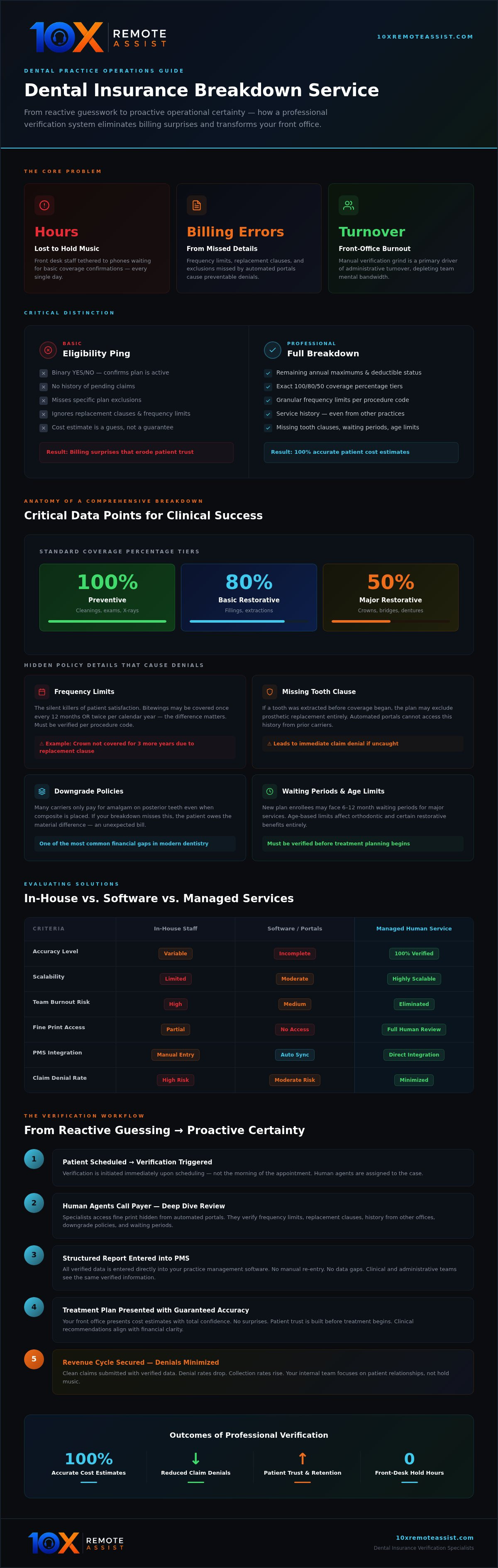
Confusion between these two terms is a primary cause of administrative friction. The difference is the depth of the data. Eligibility is a binary "yes" or "no" that confirms a plan is active today. It doesn't account for history, pending claims, or specific plan exclusions. In contrast, a full breakdown is a deep-dive investigation. It identifies remaining annual maximums, specific deductible statuses, and the exact percentage tiers for different procedure categories.
Relying solely on a basic eligibility ping is a leading cause of preventing dental claim denials failures. Without knowing if a patient had a prophy four months ago at a different office, your cost estimate is a guess, not a guarantee. A comprehensive breakdown provides the "why" behind the coverage, giving your team the confidence to present treatment plans with 100% accuracy.
The Evolution of Verification in 2026
The dental landscape has shifted toward extreme complexity. PPO plans are more restrictive than ever, often hiding limitations in fine print that automated portals can't access. Front desk staff are frequently stuck on hold for hours, leading to burnout and high turnover. This has triggered a move from "in-house only" models to hybrid remote support. Practices now leverage specialized human agents who act as a living extension of their team.
This evolution is about efficiency and accountability. Mastering dental eligibility verification is no longer a back-office chore; it's the foundation of sustainable practice growth. Modern practices require a system that is proactive rather than reactive. By delegating the heavy lifting of insurance verification to a dedicated service, your internal team can focus on what they do best: building relationships and providing elite patient care.
Anatomy of a Comprehensive Insurance Breakdown
A comprehensive report is the clinical roadmap of a profitable treatment plan. It goes far beyond the surface level data found on a standard portal. To provide a truly accurate estimate, your team needs a deep dive into the specific DNA of a patient's policy. This requires capturing foundational data points like annual maximums, deductibles, and the standard 100/80/50 percentage tiers. However, the real value lies in the granular details that automated systems often overlook. A high-quality dental insurance breakdown service identifies the specific "why" behind the numbers, ensuring your front office never has to guess at a patient's responsibility.
Frequency limits are the silent killers of patient satisfaction. It isn't enough to know that a plan covers bitewings; you must know if they're allowed once every twelve months or twice a calendar year. History tracking is equally vital. A professional breakdown should identify when the last major service was performed, even if that work happened at a different practice. This level of diligence uncovers missing tooth clauses, waiting periods, and age limits that would otherwise lead to immediate claim denials. By capturing these details upfront, you move from reactive billing to proactive financial coordination.
Critical Data Points for Clinical Success
Downgrade policies represent one of the most common financial gaps in modern dentistry. Many carriers only pay for amalgam restorations on posterior teeth, even if you only place composite. If your breakdown doesn't account for this resin limitation, your out-of-pocket estimate will be off by dozens, if not hundreds, of dollars. Specialized insurance verification ensures these nuances are documented before the patient arrives. Other critical data points include:
- Orthodontic lifetime maximums and specific age restrictions for dependents.
- Posterior resin limitations and how they affect restorative estimates.
- Specific surgical vs. non-surgical periodontal coverage requirements.
Understanding Plan Exclusions and Limitations
The "Lease Network" trap is a significant operational hurdle in 2026. Many practices struggle to identify which fee schedule actually applies when a carrier leases its network to a third party. A robust breakdown identifies the primary payer and the corresponding fee schedule with absolute certainty. This prevents the practice from over-collecting or under-billing, both of which damage the patient relationship.
Exclusions are rarely "standard," even on "standard" plans. Some policies may exclude specific high-value procedures like implants or adult orthodontics entirely. Others may have non-covered service rules that vary significantly by state. Utilizing a dedicated dental insurance breakdown service allows your practice to identify these "unwritten" carrier rules that only a human expert can catch during a direct verification call. This level of detail provides the operational security your front office needs to maintain a high-performance workflow.
The Operational Impact of Poor Insurance Data
High turnover at the front desk isn't just a staffing issue; it's a symptom of a broken workflow. When your team relies on a manual or incomplete dental insurance breakdown service, they are essentially guessing with your practice's revenue. This uncertainty creates a "revolving door" of administrative talent. Staff members quickly become overwhelmed by the constant friction of correcting errors. They aren't just filing papers; they are managing the fallout of inaccurate expectations. This leads to a culture of reactive firefighting rather than proactive growth.
The financial consequences of poor data are immediate and measurable. Inaccurate breakdowns lead to increased AR days and a ballooning list of small patient balances that are expensive to chase. Collecting a $20 balance often costs more in labor and postage than the value of the payment itself. Beyond the balance sheet, there is the cost of damaged reputation. One "wrong estimate" can lead to a negative 1-star review that lives on your profile forever. Patients don't care about carrier hold times; they care about the promise you made at the treatment coordinator's desk.
Claim Denials and the Revenue Cycle
Verification errors are the leading cause of denied claims in the modern dental practice. A comprehensive insurance breakdown acts as the primary firewall against revenue leakage by ensuring every procedure code is pre-verified against specific plan limitations. When a breakdown is missing frequency data or history, the claim is doomed before it's even sent. The hidden labor cost of "re-working" a denied claim is staggering. It requires double the effort for the same reimbursement, effectively cutting your administrative profit margins in half. Clean claims start with clean data.
Front Desk Burnout: The Human Cost
There is a significant psychological toll associated with administrative overload. Spending 4+ hours a day on hold with payers is an inefficient use of a skilled treatment coordinator’s time. It prevents them from closing cases and engaging with the patients standing right in front of them. This constant state of being "behind" leads to the 2026 trend of front-office burnout. Your best employees want to contribute to the practice's success, not fight with insurance portals all afternoon.
Strategically outsourcing dental insurance verification is more than an operational upgrade; it's a retention strategy. By removing the most tedious, high-friction task from the daily to-do list, you allow your team to focus on high-value patient interactions. This shift in responsibility restores order to the front office. It transforms the work environment from a high-stress call center into a professional, patient-centric hub. When you protect your team's time, you protect your practice's future.
Evaluating Solutions: In-House vs. Software vs. Managed Services
Selecting the right verification model is a strategic pivot point for your practice. It defines your operational resilience. Traditional in-house models offer high control, but they carry significant overhead. You aren't just paying a salary; you are paying for benefits, training, and the high cost of turnover. If your lead coordinator leaves, your revenue cycle stalls. Software-only solutions promise speed and low entry costs. However, they often deliver incomplete or stale data. They can't call a payer to clarify a specific plan nuance. A professional dental insurance breakdown service provides the "best of both worlds" approach. It offers the accuracy of human intelligence with the scalability of a modern tech platform.
The choice between these models often comes down to the level of certainty you require. In-house staff are frequently distracted by the immediate needs of patients in the office. Software is limited by what the carrier chooses to show on a portal. Managed human services act as a high-performance operating system for your business. They provide a living, active presence that ensures your data is always current and clinically relevant. This model moves your practice from a reactive state of "fixing errors" to a proactive state of "delivering care."
The Limitations of Pure AI and Automation
AI cannot navigate complex IVR systems. It cannot ask the critical follow-up questions required to uncover hidden frequency limits. Automated portals rely on data scraping, which is notoriously fragile. When a carrier updates their interface, automated tools often break or return "not found" results. This leads to data gaps that your team must eventually fill anyway. Beyond the technical failures, there is the trust factor. Patients prefer knowing a human expert has triple-checked their benefits. They want professional rigor, not an algorithmic guess. Accuracy in 2026 requires a human touch that technology alone cannot replicate.
The ROI of Managed Breakdown Services
Managed services offer a clear, measurable ROI that traditional staffing cannot match. You pay for completed tasks rather than hours spent on hold. This transition from fixed to variable costs protects your margins during slower months. The efficiency gains are immediate. Having your full schedule verified 48 to 72 hours in advance allows your treatment coordinators to prepare with absolute confidence. They can present cases knowing the numbers are 100% accurate. For DSOs and multi-location practices, this model provides instant scalability. You can add new locations without the burden of hiring and training additional administrative headcount. Ready to optimize your workflow? Explore our dental remote support solutions to see how human expertise outperforms software alone.
The 10X Advantage: Seamless Insurance Breakdown Integration
10X Remote Assist operates as a living extension of your front office. We don't just provide a service; we integrate a high-performance operating system into your practice. This isn't about handing off tasks to an anonymous third party. It's about expanding your internal culture with specialized human talent that understands the intricate nuances of dental terminology. Our agents act as a proactive force, identifying potential billing friction before it impacts your patient experience. By utilizing a dedicated dental insurance breakdown service, you move from administrative chaos to a state of total operational security.
Seamless integration is the foundation of our workflow. Our team works directly within your existing Practice Management System (PMS), including Dentrix, Eaglesoft, and Open Dental. There is no new software for your staff to master and no fragmented data silos to manage. We enter the verified data exactly where you need it, ensuring your treatment coordinators have real-time access to accurate coverage details. This deeply integrated approach eliminates the need for manual data entry by your in-office team, effectively solving the problem of front-office burnout at its source.
Accuracy is maintained through a rigorous, multi-layered quality control process. We've mastered the "Human + AI" model to ensure professional rigor. While real human agents conduct every verification call, our proprietary system records and AI-scores every interaction for accuracy and performance. This ensures that the data delivered to your practice meets the highest standards of clinical and financial reliability. We reject the impersonal nature of total automation, favoring a bespoke model where technology supports, rather than replaces, human intelligence.
Real-Time Performance Tracking
Transparency is a core value of our partnership. Our proprietary operating system provides your practice with a clear window into every verification request. You can track the status of breakdowns in real-time, seeing exactly when a policy has been triple-checked. This proactive workflow ensures that your schedule is verified 48 to 72 hours before the patient arrives. The benefit of AI-driven quality scoring means we are constantly refining our processes, delivering a level of consistency that is impossible to achieve with a rotating in-house staff.
Customizable Administrative Support
Every practice has unique operational requirements. We offer flexible models that scale with your growth, from per-task fees for smaller offices to dedicated remote teams for large DSOs. Our solutions are designed to be modular. For example, our dental call center services perfectly complement the breakdown process by handling patient inquiries and scheduling. This creates a unified administrative front that protects your team's time. Integrating 10X into your workflow is a logical step toward professional excellence. It's time to stop fighting with insurance companies and start focusing on elite patient care.
Build a High-Performance Administrative Engine
Operational excellence in 2026 requires a shift from reactive troubleshooting to proactive precision. You've seen how deep-dive data prevents billing surprises and how human expertise outperforms fragile automation. By eliminating the administrative burden of manual verification, you protect your team from burnout and your practice from revenue leakage. Integrating a professional dental insurance breakdown service is the logical next step for any growth-oriented office. It's about building a foundation of total operational security.
10X Remote Assist provides this security through real human experts who understand your clinical needs. Our system features direct PMS integration and AI-driven quality scoring to ensure 100% accountability for every verification. We never use AI voices; we prioritize professional rigor and human intelligence. Schedule your demo with 10X Remote Assist today to see how we act as a high-performance extension of your team. You deserve a front office that focuses on patients instead of insurance portals. Let's build a more efficient future together.
Frequently Asked Questions
What is included in a standard dental insurance breakdown?
A standard breakdown covers the foundational data needed for accurate billing. It includes annual maximums, deductibles, and the specific percentage tiers for preventive, basic, and major services. It also identifies frequency limits for prophys and radiographs, history for major restorations, and specific plan clauses like waiting periods or missing tooth exclusions. This level of detail ensures your treatment coordinator presents plans with absolute financial certainty.
How long does a manual insurance breakdown typically take?
A manual breakdown generally takes between 20 and 45 minutes per patient. This time varies based on carrier hold times and the complexity of the plan's specific limitations. Front office staff often lose hours each day navigating automated IVR systems and waiting for payer representatives. This significant administrative drain is a primary driver of staff burnout and prevents your team from focusing on patient relationships.
Can a dental insurance breakdown service integrate with my current software?
Yes, a professional dental insurance breakdown service like 10X Remote Assist integrates directly with major Practice Management Systems including Dentrix, Eaglesoft, and Open Dental. Our human agents enter verified data directly into your software in real time. This eliminates the need for manual data entry by your in-office team. It ensures a seamless, proactive workflow without the burden of learning new, fragmented software platforms.
Is it better to use an automated verification tool or a human service?
A human service is superior because real experts can navigate complex IVR systems and ask critical follow-up questions that automated tools miss. While automation is fast, it often returns incomplete or stale data from carrier portals. Human agents can verify unwritten carrier rules and clarify specific plan exclusions. This provides a level of professional rigor and accountability that pure AI cannot replicate for your practice.
How far in advance should insurance breakdowns be completed?
Breakdowns should ideally be completed 48 to 72 hours before the patient’s scheduled appointment. This proactive window allows your team to prepare 100% accurate cost estimates and resolve any coverage discrepancies before the patient arrives. Verifying the schedule in advance reduces check-in friction and ensures a smoother, more professional patient experience. It moves your office from a reactive state into a high-performance operating mode.
What happens if the insurance breakdown is incorrect?
Incorrect breakdowns lead to inaccurate patient estimates, which can result in unexpected out-of-pocket costs and damaged trust. This often triggers negative reviews and costly administrative rework. By using a service with AI-driven quality scoring and recorded calls, you gain total accountability. If a discrepancy occurs, you have a clear audit trail to identify the error and resolve it with the carrier or the patient immediately.
Does a breakdown service handle secondary insurance?
Yes, a comprehensive service verifies both primary and secondary insurance to ensure accurate coordination of benefits. Handling secondary insurance requires a deep understanding of non-duplication clauses and specific state regulations regarding payment order. Our human agents are trained to navigate these complexities. They ensure your billing department has the precise data needed to submit clean claims and avoid the hidden costs of claim rework.
How much does a professional dental insurance breakdown service cost?
Pricing typically follows a per-task administrative fee model or a monthly managed service subscription fee. Instead of the high fixed costs associated with in-house staffing and benefits, you pay for the specific volume of verifications your practice requires. This variable cost model protects your profit margins while providing access to a high-performance remote team. It is a scalable solution that grows alongside your practice’s clinical output.
Frequently Asked Questions
A standard breakdown covers the foundational data needed for accurate billing. It includes annual maximums, deductibles, and the specific percentage tiers for preventive, basic, and major services. It also identifies frequency limits for prophys and radiographs, history for major restorations, and specific plan clauses like waiting periods or missing tooth exclusions. This level of detail ensures your treatment coordinator presents plans with absolute financial certainty.
A manual breakdown generally takes between 20 and 45 minutes per patient. This time varies based on carrier hold times and the complexity of the plan's specific limitations. Front office staff often lose hours each day navigating automated IVR systems and waiting for payer representatives. This significant administrative drain is a primary driver of staff burnout and prevents your team from focusing on patient relationships.
Yes, a professional dental insurance breakdown service like 10X Remote Assist integrates directly with major Practice Management Systems including Dentrix, Eaglesoft, and Open Dental. Our human agents enter verified data directly into your software in real time. This eliminates the need for manual data entry by your in-office team. It ensures a seamless, proactive workflow without the burden of learning new, fragmented software platforms.
A human service is superior because real experts can navigate complex IVR systems and ask critical follow-up questions that automated tools miss. While automation is fast, it often returns incomplete or stale data from carrier portals. Human agents can verify unwritten carrier rules and clarify specific plan exclusions. This provides a level of professional rigor and accountability that pure AI cannot replicate for your practice.
Breakdowns should ideally be completed 48 to 72 hours before the patient’s scheduled appointment. This proactive window allows your team to prepare 100% accurate cost estimates and resolve any coverage discrepancies before the patient arrives. Verifying the schedule in advance reduces check-in friction and ensures a smoother, more professional patient experience. It moves your office from a reactive state into a high-performance operating mode.
Incorrect breakdowns lead to inaccurate patient estimates, which can result in unexpected out-of-pocket costs and damaged trust. This often triggers negative reviews and costly administrative rework. By using a service with AI-driven quality scoring and recorded calls, you gain total accountability. If a discrepancy occurs, you have a clear audit trail to identify the error and resolve it with the carrier or the patient immediately.
Yes, a comprehensive service verifies both primary and secondary insurance to ensure accurate coordination of benefits. Handling secondary insurance requires a deep understanding of non-duplication clauses and specific state regulations regarding payment order. Our human agents are trained to navigate these complexities. They ensure your billing department has the precise data needed to submit clean claims and avoid the hidden costs of claim rework.
Pricing typically follows a per-task administrative fee model or a monthly managed service subscription fee. Instead of the high fixed costs associated with in-house staffing and benefits, you pay for the specific volume of verifications your practice requires. This variable cost model protects your profit margins while providing access to a high-performance remote team. It is a scalable solution that grows alongside your practice’s clinical output.
Build the remote team that runs this for you
We recruit, train and manage a dedicated remote team member for your practice.